Commercial Door and Lock Service for San Diego Biotech and Lab Facilities
Commercial Lock & Door Co. handles doors, locks, and access control in San Diego County biotech and lab buildings: compartmentalized keying, cold room doors, fire rated corridors, and complete access control systems, or just the strikes, closers, and exit devices under your existing platform.
A lab building is never one building
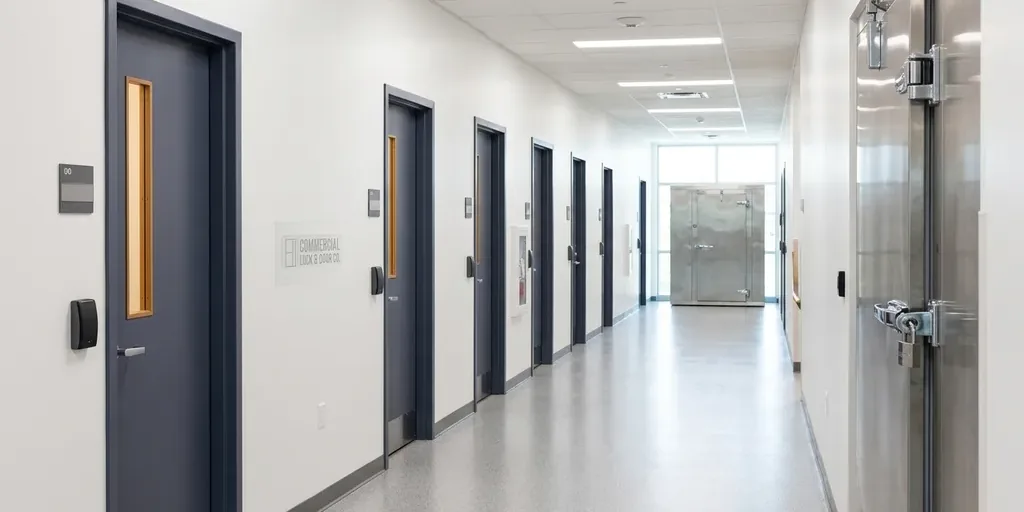
A lab building is never one building. It is an office suite, a wet lab, a cold room, a reagent store, a shipping dock, and a corridor that has to hold a fire rating, all sharing the same set of door openings.
The hardware on those openings gets treated as an afterthought until a door stops latching and a reader starts throwing faults. We work that problem across San Diego County, from Torrey Pines and Sorrento Valley to UTC and Campus Point.
Commercial Lock & Door is a door contractor, commercial locksmith, and access control installer. Whatever runs the readers, the doors, frames, strikes, closers, and exit devices underneath have to work, and if you have no electronics at all, mechanical key control designed properly will carry a lab building further than most people expect.
We work the way facilities and property management teams buy: a walk, a written scope with a hardware schedule, a purchase order, and scheduling that respects a running experiment.
What actually goes wrong in these buildings
Most of the calls we get from Torrey Pines, Sorrento Valley, and UTC lab buildings trace back to a hinge, a closer, or a keying chart nobody planned.
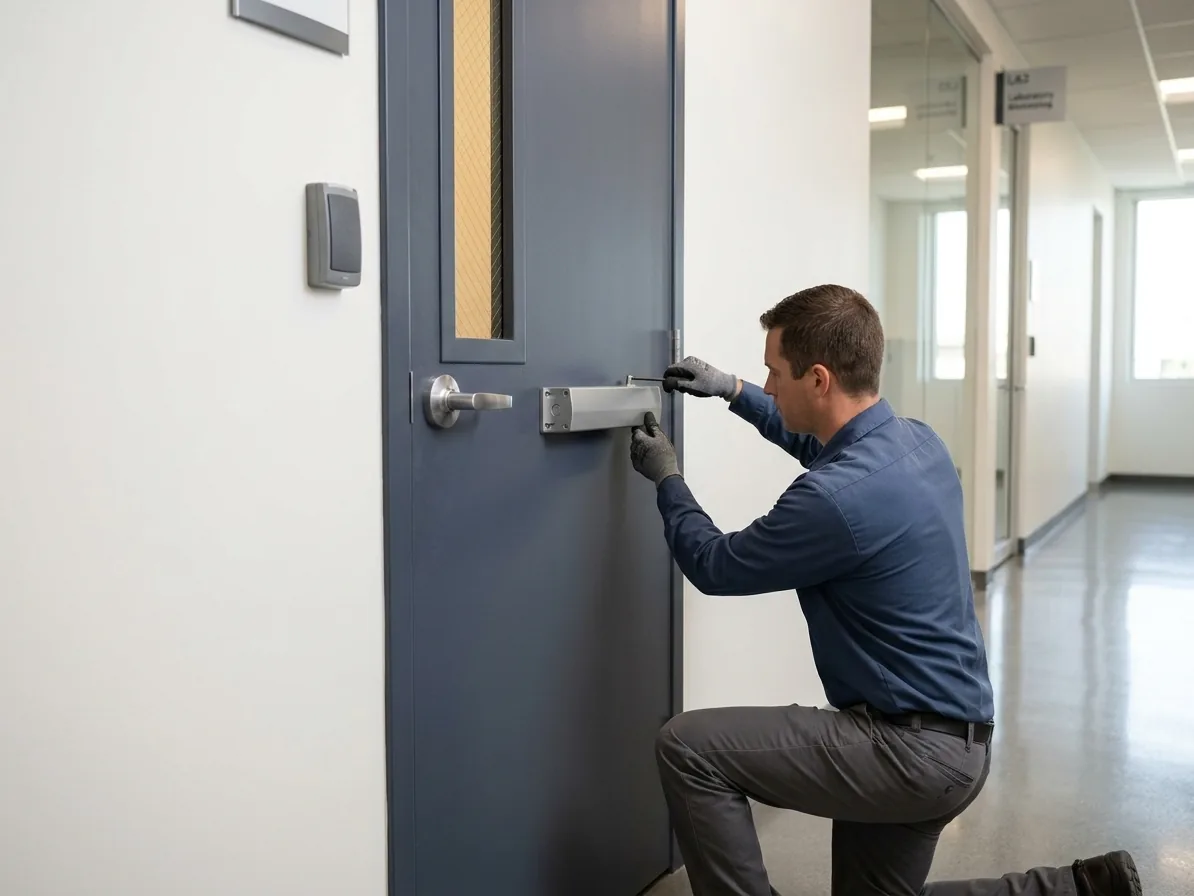
Most reader and door position faults are mechanical. A door that has sagged on worn hinges, a closer with latch speed set too slow, or a compressed gasket that stops the door in the last quarter inch will leave the latch short of the electric strike keeper and the position switch out of tolerance. We check the opening in that order: hinge wear and frame square, latch throw and strike lip alignment, closer sweep and latch speed, then the switch gap. We coordinate directly with your security vendor so nobody spends a week trading blame.
Temperature swing and condensation are hard on ordinary hardware. Plated latches and strikes corrode, closer fluid thickens as the room cools so the door either slams or hangs open, and gaskets ice into the frame. We specify corrosion resistant hardware and closers rated for the temperature range, and sometimes the right answer is spring hinges with a positive latch instead of a closer. One thing is not negotiable: anyone inside has to get out with a single motion, no key and no special knowledge. That means an inside release and no keyed cylinder that lets someone lock a door with a person still behind it.
That is a keying design problem, not a lock problem. We build the system in groups: front of house and offices, wet lab, cold and reagent storage, vivarium or animal space, mechanical and roof. A change key opens only its group, and sub-masters stack so a lab manager carries one key instead of eight. We plan pin stacks and bitting before the first cylinder is pinned so there is room to expand when a suite is subdivided. On a restricted keyway, blanks are not sold at the hardware store and duplicates come only on your written authorization, with a record of who holds what.
A rated opening keeps its label only while the assembly stays as it was listed. Cutting a door or frame for a new lock prep, a maglock, or a wire path outside the manufacturer's listing puts that label at risk, and it surfaces the next time someone inspects the building. Rated doors also have to self-close and positively latch, so a wedge or a rubber stop is a finding waiting to happen. If a door genuinely needs to stand open for carts, we install a listed hold-open closer or a magnetic holder tied to the fire alarm so it releases on alarm.
Gowning rooms, tissue culture suites, and anything with a pressure differential either fight the closer or get thrown by it. Cranking the closer down is the wrong fix, because opening force climbs past what accessibility allows and staff start propping the door. The answer is closer selection and templating: correct size and spring power for the door width and the pressure it sees, backcheck set so the door is not driven into a bench or wall, latch speed tuned so the latch actually engages, delayed action where carts move through. Near balance rooms, scopes, and mass spec, backcheck and a controlled latch stop the shock that ruins a run.
These rooms are often left with a Grade 2 cylindrical lock and a hasp somebody added. We move them to a Grade 1 ANSI/BHMA mortise lock in a properly anchored frame, with a deadbolt function where the room allows it, security studs or non-removable pins on out-swinging doors, and a cylinder on its own restricted group with a written key list. Egress still governs: whatever goes on that door releases from the inside with one motion. If your protocol requires a record of entry, that is where a keypad or your existing reader belongs, and we build the door side so the record matches the actual opening.
Life science buildings across San Diego County
The lab inventory here is not uniform. Torrey Pines and Campus Point are largely purpose built, with rated corridors, heavy traffic, and a landlord who cares a great deal about who holds which key.
Sorrento Valley and Nancy Ridge hold a lot of tilt-up R&D shells converted to lab space one tenant improvement at a time, which means mixed hardware, three keyways in one suite, and aluminum storefront entries never meant for cart traffic.
Coastal air matters more than people expect. Buildings on the mesa and along the 5 see enough salt to pit finishes on exterior levers, thresholds, and exit device rods. We specify materials and finishes with that in mind instead of replacing the same part over and over.
- Torrey Pines mesa and the North Torrey Pines research corridor
- Sorrento Valley and Nancy Ridge R&D conversions
- UTC and Campus Point office and lab mix
- Mira Mesa and Miramar support, storage, and warehouse space
- Carlsbad life science along the 78
Access control, designed by us or built under your platform
We design, install, and service complete access control systems: card, fob, and mobile-credential readers, keypads, door controllers on cloud-managed platforms, video intercoms at the entry, and the credential setup that follows.
We also still install just the door side under an integrator platform you already run, which is often the right call in a lab building with an incumbent security vendor.
Choosing the right electrified device matters more in a lab than in a plain office suite. An electric strike is often the cheapest path on a hollow metal frame, but it moves the security to the frame. An electrified lever or electrified mortise lock keeps the latch under control at the door and holds up better on a high traffic corridor. A maglock has no latch at all, which raises egress questions immediately and is rarely right on a lab door.
Fail-safe versus fail-secure gets decided opening by opening. A rated corridor door and a reagent store should not behave the same way when power drops, and egress from the inside must never depend on power in either case.
- Electric strikes on hollow metal and aluminum frames, with a keeper matched to the latch you actually have
- Electrified mortise and cylindrical locks, power transfer hinges and loops, concealed wire paths
- Request to exit devices and door position switches installed and aligned to your panel
- Fail-safe and fail-secure specified per opening, with mechanical key override where you want it
- Exit devices with electric latch retraction, and dogging behavior that matches your hours
- Punch list work on openings your security vendor has already flagged
Key control that survives turnover and suite changes
Lab staff turns over. Postdocs finish, contractors rotate, a program winds down and everyone on it leaves the same month.
If the building was cut on a common keyway, each of those departures is a small unknown. A restricted keyway with a written key record turns it into a paperwork step instead.
When someone with sensitive access leaves, we rekey the affected group rather than the whole property. That is only possible if the master key system was designed in groups to begin with, which is the argument for planning it before you need it. The same structure carries you through tenant improvement work: when a suite is split, subleased, or handed back, we rekey the boundary and leave the rest alone.
On multi-tenant buildings we keep the arrangement property managers expect. The building master stays with the landlord, the tenant carries their own sub-master for their suite, and neither side has to trust the other's filing cabinet.
Exterior doors, docks, and the openings nobody budgets for
Most urgent calls from lab buildings are not lab doors. They are the storefront entrance, the dock man-door, and the vestibule everyone drags a cart through.
Aluminum storefront is its own trade: narrow stile doors take Adams Rite style deadlatches and narrow mortise locks, pivots and closers wear, the door drops, and the deadlatch stops engaging the strike. On the exit side, rim devices, surface vertical rods, and concealed vertical rods each fail differently, and rods that drift out of adjustment leave a top latch that never catches.
- Storefront deadlatch and mortise lock replacement, pivot and closer work, door and frame alignment
- Rim, surface vertical rod, and concealed vertical rod exit devices adjusted, rebuilt, or replaced
- Dock and receiving doors, armor and kick plates, hold-open arms sized for cart traffic
- ADA lever hardware and low energy operators where knobs are still in service
- Thresholds, sweeps, and weatherstripping on exposed coastal elevations
How a quote and an account work
Start with photos, or a walk when photos are not enough.
We survey the openings you are concerned about and note door type, frame, hardware grade, rating, and what is already electrified, then send a written scope with a hardware schedule so you can compare it line by line instead of guessing what is inside the number.
We phase work so a floor stays usable, and we schedule around runs, deliveries, and shutdown weeks. If your building requires vendor onboarding paperwork or a badged escort, send the requirements with the quote request so it is handled before the crew arrives rather than at the door.
Ongoing work is easier on an account: purchase orders, one point of contact, standard terms, and a keying record we maintain so the next rekey does not start from scratch. Call us or send a quote request with the building and the openings, and we will take it from there.
- Egress governs every other decision. Doors people can be behind, including cold rooms, walk-ins, and storage rooms, must open from the inside with one motion, no key, no tool, no special knowledge. Electrified locking has to release in the manner your authority having jurisdiction approves, and inside egress should never depend on power.
- A fire rated opening keeps its label only while the assembly stays as listed. Rated doors need a self-closing device and positive latching, hold-opens must be listed devices released by the fire alarm, and field modification outside the manufacturer's listing can void the label.
- Accessibility applies to lab doors too: lever style hardware operable with one hand without tight grasping, pinching, or twisting, mounting heights within the accepted range, and opening force and closer timing kept within limits. A closer cranked down to beat room pressure often pushes force past what is allowed.
- Occupancy classification drives locking. Rooms with hazardous materials or higher occupant loads may require panic hardware, and delayed egress or other special locking arrangements are permitted only under specific conditions with approval. Confirm with your authority having jurisdiction before locking anything down.
General principles only. Your authority having jurisdiction has the final say on any specific opening.
What we are usually called out for
In a lab building the work clusters around electrified corridor doors, restricted keying for reagent and sample rooms, and rated assemblies that have to keep their label.
Access Control Systems
The whole system, credential to latch
DetailsElectric Strikes
Fail-safe or fail-secure, matched to frame and latch
DetailsElectrified Door Hardware
The door side of access control
DetailsMaster Key Systems
Commercial keying design for San Diego buildings
DetailsHigh Security Locks
Key control for San Diego commercial buildings
DetailsFire-Rated Door Installation
Door, frame, and hardware as one labeled set
Details