Lock and Door Work for San Diego Office Buildings and Business Parks
Commercial Lock & Door Co. services locks, doors, and master key systems in multi-tenant office buildings and business parks across San Diego County, covering suite rekeys, corridor and exit hardware, closers, and keying records for property managers.
Master access for management, separation for every tenant
A multi-tenant office building is a keying problem wearing a hardware problem's clothes.
Management has to reach every space. Tenants have to be certain nobody else reaches theirs. Between those two facts sit suite doors, common corridors, stairwells, restroom cores, electrical and IDF closets, roof access, and a perimeter that locks at close of business and opens again the next morning.
Commercial Lock & Door works with property managers, building engineers, and office managers across San Diego County, from the Sorrento Valley and UTC corridors to Kearny Mesa, Mission Valley, and the business parks up in Carlsbad and Escondido. Work is quoted per job, scheduled around tenant hours, and documented so the system survives a change in on-site staff.
What actually goes wrong in these buildings
Turnover rekeys, construction keys that never got retired, and suite entry doors that will not latch make up most of the calls from multi-tenant office properties.
Suite rekeys are change key work inside the existing hierarchy. The change key bitting moves, the master pin positions in the stack stay where they are, and the building master and grand master still pass. If the property was never built on a system, or the records left with a previous manager, we can key the suite to a clean bitting now and fold it into a proper hierarchy later without redoing the labor.
General contractors set cylinders to a construction key so every trade can get in, and the last punch item is supposed to be permanent cores or repinning that key out of the system. It gets missed constantly. We survey the suite, verify what actually operates those cylinders, install or repin permanent cores, and hand back a keying schedule that states which key opens what.
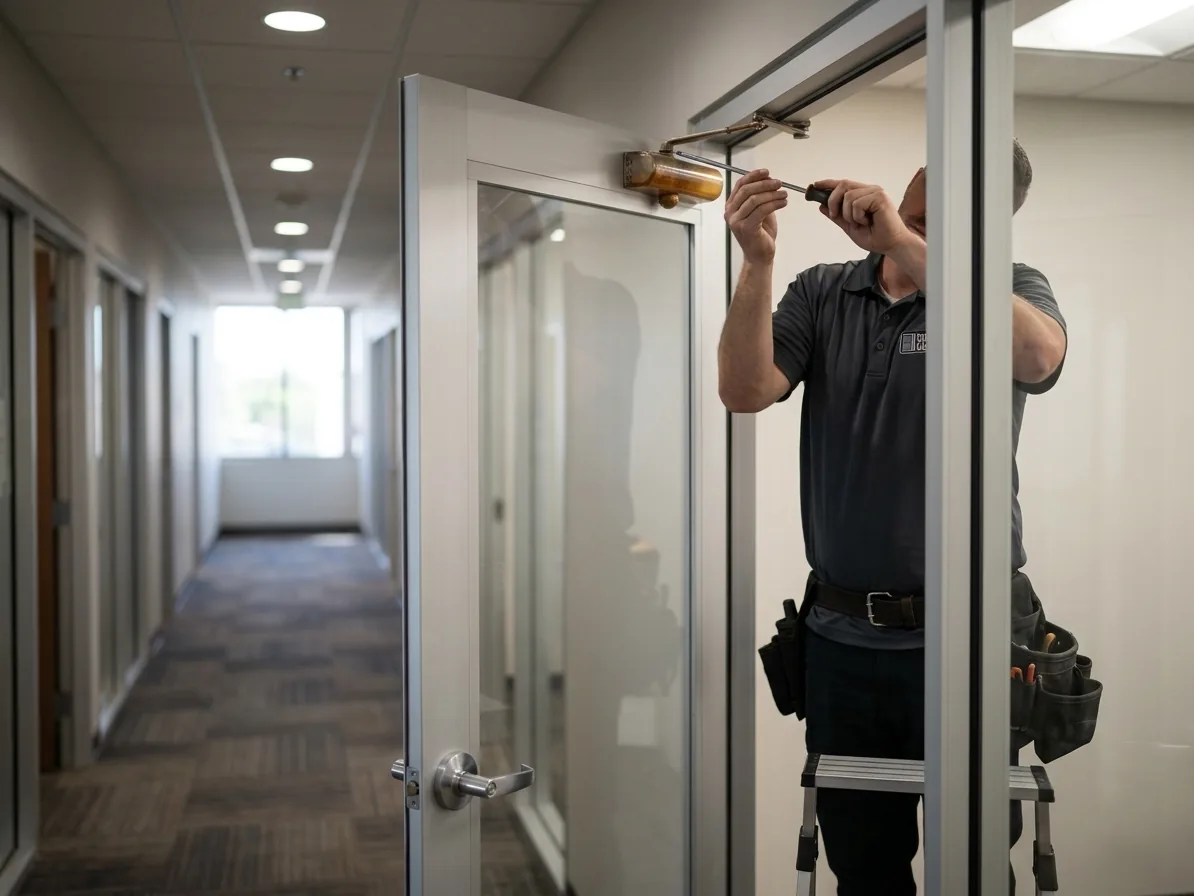
Usually this is strike alignment or a worn deadlatch, not the lock body. Aluminum storefront suite fronts sag at the top corner and drop the latch below the strike lip. We check the door for square, adjust or replace the strike, confirm the deadlatch plunger rides the strike face instead of dropping into the keeper, and reset the closer so the door closes under control.
A credential is only as good as the lock it releases. On a narrow stile aluminum entrance that usually means an electric strike matched to the stile and to the latch it catches, wired fail-secure so the opening stays locked when power drops. Egress stays mechanical: the inside lever or panic bar retracts the latch regardless of the electronics. We handle the electric strike, the electrified lever or transfer loop, the request-to-exit device, and the door position switch, and we design and install the readers, controllers, and credentials when the opening needs the full system.
Labeled corridor and stairwell doors are assemblies, not just doors. They have to close and positively latch on their own, which rules out wedges and rules out an arm-mounted hold-open on a rated opening. Drilling a labeled door or frame beyond its listed preparations can void the label. When a suite on a rated corridor needs a different lock function, we work with listed hardware in listed preps instead of cutting the label off the building.
A standard keyway gets duplicated anywhere. A restricted keyway moves duplication behind a signature list you control, so a departing office manager cannot make a stack of copies on the way out. Buildings convert over time: rekey suites and common doors to restricted cylinders at each turnover, run the old system alongside it, and finish without a weekend shutdown.
Keying a building so management keeps access and tenants stay separated
A workable office system has three or four levels and no accidental cross-keying.
Grand master for ownership and the building engineer. A master per floor, or per building in a park. Change keys per suite. Then a few controlled sub-systems that belong to nobody else: mechanical, IDF and electrical, roof access, fire control room, janitorial.
The design matters more than the cutting. Stack too many masters into a chamber and you get key interchange, where a suite key quietly opens the suite two doors down and no one finds out until it matters. We build the master key system on paper, check the bitting list for interchange, then pin it.
- Grand master, floor or building master, suite change keys, plus separate controlled sets for mechanical, IDF, roof, and janitorial
- Bitting list checked for accidental interchange before anything gets pinned
- Restricted keyways where key control matters, standard keyways where it does not
- A written keying schedule and key record you keep on file
- New suites folded into the existing hierarchy rather than started from scratch
- Construction keying retired at closeout
Suite doors, corridor doors, and the hardware between them
Most San Diego office stock mixes three door types, and each fails differently.
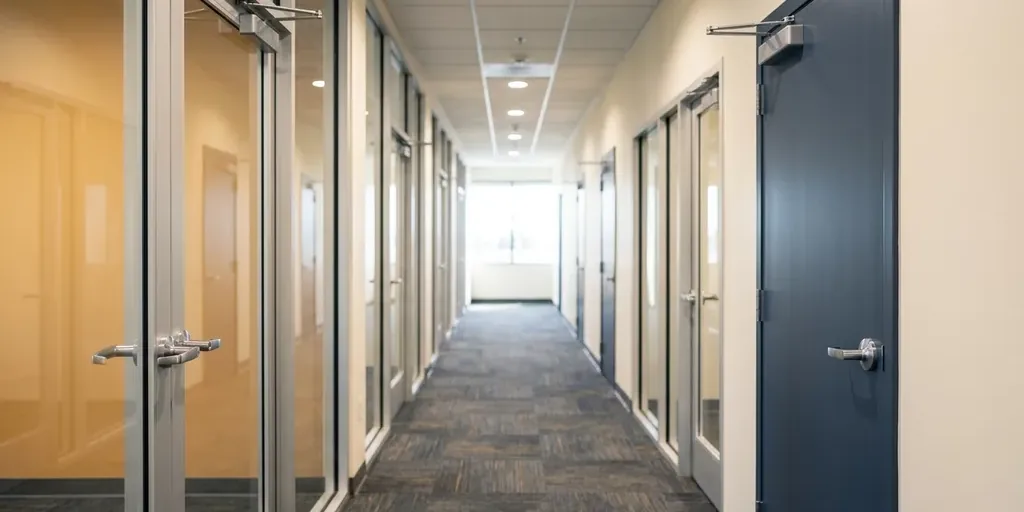
Hollow metal in rated corridors and stairs takes mortise or Grade 1 cylindrical hardware and usually fails at the closer or the hinges. Aluminum storefront at the building perimeter and on glass suite fronts takes narrow stile hardware, deadlatches, and rim or vertical rod exit devices, and it fails at the pivot, the bottom rail, and the threshold. Interior wood doors fail at the strike and the frame.
Specifying Grade 1 on a suite entry or a lobby door costs more at the order and ends the yearly replacement cycle. On a low-traffic interior office, Grade 2 is honest hardware and we will say so.
- Mortise or cylindrical chosen for the door and the function, not for whatever fits the existing prep
- Grade 1 ANSI/BHMA on suite entries, lobby doors, and anything on a corridor
- Closers templated to door width and swing, with backcheck set so the door does not slam into the sidelite in a Santa Ana
- Handing verified before ordering, since a left hand reverse door will not take a right hand lock
- Rim, mortise, and vertical rod exit devices serviced, including dogging so doors stay push-pull during business hours
- Filler plates and wrap-around plates where an old prep no longer matches the new hardware
After-hours work, tenant improvements, and turnover
The work that keeps a building running rarely belongs at ten in the morning. Rekeying a floor, swapping lobby hardware, or cutting in an electric strike means noise, a door standing open, and a stretch of time when the opening is not secure.
We schedule around the tenants: evenings, early mornings, weekends, or the gap between a tenant vacating and the next build-out starting.
On tenant improvement projects we can read the hardware schedule before the order goes in, flag substitutions that will not work in the field, install the finish hardware, and deliver keying at closeout so the new tenant is not living on a contractor key.
- Turnover visits that cover suite rekey, closer adjustment, latch and strike check, and a key count in one trip
- Hardware schedule review ahead of procurement
- Punch list closeout with matching functions and finishes
- Access control design and installation for lobby and suite doors, or door-side coordination with your alarm or IT vendor
- Vacant suite security before the space shows
Set up as an account, not a series of one-off calls
Most of our office and business park work is account work.
A written quote before anything starts. Purchase orders accepted. Invoices that reference the property and your work order number so they clear AP without a phone call. If your building requires vendor documents on file before a first visit, send the requirements along with the quote request and the office will work through them.
If you manage several properties, the highest-value thing we do is a survey. Every opening gets recorded: door type, frame, hardware, function, handing, cylinder, and keying. After that, most requests take one line to place, because both sides already know what is hanging in that frame. Call us or send the address and the suite, and we will get a quote back to you.
- Doors in the path of egress must open from the inside in one motion, without a key, a tool, or special knowledge. That rules out double cylinder deadbolts, thumbturn covers, and add-on surface bolts on suite exits and corridor doors, however a tenant wants the space locked at night.
- Labeled fire doors on corridors and stairs have to self-close and positively latch. Wedges, kickdown holders, and mechanical hold-open arms defeat that. Hold-open on a rated opening belongs to listed closer holders that release on the fire alarm. Field modification beyond the listed preparations can void the label.
- Multi-story buildings generally have to provide re-entry from the stair back into the building, either by leaving stair-side levers unlocked on designated floors or by using fail-safe electrified locks that release on alarm. A stair door rekey is the right moment to confirm your building's approved arrangement.
- Accessible entrances need hardware operable with one hand and without tight grasping, pinching, or twisting, mounted within the required height range, with opening force and closing speed kept inside the accessible limits. Levers, push-pulls, and a properly adjusted closer meet that. Knobs and an over-sprung closer do not.
General principles only. Your authority having jurisdiction has the final say on any specific opening.
What we are usually called out for
Property managers and building engineers mostly bring us master keying, suite turnover rekeys, closer resets on glass suite entries, and electric strikes behind after-hours readers.
Master Key Systems
Commercial keying design for San Diego buildings
DetailsAccess Control Systems
The whole system, credential to latch
DetailsTenant Turnover Lock Change
Turnover work for property managers
DetailsDoor Closers
Surface, concealed, and floor closers
DetailsInterior & Office Doors
Solid core doors, matched finishes, the right function per room
DetailsElectric Strikes
Fail-safe or fail-secure, matched to frame and latch
Details