Surface Vertical Rod Exit Devices in San Diego
Surface vertical rod exit devices latch a pair of doors at the head and the floor from one push bar. Commercial Lock & Door Co. realigns latches, replaces bent rods and strikes, and handles less-bottom-rod conversions on door pairs across San Diego County.
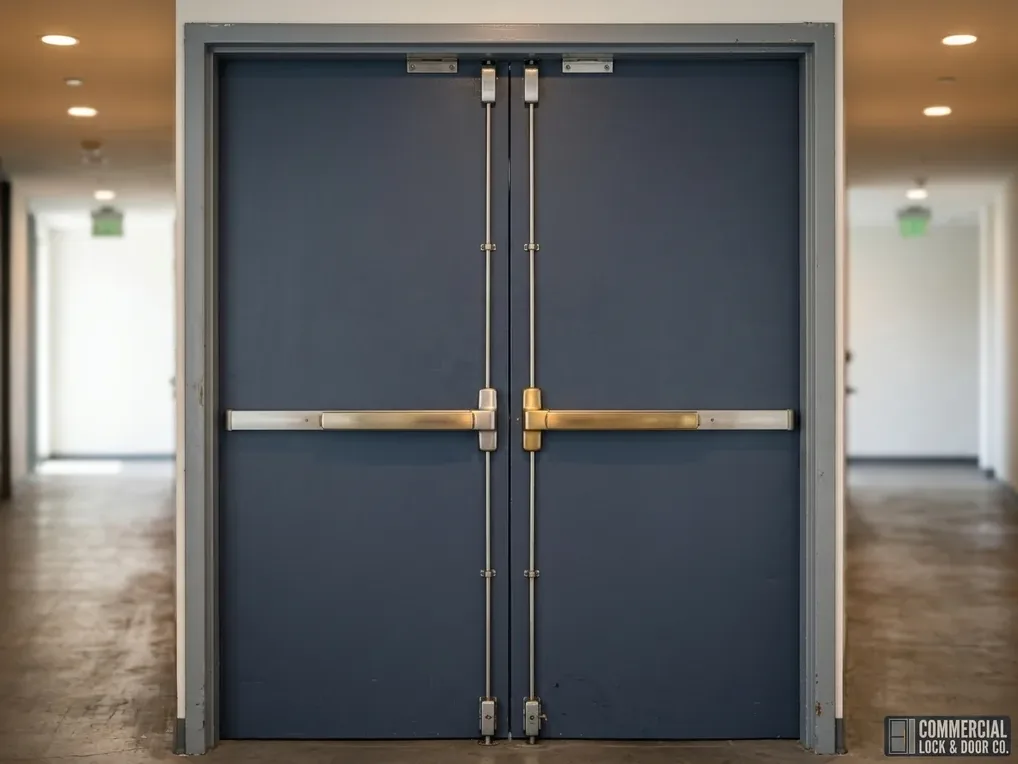
When a pair of doors stops latching on its own
The pair at the back of the building does not latch anymore. Staff pull it shut, it bounces open, and eventually someone props it with a bucket.
Or the bottom latch drags across the slab and screeches every time a cart goes through, so a maintenance tech took the bottom rod off last year, and now the top latch skips the strike too.
Surface vertical rod devices carry most of the pairs in San Diego County. Warehouse pairs off the 905 near Otay Mesa, school corridor pairs, back-of-house pairs behind restaurants and retail, stair pairs in office buildings. It is simple hardware with a lot of adjustment built into it, and most of the pairs we get called to are not worn out. They are out of alignment, missing parts, or converted the wrong way by someone trying to stop a noise.
Below is how the hardware actually works, what fails on it, and what a correct less-bottom-rod conversion looks like on a labeled opening. If you already know your pairs are wrong, send the count and a photo of each pair and we will quote them per opening.
How a surface vertical rod device holds a pair of doors
A surface vertical rod exit device is one chassis driving two latches. Push the bar and both retract at once.
The top latch throws into a surface strike at the frame head. The bottom latch throws into a floor strike or a strike built into the threshold. The rods run up and down the face of the door under snap-on covers. Concealed vertical rod devices do the same work inside the door edge, which is why they take longer to service and why most buildings are better off staying surface mounted where they already are.
Pairs get built three ways, and the arrangement decides everything about the repair. With a removable mullion, both leaves can carry simple rim exit devices and the mullion takes the latching. Without a mullion, either both leaves get vertical rods, or the active leaf gets a device and the inactive leaf gets manual or automatic flush bolts. On labeled pairs with an overlapping astragal, a door coordinator forces the inactive leaf to close first. A bent coordinator or a carry-open bar out of adjustment lands the leaves in the wrong order, and no amount of work on the exit device will fix that.
- Top latch and header strike, bottom latch and floor or threshold strike
- Rods, rod connectors, and snap-on rod covers
- Grade 1 devices under ANSI/BHMA A156.3, Type 3 for surface vertical rod and Type 4 for concealed vertical rod
- Coordinator and astragal on labeled pairs
- Lever, pull, or exit-only trim, with a cylinder that can stay in your keyway
Why the bottom rod is the part that fails
Everything at floor level takes the abuse. Mop water and degreaser run down the rod and into the floor strike.
Dock dust, sand, and grit pack the strike pocket until the latch bolt cannot seat. A dust proof strike loses its spring and stops returning. Pallet jacks, hand trucks, and rolling racks catch the exposed rod and bow it, and once a rod is bent the latch throw shortens at the exact moment you need it.
Then the building itself moves. A slab settles, someone lays new flooring over the old, a threshold gets replaced at a different height, or a leaf sags on tired hinges. The bottom latch starts riding the floor instead of dropping into the strike, and the door announces it every swing. The fastest fix anyone knows is to pull the rod off, and that is where most of the pairs we see went wrong.
What removing the bottom rod actually costs you
Take the bottom out and the top latch carries the whole opening by itself. On an exterior pair that is a real problem.
Wind pressure and stack effect push on the leaves, the meeting stiles spread, and a single latch point at the head lets the doors bow just enough for the top latch to skip its strike. Now the pair rattles, then it blows open, then someone chains it and you have an egress violation instead of a hardware problem.
There is a security side too. A pair latched only at the head can be pried at the bottom with very little effort, which matters on a rear alley door or a yard-facing pair. And on a fire rated opening, cutting a rod off is a field modification. A labeled door and its hardware are only good while the opening stays within its listing, so the modification is what gets written up when an inspector walks the building.
Less bottom rod done correctly, and the auxiliary fire latch
Less bottom rod is a manufacturer configuration, not a removal. The device is ordered or converted with the correct kit so the chassis, the top latch, and the strike are set up to work as a single latch point.
On the right opening less bottom rod is a good decision. It ends the dragging, it ends the floor strike maintenance, and it takes the worst wear point out of the assembly.
On a fire rated pair, the LBR version of a fire exit device is paired with an auxiliary fire latch at the bottom of the leaf. It sits idle in normal use and projects a bolt into the floor when heat rises, holding the leaf down during a fire. That part is what keeps the opening inside its listing after the bottom rod comes off. It is not optional on a labeled pair and it is not something to improvise.
Half the time the exit device is not the problem
Before we quote parts we close the door slowly by hand. If it latches by hand and not on its own, the exit device is fine and the door closer is not delivering the leaf with enough latch speed.
Closers get turned down when someone complains about a slam, and the last few degrees of swing lose the energy the latch needs. Backcheck set wrong, an undersized spring size for the door width, or a closer mounted off template will do the same thing.
The rest of it is geometry. Hinges worn enough to drop the leaf, a frame spread at the head, a top strike that was shimmed instead of re-templated, a sweep or weatherstrip compressing hard enough to hold the leaves apart, gasketing swollen on a labeled pair. On pairs we also check the gap at the meeting edges, because a wide meeting gap tells you the leaves are no longer square to each other and no latch adjustment will hold.
Rod covers matter more than they look. A missing cover leaves the rod exposed to carts and to hands, and a bent rod is a latch that no longer throws. Covers are cheap and they are the difference between a device that lasts and one you call about every year.
How we handle a building with several pairs
Most calls start with one bad opening and end with a walk of the property.
We tag each pair: manufacturer and series, device function, trim, fire label status, door and frame construction, condition of the header strike, the floor strike, the threshold, and the closer. You get a line per opening so you can approve the urgent ones now and hold the rest for the next budget cycle.
Standardizing pays off. Mixed devices across a portfolio mean mixed rod lengths and mixed parts, and your stockroom never has the right piece. When a device has to be replaced we point at the family that matches the rest of your building, and we keep the cylinders in your existing keyway so the lever trim still works on your key system.
Scheduling is yours to set. Before opening, after close, weekends, a shift change on a warehouse floor. Tenant spaces get coordinated with whoever you name on the work order. If your building requires vendor paperwork before anyone works on site, send the requirements with the request and we will get them handled ahead of the visit rather than at the door. Purchase orders and account billing are normal for us.
Commercial work is quoted per job, never off a price list. These are the factors that make a quote larger or smaller:
- Number of openings, and whether they are one device family or five different ones
- Fire label status, since a labeled pair needs listed parts and an auxiliary fire latch for any less-bottom-rod conversion
- Door and frame construction: narrow stile aluminum storefront, hollow metal, or labeled wood
- Rebuild versus replacement, which depends on whether parts are still made for the device on the door
- Condition of what the latches land in: header strike, floor strike, threshold, slab height, and whether the frame has spread
- Access and timing, including occupied tenant space, work outside business hours, or header work that needs a lift
Where we run surface vertical rods
Dock pairs off the 905, school corridor pairs, and the back-of-house pairs behind restaurants and retail put most of our rod and strike calls in these districts.
Common in these buildings
Pallet jacks bend dock rods, corridor pairs take a full school day of traffic, and office stair pairs turn up with the bottom rod already cut off.