ADA Door Hardware for San Diego Commercial Buildings
ADA door hardware corrects the openings flagged in accessibility reviews: lever trim, opening force and closer timing, thresholds, and mounting heights. Commercial Lock & Door Co. surveys and corrects commercial doors across San Diego County, one opening at a time.
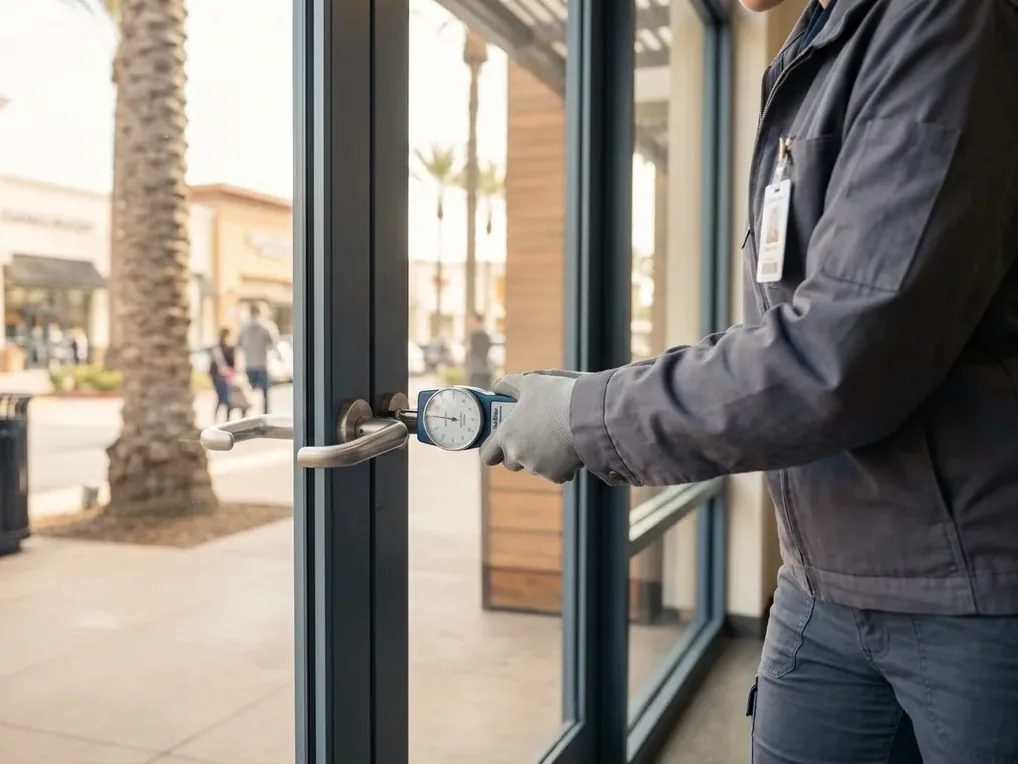
When a flagged door becomes your list to price
Someone flags a door. A tenant says the suite entry is too heavy to hold with an elbow.
A visitor cannot reach the thumbturn on the storefront. An inspector marks a knob on a restroom door, or a letter arrives with photographs of openings and no explanation of what is wrong with any of them. Now it is your list to price and schedule.
Much of what gets flagged is hardware and adjustment, not construction. Opening force, lever trim, mounting height, threshold profile, and closer timing are all correctable at the door, usually without touching the frame, the floor, or the wall. The work is unglamorous and it is measurable, which is the useful part. A door pressure gauge gives you a number before and a number after.
We work commercial openings across San Diego County one door at a time. Survey first, write down what each opening actually does today, then quote the smallest change that corrects it. California's accessibility chapter is tighter than the federal standard in a few places that matter for doors, so we set hardware to the stricter of the two and skip the argument later.
What usually gets flagged in an accessibility review
In existing buildings the same short list comes up over and over. None of it is exotic and almost all of it is hardware you can hold in your hand.
Two exceptions are worth knowing before you budget. Fire-rated openings are treated differently on opening force, because a labeled door still has to close and latch from any position. And thresholds already in place in an existing building get more latitude than a threshold going into new work.
- Knob sets and thumb latches, which require grasping and twisting the wrist to operate.
- Closers set too strong, or doors dragging on hinges, gasketing, sweeps, and new flooring, which puts opening force over the limit.
- Closers that slam, with a sweep period faster than the five seconds from 90 degrees to 12 degrees the standard calls for.
- A separate thumbturn deadbolt above the lever, which makes leaving a two-motion operation and often sits above the reach range.
- Hardware mounted high on older doors, or a deadbolt added later well above the lockset.
- Thresholds built up under new flooring, now past a half inch with no bevel.
- Vertical rod bottom fittings, floor bolts, and offset pulls projecting into the bottom ten inches of the push side, which has to stay smooth.
Lever trim, panic touchpads, and one-motion egress
The requirement is that hardware works with one hand, without tight grasping, pinching, or twisting. The field test is whether you can operate it with a closed fist.
A lever passes. A knob does not. Neither does a lever that needs a thumbturn thrown first. How the fix goes depends on what is in the door. A mortise body usually keeps its function and its cylinder, and only the trim changes, so a storeroom function stays a storeroom function with a lever instead of a knob and your keying is untouched. A cylindrical knob set is a different conversation. The chassis is its own component sitting in the cross bore, and the knobs mount to it, so some product lines take retrofit lever trim on the existing chassis and others do not. We confirm manufacturer and model before anyone budgets for trim alone. Where the lockset has to come out, a Grade 1 or Grade 2 cylindrical lever goes back in after confirming backset, door thickness, cross bore and edge prep, and handing. Skip the residential-grade levers on any door with traffic. They sag, and a drooping lever return catches sleeves and lanyards.
Exit devices get the same treatment. A touchpad device is easier to operate than an old crossbar, and on non-rated openings mechanical dogging lets you hold the latch retracted during business hours so the door behaves as push and pull and the only force left is the closer. Fire exit hardware has no mechanical dogging, so on a labeled opening that convenience comes from electric latch retraction or not at all.
On a restroom or storage door that does not need to lock, a push plate and pull is the simplest compliant hardware there is, and it removes a whole category of failure.
Opening force is a closer problem, then a door problem
Measure at the latch edge, perpendicular to the door face, with a gauge, from whichever side you are opening the door from.
A door on a closer is normally checked from both approach directions, because the seals, the stop, and building pressure do not load the door the same way in each. The number people quote is five pounds for interior hinged doors, and California applies the same limit to exterior hinged doors where the federal standard leaves that to the local authority. Fire doors are the exception and get the minimum force the authority will allow, because the door still has to close and latch.
The most common mistake in the field is turning the wrong screw. Sweep and latch valves meter oil on the closing cycle. They control speed, not opening force. Opening force comes from spring power plus everything the door fights on the way open: hinges out of plumb or worn, a continuous hinge binding at the top, gasketing compressed too tight, a sweep dragging fresh carpet, backcheck cranked so hard it reads as resistance late in the swing, and building pressure. Stack pressure in a lobby or stairwell and afternoon wind on a west-facing entrance are real loads, not excuses.
Most current closers have adjustable spring power across sizes one through six, so a door that is heavy at the factory setting can often be corrected with a closer adjustment rather than new hardware. Older fixed-size units cannot, and fighting one is wasted labor. Mounting matters too. Regular arm is the most efficient of the three arrangements and parallel arm the least, so on a marginal door the mounting itself can be the difference.
Then latching becomes the constraint. A closer set light still has to drive the latch home against seals and pressure, and surface vertical rod devices are the least forgiving of a weak closer. On a door people need extra time at, delayed action is the better answer than a weak spring.
Thresholds, bottom rails, and where hardware sits
Thresholds are simple until someone re-floors the suite.
A quarter inch of vertical change is fine as is. Above that it needs a bevel no steeper than one to two, and the overall height caps at a half inch in new work, with existing and altered thresholds allowed a little more when they are beveled. Adding tile or new carpet over old is the usual way a threshold that used to pass stops passing. The fix is normally a lower profile or double-beveled threshold plus a new door bottom so the opening still seals.
Mounting height is the other quiet one. Operable parts start at 34 inches, and California caps the top of that range lower than the federal 48, so we mount to the tighter number. Original hardware heights are rarely the problem. A deadbolt somebody added later, well above the lockset, usually is.
Maneuvering clearance is not hardware, but hardware can sometimes solve it. Pull side approaches want clearance beyond the latch edge, and the push side requirement changes depending on whether the door has both a closer and a latch. Where a column or a return wall eats that space, changing the door to push and pull, or reversing the swing, occasionally solves on the door what would otherwise be a wall demo.
The bottom ten inches of the push side has to be a smooth surface across the full width. A flat kick plate is fine. A bottom rod, a floor bolt, or a pull mounted low is not.
Low energy operators, and when you do not need one
An operator is a legitimate answer to a door that cannot reach the force limit any other way.
Labeled fire doors with full gasketing, vestibules fighting stack pressure, and heavy full-lite aluminum entrances on the windward side of a building all end up there honestly. An operator should not be the answer to a hinge that has dropped.
Low energy swing operators under ANSI/BHMA A156.19 open slowly on a knowing act, a push plate or wave plate, and do not carry the guide rail and sensor requirements of a full power automatic entrance. They need power at the header, actuators on both sides placed clear of the door swing and within reach range, and coordination with whatever secures the door, usually an electric strike so the operator is not driving against a latch.
We install and service the hardware side of that opening: the lock, the strike, the closer or operator arm, the hinges, and the door and frame themselves. We are a door and hardware contractor, not an automatic entrance dealer, and when a job is really an entrance package we will tell you that instead of selling around it. Before an operator goes into a budget, rule out the ordinary causes first: an adjustable closer left at the wrong spring size, a dropped hinge, gasketing crushed too tight, or a door swollen against the stop. Those are cheaper to correct, and the gauge will tell you whether they were the problem.
How the survey and quote work
We walk the openings and record what each one is: door and frame type, existing hardware and function, measured opening force, closer sweep, threshold height, hardware height, and anything the door is binding on.
The quote is a line item per opening rather than one lump number, so you can approve all of it or phase it by floor, building, or tenant.
Scheduling is built around the building being occupied. Suite doors go during business hours if the tenant prefers. Lobby, corridor, and restroom doors go early or after close, so the opening is only apart when nobody is trying to use it. If your management office runs a vendor packet or has its own paperwork requirements before anyone works on site, send it over during the survey so that side is worked out on the front end instead of at the door.
Buildings with more than a handful of doors usually end up on an account with us. After that, the next flagged opening is a phone call and a PO number instead of a new vendor packet and another walkthrough.
Commercial work is quoted per job, never off a price list. These are the factors that make a quote larger or smaller:
- Number of openings, and how many share a door type. One lever family repeated across matching doors prices differently than a list of one-off openings.
- Whether the existing lock is mortise or cylindrical. A mortise body often takes lever trim with the function and cylinder intact, while a cylindrical knob set may or may not accept retrofit lever trim on its chassis and often comes out as a unit.
- Whether closers can be adjusted, need the arm and shoe corrected, or need replacement because the spring size is fixed and wrong for the door.
- Fire-rated openings, where hardware has to match the label, force cannot be dropped below what closes and latches the door, and field modification is off the table.
- Narrow stile aluminum and storefront, which needs stile-specific hardware and sometimes new prep in the door.
- Threshold and floor conditions, plus after-hours access, tenant notice, and elevator or loading dock coordination in occupied buildings.
Where we run ADA door hardware
Opening force checks, lever trim, and threshold corrections run from Downtown San Diego tower lobbies to Carlsbad business parks and inland suites in Poway, Escondido, and El Cajon.
Common in these buildings
Most flagged-door lists we price come from managed portfolios, multi-tenant office suites, and clinics where restroom and exam room doors have to work one-handed.