Master Key Systems for San Diego Commercial Buildings
A master key system organizes a building's locks into a hierarchy, so each key holder opens exactly the doors their role requires and nothing else. Commercial Lock & Door Co. designs, pins, and installs master key systems for commercial properties across San Diego County.
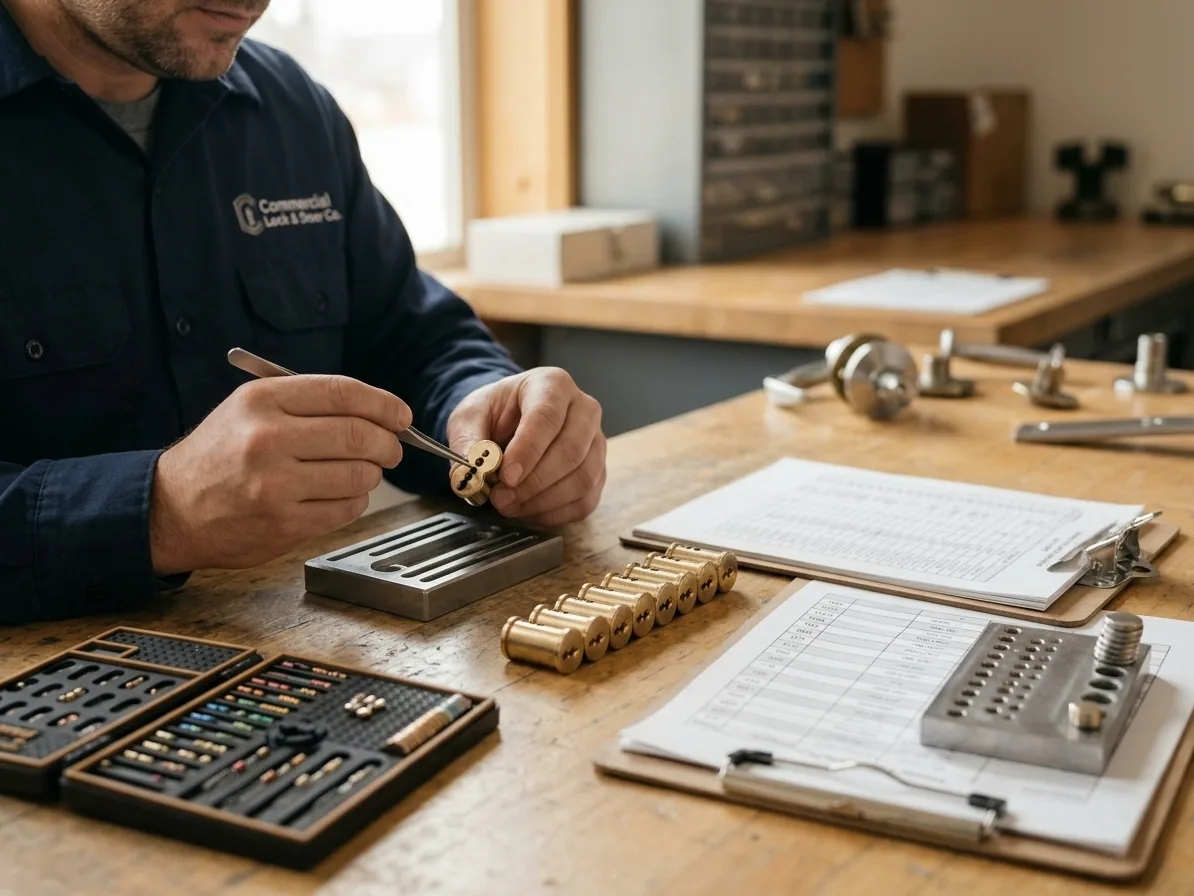
The key system your building accumulated by accident
Most buildings do not get a master key system. They accumulate one.
A suite gets rekeyed, a maintenance closet gets its own key, an incoming tenant brings their own locksmith, and after a few years the ring on the maintenance cart is thick, half the keys are unlabeled, and nobody can say with confidence which key opens what. Somewhere there is a key that opens almost everything, and nobody knows how many copies of it exist.
A properly designed system replaces that with a hierarchy you can actually administer. The cleaning crew carries one key that opens common areas and nothing else. The building engineer carries one that reaches mechanical and electrical spaces. A tenant carries a key that opens their suite and stops at their own door. When any one of those keys goes missing, you know exactly what your exposure is and exactly which cylinders have to change.
We design, pin, and install master key systems for commercial properties across San Diego County, from single-tenant office buildings off the 163 to multi-building industrial parks near Otay Mesa. The design work matters more than the hardware. Get the hierarchy and the expansion room right and the system serves the building for years. Get it wrong and you pay to rebuild it the first time a floor gets subdivided.
Grand master, master, sub-master, change key
Every cylinder in a master keyed system operates on at least two keys: its own change key, and one or more higher level keys above it. The levels are what make the system administrable.
Keysets get symbols, not descriptions. A key stamped AA1 tells anyone in the trade where it sits in the hierarchy and which keyset it belongs to, without telling a stranger what it opens. The actual bitting never gets stamped on the key face where a phone camera can capture it. Interchangeable core systems add one more key that lives outside this hierarchy entirely: the control key, which does not unlock anything but pulls cores out of housings.
- Change key (CK): operates one keyset. The suite key, the office key, the closet key. Most keys in a building are change keys.
- Sub-master (SMK): operates a defined group of change keys. A wing, a floor, a department, or the interior doors inside one tenant suite.
- Master (MK): operates every sub-master beneath it. Commonly one building, or one function class such as all mechanical spaces.
- Grand master (GMK): operates every master below it. Used when a portfolio needs one management key across several buildings.
- Great grand master (GGMK): the level above that, rarely justified outside large campuses and school districts.
Design starts with a door schedule, not a key count
Before anything is pinned, someone walks the building and writes down every opening: door number, location, door type, lock type and manufacturer, cylinder type, handing, and lock function.
That schedule is the design document. Everything else follows from it. Function matters as much as location. A storeroom function lever is locked outside at all times and takes a key on every entry. A classroom function lever can be left unlocked with a key and stays unlocked until keyed again. An office or entrance function has a thumbturn or pushbutton inside. Those are three different key policies wearing the same trim, and they change how many keys a building actually needs.
Groups should follow responsibility, not floor plans. The person who has to get in at two in the morning is the reason a sub-master exists. Cleaners, engineers, tenant managers, alarm response, and the fire department key box each represent a role. Build the levels around roles and the system stays readable a decade after the person who designed it has left.
Cylinder inventory drives the parts list. Mortise cylinders with the correct cam, rim cylinders with the correct tailpiece length, key-in-lever cylinders, interchangeable core housings, cam locks on electrical panels, and padlocks on gates, roof hatches, and telecom rooms all need to land in the same system. Anything left out becomes the second key ring that undoes the whole point.
Pin stacks, cross keying, and the cost of one more key
A master keyed cylinder works because a master pin splits the pin stack, creating a second place where that chamber can break at the shear line.
Bottom pin, master pin, top pin, spring. Every master pin added to a chamber multiplies the number of key cuts that will turn that plug.
That is the trade-off nobody mentions when the request is to just add the new manager to the master. More master pins mean more shear line positions, thinner pin segments, easier manipulation, and a higher chance of key interchange, where a key cut for one door quietly operates a door it was never meant to touch.
Two design methods control that. Total position progression uses every chamber for progression and yields the largest number of change keys, but in a big system it is the most prone to interchange. The rotating constant method holds one chamber constant per group, gives up some theoretical capacity, and produces a cleaner system with far fewer master pins per cylinder. On a building that will be resold or subdivided, the second approach usually ages better.
Cross keying, where one cylinder is deliberately keyed to two masters that do not share a branch, is the most common way a system goes soft. Sometimes it is unavoidable, such as an electrical room shared between two tenants. It should be a documented exception on the schedule, not a habit. The same goes for maison keying on common area doors, which is convenient and weak for exactly the same reason.
Keyways, key control, and interchangeable cores
Do Not Duplicate stamped on an open keyway is unenforceable. Any shop with the right blank can cut it, and the blank is on the shelf.
Real key control comes from the blank itself. A restricted or patented keyway means blanks are not sold on the open market and duplication is tied to an authorized dealer and a signature card. High security cylinders add a second control element, a sidebar or an angled cut, that a standard duplicator cannot reproduce at all.
Multiplex keyway families give a large system another tool. Sectional keyways let a master operate across several sections while the change keys below it are physically restricted to their own section. A tenant key will not even enter the neighbor's cylinder, which removes an entire class of complaint before it happens.
Interchangeable core changes the labor math. Small format interchangeable core (the figure eight shape) and large format interchangeable core both come out with a control key and drop back in with the same motion. New cores get pinned at the bench, verified against the schedule, and swapped in the field in the time it takes to turn a key, instead of pulling and disassembling every lock on site. For a portfolio that turns tenants regularly, that difference shows up on every rekey for the life of the building.
When a master key goes missing
Scope depends entirely on which level walked out the door, and the honest answer is not always the small one.
There are two ways forward and they price very differently. Rekeying inside the existing keyway assigns new bittings across the affected cylinders and keeps the hardware you already own. That is usually right when the loss is contained and the keyway was never the weak point. Moving the system to a new restricted keyway replaces cylinders instead of repinning them and closes the door on every unaccounted copy, including ones cut years ago by a vendor nobody remembers hiring. That is the right call when you have genuinely lost count of how many masters exist.
An interchangeable core system can do either one without taking a single lock apart, which is the strongest argument for specifying it up front rather than on the day you need it.
Either way, the work should close with a fresh key control record: who was issued which symbol, on what date, signed for. A system without an issuance log is already halfway back to a drawer full of unlabeled keys.
- A change key is lost: rekey that keyset and reissue. Contained to one opening or one suite.
- A sub-master is lost: every cylinder that key operates changes, along with the change keys under it.
- A master or grand master is lost: the system is compromised from that level down, and there is no partial fix that is honest.
Running the work in an occupied building
Most of a master key job happens away from your tenants. The survey is quiet, the pinning happens at the bench, and the keying schedule is built and reviewed with you before a single cylinder comes out of a door.
Field work gets phased. Common areas, mechanical rooms, and exterior doors usually go first because they carry the highest exposure and the lowest tenant impact. Suites follow on a schedule you set, with notice and key handoff coordinated through your property manager. Restaurants and retail get done outside service hours. With interchangeable cores, a door is out of service for about as long as it takes to turn the control key. With standard cylinders, the lock comes apart and goes back together at the opening.
A few things do not get compromised for schedule. A labeled fire rated door does not get drilled or reprepped in the field for a new cylinder, because field modification outside the manufacturer's listing voids the label. Exit devices keep the cylinder type the device was built for, rim cylinder for a rim device and mortise cylinder for a mortise device, with the correct tailpiece and cam. Electrified hardware with a keyed mechanical override gets that override cylinder keyed into the same system, so it actually works on the day the network does not.
At closeout the whole package changes hands: schedule, bittings, issuance record, stamped keys. That documentation is the system. Losing it costs more than losing a key.
Commercial work is quoted per job, never off a price list. These are the factors that make a quote larger or smaller:
- Number of openings and how many distinct keyset symbols the hierarchy requires
- Cylinder mix: mortise, rim, key-in-lever, interchangeable core, cam locks, and padlocks each carry different parts and labor
- Whether existing cylinders can be repinned or have to be replaced to bring the building under one keyway
- Standard keyway versus a restricted or high security keyway with controlled blanks
- Depth of the hierarchy and how much expansion room you reserve for future suites
- Access windows: after hours, weekend, or phased tenant coordination adds site time
Where we run master key systems
Otay Mesa and Miramar industrial parks, Kearny Mesa office parks, Mission Valley hotels, and Chula Vista medical suites each get a hierarchy sized to their door schedule.
Common in these buildings
Property managers want one grand master per portfolio, office suites want tenant keys that stop at their own door, and school campuses often go a level deeper.