Storefront Door Repair in San Diego
Storefront door repair restores aluminum entrance doors as one system: pivots, closers, deadlatches, hook bolts, thresholds, and out-of-square frames. Commercial Lock & Door Co. services retail, restaurant, office, and multi-tenant storefronts across San Diego County.
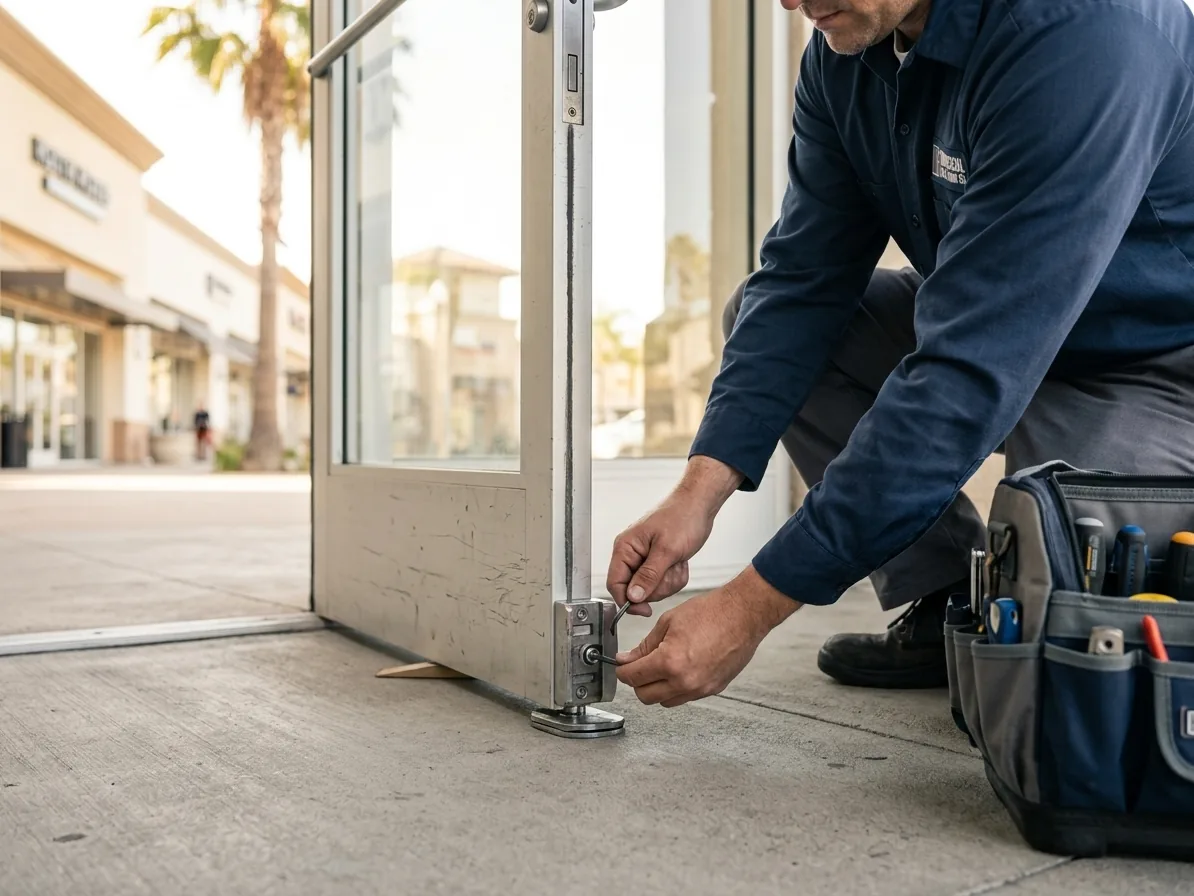
When the entrance stops latching at close
The entrance is the door that tells you when something is wrong. The latch stops catching unless someone pulls the leaf toward the jamb.
The closer floats most of the way, then slams the last few inches. The bottom rail has worked loose and the door sits low enough that the sweep drags on the threshold. Staff learn to lift the handle and shove, and that workaround holds right up until the night the suite cannot be secured at close.
Aluminum storefront is a system, not a door. Thin extruded stiles and rails are joined at the corners with keys and tie rods, glazed with tempered glass on setting blocks, hung on pivots, and pulled shut by a closer that has to overcome wind, stack pressure, and its own age. Move one part of that system and nothing downstream lines up. We repair the leaf, the frame, and the hardware as one assembly for retail suites, restaurants, offices, and multi-tenant buildings across San Diego County.
Most storefront doors that get quoted for replacement do not need replacing. They need the right pivot, a closer matched to the header, a strike that the deadlatch can actually ride on, and someone willing to check whether the opening is still square before touching the hardware.
What actually fails on a storefront entrance
Nothing in an aluminum door is heavy, and nothing in it forgives misalignment.
Almost every entrance call we take traces back to one of five things: a worn pivot, a spent closer, a deadlatch that no longer meets its strike, a loose corner joint, or a frame that has gone out of square.
The symptom rarely sits where the cause does. A latch that stops catching is usually a pivot problem. A door that slams is usually a closer that has lost fluid, not a spring that needs tightening. A draft at the meeting stile is usually a sagging leaf, not worn weatherstrip. We diagnose in that order so you are not paying to replace the parts that were only reporting the failure.
- Bottom pivot bearing worn flat, dropping the leaf and dragging the sweep across the threshold
- Overhead concealed closer leaking hydraulic fluid down the inside face of the glass
- Deadlatch plunger falling into the strike pocket with the bolt, so the latch is no longer deadlocked
- Corner keys and tie rods loose at the bottom rail, letting the lock stile rack under load
- Racked frame or header deflection after slab movement, settlement, or vehicle contact at a drive-up suite
- Threshold anchors stripped in the slab, so the saddle lifts and the sweep stops sealing
- Hook bolt on a pair throwing past a keeper that has shifted, leaving the pair held by the latch alone
Pivots, sag, and openings that are out of square
Most storefront leaves hang on offset pivots: a top pivot in the header, a bottom pivot in a floor plate or bottom arm, and on tall or heavy leaves an intermediate pivot at mid height.
Center hung doors ride a spindle off a floor closer instead. The bottom pivot carries the weight of the leaf and the glass, and it wears in one direction only. When the bearing flattens, the door drops, the top rail leans out of the header, and the latch stops lining up with the strike.
Before we touch hardware we read the reveal at the top rail, the hinge stile, and the lock stile, then measure the frame diagonals. If the diagonals disagree, the frame is racked and no amount of strike filing will fix the latch. Depending on how far out it is, the answer is resetting the frame, reinforcing and shimming at the pivot, or replacing the leaf and the jamb section together.
Chasing a moving latch with a file is the field repair we undo most often. It works for a season. Then the door drops further, the strike opening is now oversized, and the deadlatch has nothing left to ride on.
Deadlatches, hook bolts, and the lock stile
The narrow stile lock on most storefront doors is an Adams Rite style deadlatch: a beveled latch bolt with a small auxiliary plunger beside it. The plunger has to land on the flat of the strike while the bolt drops into the opening.
That contact deadlocks the bolt against a shim. When the leaf sags or the strike wears, the plunger drops into the pocket alongside the bolt and the door is no longer secure even though it feels latched. It is the most common security defect we find on retail entrances, and the staff closing the building have no way to see it.
Backset and stile width drive what will fit. Narrow stile hardware runs about 31/32 inch, medium stile 1-1/8 inch, wide stile deeper still. The mortise cylinder needs the cam that matches the lock body; the wrong cam either spins without moving the bolt or binds and snaps a tailpiece. On pairs, a maximum security deadbolt throws a hook bolt into a keeper in the inactive stile, or down into the threshold on an out-swing pair. Hook bolts fail quietly, so we check keeper engagement by feel and by mark, not by whether the key turns.
On the egress side an entrance carries a paddle or an exit device. A rim device on a narrow stile needs a strike suited to the stile depth, and a surface vertical rod set has to have top and bottom latches adjusted against each other rather than one at a time. If a door is being held open on the dogging mechanism through the day, we confirm the dogging is actually releasing at close.
Closers, thresholds, and the weather line
Storefront doors use overhead concealed closers in the header, surface closers, or floor closers under a center hung leaf. Each is templated to a specific frame and door prep, which is why closer work is rarely a straight swap.
We match body, arm, and spindle length to the header depth and door thickness, then choose spring size for the leaf width and how exposed the entrance is.
Adjustment is four separate things: sweep speed, latch speed, backcheck, and delayed action where the closer has it. Backcheck is the one that gets skipped. Without it, a gust through the parking lot or a customer pushing hard drives the leaf into the header, and that is the cycle that loosens pivots and corner keys in the first place. Opening force matters too. A closer cranked down to fight wind can push an accessible entrance past what a person with limited strength can open, so the fix for a door that blows open is usually backcheck and a sweep seal, not spring tension.
A closer that is leaking oil is finished. Fluid loss is not an adjustment. While we are at the opening we look at the sill: threshold anchors, the sweep, jamb weatherstrip, and the astragal on a pair. On coastal and port-adjacent suites, a worn sweep pulls salt air straight to the pivots and the cylinder, and the second call for corrosion almost always starts with a threshold that was never resealed.
Glass stops, rails, and when a leaf is past repair
Glass in a storefront door is tempered. It cannot be cut, drilled, or notched in the field, which is why hardware changes on a glazed leaf get planned rather than improvised.
The lite sits on setting blocks and is held by removable stops with vinyl or wedge gasket. When gasket dries and shrinks, the glass shifts in the opening, the stops rattle, and the corner joints carry load they were never designed for. Re-gasketing and resetting the lite is a small job that prevents a much larger one.
Bottom rails take the worst of it. Mop water, sprinkler overspray, and marine air corrode the inside of the extrusion, and the tie rods that pull the corner tight lose their bite. Once the rail is soft the stile racks under the closer, and the door will not hold adjustment no matter how carefully the pivots are set. In many cases we can replace the bottom rail and re-glaze the existing lite rather than replace the leaf.
There is a point where repair is the wrong call. A door with corroded corners, an oversized strike pocket, and a lock stile chewed up by three generations of hardware costs more to keep chasing than to replace. When we get there we say so, take the opening dimensions and the handing, and quote a new leaf with the existing hardware carried over or upgraded. That work is storefront door installation, and we do it ourselves, so the repair-or-replace call is made by one outfit with no incentive to oversell either path.
How the visit and the quote work
The first visit is an assessment on the opening: pivots, closer function, latch and plunger engagement, frame square, threshold and sweep, and the condition of the glazing. You get a written scope with parts called out by type, not a lump sum.
If the door can be made secure that day with what is on the truck, we do that first and quote the balance.
For property managers and facilities teams we work the way your process works. Purchase orders, vendor paperwork and building access requirements handled before we schedule rather than at the door, work windows set outside customer hours, and tenant notification arranged in advance. If you carry several buildings, we keep notes on what hardware and keyways are installed at each so the next call starts from a known door.
Commercial work is quoted per job, never off a price list. These are the factors that make a quote larger or smaller:
- Closer type. A surface closer is a different job than an overhead concealed unit in the header or a floor closer under a center hung leaf.
- How far the frame is out of square. Resetting or reinforcing a racked frame is a larger scope than replacing a pivot.
- Single leaf versus a pair. Pairs add an astragal, hook bolt and keeper, and two closers that have to be balanced against each other.
- Whether the existing hardware is a current catalog item or a discontinued profile that needs a cross reference or stile modification.
- Whether the lite has to come out. Re-glazing brings setting blocks, gasket, glass handling, and covering the opening between visits.
- Access and timing. After-hours work, occupied tenant spaces, and buildings requiring badging or escorts add time to the same scope.
Where we run storefront door repair
Sagging leaves and slamming closers on retail and restaurant entrances are the usual call in these cities, from inland El Cajon to salt air in Carlsbad.
Common in these buildings
Narrow stile aluminum doors with Adams Rite style deadlatches and concealed closers are standard on retail suites, restaurant fronts, and the multi-tenant centers property managers run.