Commercial Mortise Locks in San Diego County
Mortise locks carry the latch, deadbolt, and lever springs in one steel case set into a pocket in the door edge. Commercial Lock & Door Co. installs, retrofits, repairs, and rekeys mortise locks on offices, schools, medical suites, and warehouses across San Diego County.
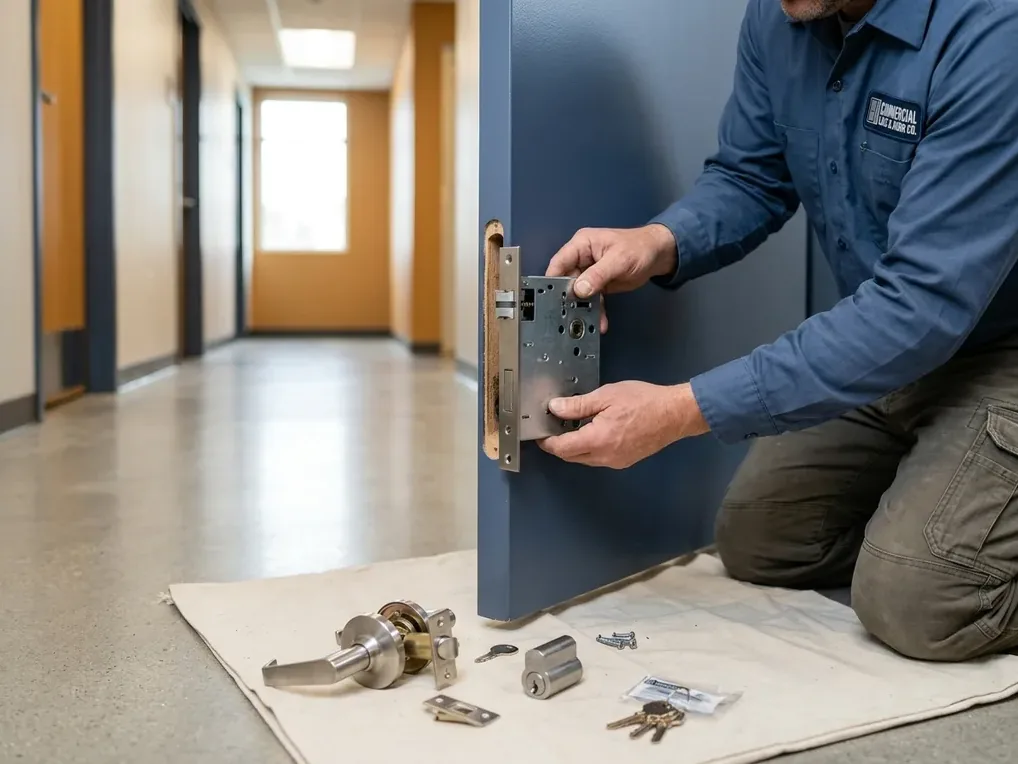
When the lever sags and the latch stops catching
The lever on a main entry drops a few degrees below level. The latch stops catching every time.
Staff start reporting that the door "sticks," then somebody puts a wedge under it. On a door that cycles all day, that is usually a mortise lock at the end of its service life, or a bored lock that was never the right choice for that opening.
We install, retrofit, repair, and rekey mortise locks on commercial openings across San Diego County: offices and business parks off the 805 corridor, medical and dental suites, schools, warehouses, and restaurant back-of-house. Most facilities managers call about one bad door and end up standardizing a building.
A mortise lock does its work inside a machined pocket in the door edge. One steel case carries the latch, the deadbolt, the hubs, and the springs, anchored at the faceplate with the trim through-bolted around it. That construction is why mortise hardware holds up on high traffic openings, and it is also why this is door work rather than a lock swap. Pocket dimensions, door thickness, handing, function, cylinder cam, and trim all have to line up before anything gets ordered.
Why mortise outlasts cylindrical on a high traffic door
A cylindrical lock carries everything in a chassis living inside a 2-1/8 inch cross bore. Every bag hung on the lever and every shoulder into the door puts that load on one hole and two through-bolts.
In wood doors the bore elongates. In hollow metal, the chassis works loose and the lever travels farther and farther before the latch moves.
A mortise case spreads the same job across the whole edge of the door. Latch and deadbolt are separate mechanisms in one housing, the hubs are typically independent so a failure on one side does not take the other with it, and the case is serviceable. Spring cages, hubs, and trim are replaceable parts.
Openings where the extra prep pays for itself:
- Main entries and vestibule doors in constant use
- Stairwell and corridor doors working against a closer all day
- Rooms that need a deadbolt and a latch in a single lock body
- Doors that need specific behavior, such as always locked outside with free egress inside
- Openings that may be electrified later without new door prep
- Doors already prepped for mortise, where a bored conversion would be a downgrade
Function codes: pick the behavior, then the part number
Most hardware complaints we hear on a walk are not broken locks. They are the wrong function.
The door people keep propping is usually an entry function that somebody has to remember to lock. The door that gets locked by accident on a Saturday usually has an inside turn it should never have had.
ANSI/BHMA A156.13 publishes function numbers for these behaviors, but catalog suffixes are not consistent between lines. A Schlage L9000 series, a Sargent 8200, a Corbin Russwin ML2000, a Yale 8800, and a Best 45H will all do the same job under different part numbers, keyways, and trim. We confirm the behavior in plain words at the door, then order to that.
Free egress is not negotiable in any of them. The inside lever has to retract the latch in one motion, with no key, no special knowledge, and no second operation. On cases with a deadbolt, the inside lever pulls the bolt and the latch together. That rules out several combinations people ask for.
- Passage: latch only, no cylinder, both levers always free. Corridor doors, closets, doors that never lock.
- Entry or office: outside lever locked and unlocked by key, often also by a thumbturn or a toggle button in the case face. Convenient, and dependent on somebody remembering.
- Storeroom: outside lever always rigid, key retracts the latch, inside lever always free. The right default for IT closets, electrical rooms, stock rooms, and mechanical spaces.
- Classroom: key locks and unlocks the outside lever from the corridor, no inside turn, so the room cannot be locked from within by accident. Classroom security versions add an inside cylinder so the outside lever can be secured without stepping into the corridor.
- Dormitory or apartment: deadbolt with an inside turn, outside lever released by key.
- Privacy: inside turn with an outside emergency release, for single occupancy restrooms and similar rooms.
Retrofits, pocket prep, and doors you should not cut
Going from a bored lock to a mortise lock means routing the edge for the case, drilling for the spindle and through-bolts, drilling for the cylinder, and mortising for the faceplate.
The old 161 prep, a 2-1/8 inch cross bore on a 2-3/4 inch backset, sits inside the footprint of most escutcheon trim. Sectional trim will not cover it, and a wrap plate is a patch rather than a fix.
Mortise to mortise is the easy case. Pocket depth, door thickness, backset, and faceplate size usually line up across the major lines, so a tired case comes out and a current Grade 1 case goes in with new trim and a cylinder keyed to your system. That is a short interruption at one opening.
What the door is made of decides the rest:
- Solid core wood: the lock block has to be deep enough for the case. Plenty of flush wood doors are blocked for a bored prep only, with nothing behind the veneer to hold a pocket.
- Hollow metal: field mortising is possible with the right jig, and the internal reinforcement decides whether it is worth doing. Sometimes the honest answer is a factory prepped replacement leaf.
- Narrow stile aluminum storefront: a standard mortise case does not fit. Those openings take narrow backset hardware on 31/32 or 1-1/8 inch backsets, deadlatches and MS style deadlocks, which is different work.
- Fire rated doors: the label covers the assembly as it was tested. Cutting a new pocket in the field falls outside listed limits and gets written up on an NFPA 80 inspection. On labeled openings we spec a listed lock that fits the prep the door already carries.
Trim, cylinders, and keying it into the building
The case is half the order. Trim decides how the door feels and whether it survives an accessibility review.
Levers have to operate with one hand, without tight grasping or wrist twisting, mounted within the height range the code allows. A lever that returns toward the door face is worth specifying anywhere carts, gowns, or bags go past. Escutcheon trim covers more of the face and hides old prep. Sectional trim looks lighter and hides nothing.
Mortise cylinders thread into the case and drive it through a cam, and the cam has to match the lock line. A cylinder that fits the hole and turns freely will still fail to retract a latch with the wrong cam on the back. Length matters too. Cylinders step in 1/8 inch increments, and with the right collar or spacer the face sits close to flush so nothing can get a grip on it. Small format and large format interchangeable core housings let you rotate cores without opening the lock.
Keying is where a property gets simpler or gets worse. Mortise cylinders drop into an existing master key system, or move to a restricted keyway so keys are cut on record instead of at a hardware counter. Mixing keyway families building by building is what produces the ring of thirty unmarked keys in the maintenance desk.
How mortise locks fail, and what we usually find
These doors almost always give warning before they strand somebody. What gets reported as "the lock broke" is usually one of a short list, and several items on that list are parts repairs rather than replacements.
- The lever sags below level. Worn spring cage or hub bushing, sometimes trim that was never through-bolted.
- The latch stops holding. The anti-friction tongue or auxiliary deadlatch is missing the strike lip because the door settled on its hinges or the strike shifted. Alignment first, hardware second.
- The deadbolt binds. Frame movement, hinge wear, or a strike box packed with debris. Coastal openings pick up salt and grit and stiffen up.
- The key turns and nothing retracts. Broken hub, sheared spindle, or the wrong cylinder cam.
- The lock feels gritty. Cleaning and a dry lubricant. Oil collects dust and makes it worse within a month.
- The closer overpowers the latch. Latch speed and backcheck out of adjustment, so the door bounces off the strike and never catches.
- The function is wrong and the staff have already voted. A wedge under a door is a hardware spec problem, not a discipline problem.
- Electrified mortise locks add failure points: transfer hinge or door loop wiring, a dead solenoid, or a fail-safe versus fail-secure choice that does not match what that opening is supposed to do when the alarm sounds.
The walk, the quote, and keeping the building open
Mortise work is quoted per opening, because openings are not interchangeable. Two doors ten feet apart can need different cases, different trim, and different functions.
From the survey you get a written quote per door with hardware and labor separated, so you can approve one floor, one suite, or one problem door without committing to the rest. Some finishes, functions, and electrified options are order items rather than stock, and we tell you which ones those are before a date is set.
Scheduling is built around your operations. Doors on a patient corridor, a kitchen line, or an occupied tenant suite get staged so one opening is apart at a time and every door is secure before we leave it, and work can run outside business hours. If your building requires vendor onboarding, a purchase order, or compliance paperwork before the dock is booked, say so at the walk so the paperwork moves while hardware is on order. Accounts get one point of contact and a keying record kept on file.
The survey is short and it is what the number is built from:
- Door count, location, and floor
- Handing: left hand, right hand, left hand reverse, right hand reverse
- Door material, thickness, and existing prep
- Existing lock line and whether the pocket is a standard size
- Frame type, strike condition, and whether the closer needs attention
- Fire label on the door and on the frame
- Required function for each door, written in plain language
- Keyway, existing master system, and finish
Commercial work is quoted per job, never off a price list. These are the factors that make a quote larger or smaller:
- Number of openings and whether they can be completed in one mobilization
- Whether the door is already prepped for a mortise pocket or needs new prep
- Door construction: hollow metal, solid core wood, or narrow stile aluminum
- Function and trim selection, escutcheon versus sectional, mechanical versus electrified
- Cylinder and keyway, including interchangeable core, restricted keyways, and joining an existing master system
- Fire label status, frame and strike work, closer adjustment, after-hours or tenant coordination
Where we run mortise locks
Sagging levers and worn cases turn up in UTC office towers, Kearny Mesa and Mission Valley suites, and the stairwell doors of Miramar and Otay Mesa warehouses.
Common in these buildings
Storeroom function on office IT closets, classroom function on school doors, and one keyway family across a manager's portfolio are the mortise jobs these buildings generate.