Commercial Door Closers in San Diego County
Door closers control how a commercial door swings shut so it latches instead of slamming or standing open. Commercial Lock & Door Co. adjusts, repairs, and replaces surface, concealed, and floor closers on commercial buildings across San Diego County.
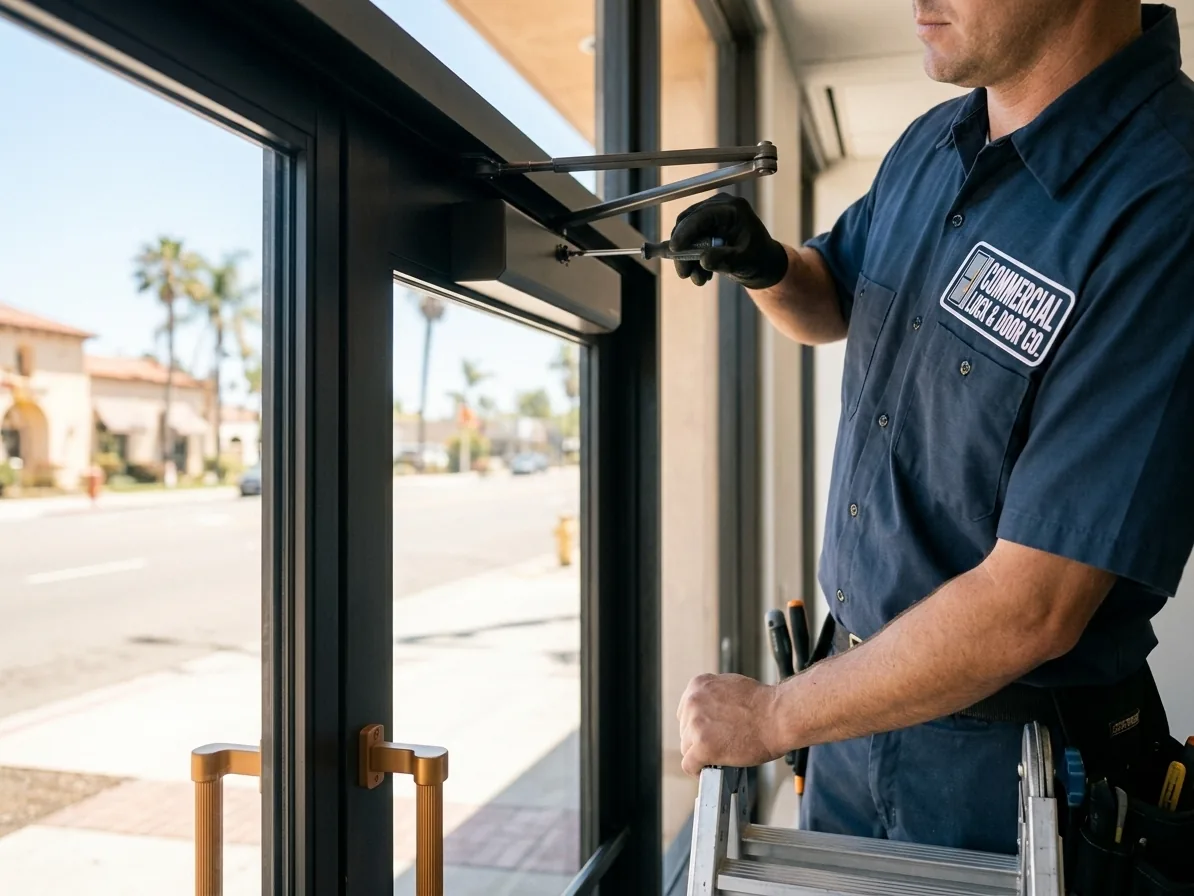
When a door slams all day or stops an inch short
The front door slams hard enough that the person at the desk looks up every time, or it drifts to within an inch of the strike and stops there, so the suite sits unlocked overnight.
Somebody has already turned the screws on the side of the closer. That is usually where the call starts.
We adjust, repair, and replace surface mounted, concealed, and floor closers on hollow metal, aluminum storefront, and wood doors across San Diego County. Some of that is valve work with a hex key and a force gauge. Some of it is rebuilding a top jamb that has been drilled and redrilled by whoever came before.
A closer takes more cycles and less attention than anything else on the opening. It absorbs every delivery cart, every propped door, every afternoon gust up the canyon. When it goes, the door stops latching, the exit device stops securing the opening, and on a fire rated opening the assembly stops doing what the label says it does.
Read the symptom before you touch a valve
Most closers get diagnosed from the doorway. The way a door moves through its arc names the part that failed, and the sound it makes at the strike says whether the problem is power, timing, or drag.
A closer complaint is not always a closer problem. Hinge and pivot condition, door sag, weatherstrip drag, and strike alignment get checked before anyone quotes a new closer, because a new body bolted over a dragging sweep behaves the same way the old one did.
- Slams the last few inches: latch speed valve open too far, or spring tension cranked up to force the door shut against drag it should not be fighting.
- Stops an inch short and never latches: spring size too light, a dragging sweep or gasketing, a bound hinge, a misaligned deadlatch strike, or building pressure working against the swing.
- Oil film on the door face or a drip down the frame: the pinion seal is gone. Fluid is what the valves meter, so once the volume drops, no setting holds.
- Hangs open near ninety degrees: sheared spindle, stripped arm splines, or an arm bent after the door was kicked or blown past its stop.
- Sluggish on a cold morning and quicker by a warm afternoon: closer fluid thickens as it cools and thins as it warms. A temperature stable body holds its setting through that swing. A worn or low grade one does not, which is why an exterior door tuned in the heat of the day can fail to latch at opening.
Arm type and mounting decide how the door behaves
The arm itself is a specification. A cush or stop arm builds a dead stop into the arm and protects an opening with no floor stop, though on a heavy exterior door catching wind it is no substitute for an overhead stop.
A hold open arm is fine on a stockroom. It does not belong on a fire rated opening unless it is an electromagnetic hold open released by the alarm. Narrow top rails, deep reveals, and blade stops call for drop plates, spacers, or brackets, so those get measured at the quote stage instead of discovered at the door.
Three standard mountings cover most surface closers, and the choice is not cosmetic. Each one changes the leverage the arm has on the door, which changes the spring size needed to close it.
- Regular arm: body on the pull side, arm projecting into the opening. The most efficient of the three, so the smallest spring for a given door, and the most exposed in a busy corridor.
- Top jamb: body on the push side, on the face of the frame head. The choice when the pull side is blocked by a transom or a ceiling condition, and common on aluminum entrances with a narrow top rail.
- Parallel arm: body on the push side of the door, arm folded back along the door face, shoe on the frame soffit. Lowest profile and the most abuse resistant. It gives up efficiency, so the spring usually steps up to hold the same closing power.
Spring size, valves, and ADA opening force
Closers are sized against door width, weight, and exposure. Most current bodies are non-sized, with a spring tension adjuster covering part of that range, but a light body wound to the top of its range on a wide exterior door will never behave.
An interior office door, an aluminum entrance facing an onshore breeze, and a stairwell door on a pressurized shaft are three different sizing problems, and the same model number solves none of them by itself.
Sweep and latch speed are separate valves, and nearly every closer adds backcheck. Sweep controls the long part of the arc. Latch speed controls the final degrees of the swing, which is what drives the deadlatch into the strike. Backcheck cushions the door late in the opening swing so a gust does not throw it into the wall, and it is a cushion, not a stop. Delayed action holds the door open longer at the top of the arc, which matters where carts move through. Valves move a quarter turn at a time and never get backed past their stop, since a valve run all the way out can eject and dump the fluid.
Opening force is where accessibility and latching argue. The limits come from the accessibility standards and the California Building Code, they are not the same for an interior hinged door as for an exterior one, and a fire door is allowed the force it needs to latch positively. The standards also set a minimum sweep period, timed from the open position toward the latch, so the door cannot close faster than a person can clear it. We read the door with a gauge and a stopwatch against what the authority having jurisdiction enforces on that building, not against a number off a website. When a door fails a force reading, backing off spring tension is the last move, not the first. The extra pounds usually come from a compressed gasket, a dragging sweep, a bound hinge, or a strike fighting the latch, and a closer wound down to pass a gauge is a closer that will not push the deadlatch home on a windy afternoon.
Stripped top jambs and doors that will not hold a closer
Sometimes the closer is fine and the holes are not. The body still meters, the arm is straight, and the whole assembly is working loose off the door every time somebody pushes through.
A hollow metal door carries a reinforcement channel welded inside the face for this hardware. Once those threads pull, the fix is to drill and tap oversize, or to run sex bolts through the door with a plate spreading the load. On aluminum storefront the closer often lands on a top rail or header tube with very little metal holding a machine screw, and after two or three replacements there is nothing left to bite. A tube filler, a reinforcing plate, or a bracket mount is the honest repair. Setting a new closer into wallowed out holes with longer screws does not repair anything. It moves the next failure down the road and usually takes more of the door with it.
Frame soffits tear the same way where a parallel arm shoe was ripped loose by somebody kicking the door open, and a knock down frame gives less to work with than a welded one. On aluminum doors, check the corner joinery first. Loose tie rods let the door rack and drop, the closer fights the geometry, and no valve work fixes that.
Concealed closers, floor closers, and fire rated openings
Concealed units come in three families.
Concealed-in-door closers sit inside the top rail and drive an arm in a track in the frame head. Concealed overhead bodies mount in a pocket in the head with a track and roller arm. Floor closers live in a cement case on center hung or offset pivots and carry the weight of the door as well as closing it, which is why they sit under all glass entrances. All of it is templating work: pockets, cases, and cutouts are model specific, so the existing prep decides whether the job is a swap or a fabrication.
Floor closers at grade level have their own failure mode. Cases collect water, the spindle seal corrodes, and the unit seizes or leaks. Replacing one means pulling the door, opening the case, and sometimes chipping concrete to fit the new body, so the opening is down longer than a surface swap and gets scheduled that way.
Fire rated openings limit field work. NFPA 80 allows only limited job site preparation for surface applied hardware, and routing a new pocket for a concealed closer in a labeled door or frame is not part of it. A fire door has to self close and positively latch from the fully open position, hold open arms are out unless they release on the alarm, and the closer cannot be detuned below what makes the door latch just to pass a force reading.
How closer work gets quoted and scheduled
Photos start the triage and the walkthrough sets the number. We count openings and note door type and handing, existing mounting and arm style, spring size where it is readable, condition of the prep, and whether the opening is labeled.
Quotes come back per opening, so a property manager can release the six doors that matter this quarter and hold the rest.
Across a portfolio, standardizing on one closer family pays. Covers match, arms and drop plates interchange, spare parts sit on one shelf instead of five, and any tech at the door knows which valve is which.
Most of this work happens without closing the space, and what cannot be done live runs before opening, after close, or on a weekend for retail, restaurants, and clinics. Onboarding paperwork, PO numbers, tenant notification, and net terms get handled when the account is set up, so the next call is a text message and a date.
Commercial work is quoted per job, never off a price list. These are the factors that make a quote larger or smaller:
- Number of openings handled on one visit. Six doors in a single trip carries less labor per door than six separate calls to the same address.
- Whether the closer can be adjusted, needs its mounting rebuilt, or needs full replacement.
- Surface mounted versus concealed overhead or floor closer. Concealed work is templating work, and a floor closer means pivots, a case, and the door off its pivots.
- Condition of the substrate. Stripped reinforcement, a torn frame soffit, or a sagging aluminum door adds labor and material before the closer goes on.
- Arm and accessory requirements: cush arm, hold open, drop plate, blade stop spacer, overhead stop, or an electromagnetic hold open tied to the fire alarm.
- Access and timing. After hours, weekends, secured floors, a lift for a high transom, and tenant coordination all move the labor.
Where we run door closers
Tower lobbies in UTC, aluminum entrances in Mission Valley, and warehouse man doors in Otay Mesa each call for their own spring size and arm style.
Common in these buildings
Suite entries that stopped latching after hours, street doors kicked open all day, and portfolio punch lists of slamming doors are where most closer calls start.