Electric Strike Installation and Service for Commercial Doors
Electric strikes release a door's latch from a badge reader, keypad, intercom, or desk button. Commercial Lock & Door Co. installs, replaces, and repairs fail-safe and fail-secure strikes on commercial doors across San Diego County, matched to the lock, the frame, and the power feeding the coil.
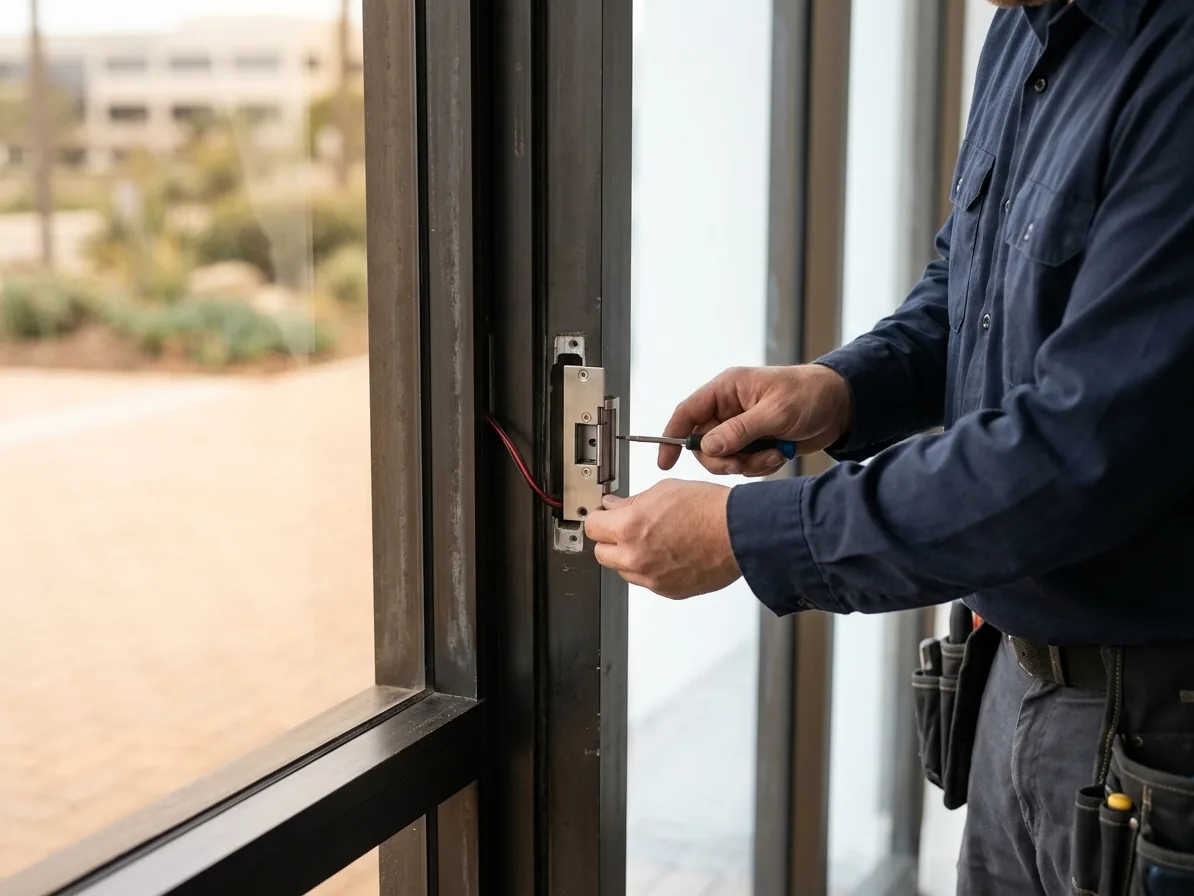
When a door has to release from a desk or reader
A door that used to be opened by hand now has to release from a front desk, a keypad, or a badge reader.
Or the strike you already have buzzes and does not let go, and staff have learned to shoulder the door at exactly the right moment. Either situation lands in the same place: an electric strike that matches the latch, a frame prepped to hold it, and power that can actually carry the coil.
Strikes look simple from the outside. A keeper pivots or slides, the latch is released, the door pulls open. Most of the failures we get called out on are not the strike itself. They are a strike that was never right for that latch, a jamb pocket cut without clearance behind it, a coil fed from an auxiliary output that cannot handle inrush, or a fail-safe unit sitting on a fire-rated opening where it does not belong.
We work both sides of electronic entry. Through our access control installation work we can design, supply, and install the whole system, readers, controllers, and credentials included, with the strike as one piece of it. And if an integrator already owns the panel, we build to the contact it hands us and stay coordinated with them.
Fail-Safe and Fail-Secure Are Not Interchangeable
Fail-secure means the keeper stays locked when power is removed, so the strike has to be energized to release. Fail-safe means the opposite.
Cut power and the keeper is free. Which one an opening gets is decided by the opening, not by preference. Egress settles most of it. A fail-secure strike traps nobody. The lever or the exit device on the inside retracts the latch mechanically regardless of what the strike is doing, so people leave normally during an outage. That is why the majority of exterior and tenant suite doors are fail-secure. Fail-safe belongs on openings that are meant to release on alarm, and that release gets wired through the fire alarm relay rather than left to whatever unplugs first.
Fire-rated openings are the hard line. A fire door has to stay positively latched, which rules out a fail-safe strike and requires labeled fire-rated hardware. The label also rules out field modification of the frame or the door to make something fit.
Duty rating is a real spec. A continuous-duty coil is built to sit energized; an intermittent-duty unit held energized will cook itself. Many current strikes are field-selectable between the two functions with a jumper or a reversible solenoid plate, which is convenient and also easy to leave set wrong.
The Strike Has to Match the Lock, Not Just the Door
An electric strike releases a latch. It cannot release a deadbolt.
If a storefront door is secured with an MS-style deadbolt, no strike will change anything until that hardware becomes a deadlatch or the opening moves to electrified lock hardware. After that it is about what the latch looks like. An aluminum storefront deadlatch has a short throw and a small auxiliary plunger that has to ride the strike face. If that plunger drops into the keeper pocket, the anti-shim function is gone and the door can be loided with a piece of plastic. A cylindrical lockset throws about a 1/2 inch latch, a mortise lock about 3/4 inch, and an aluminum storefront deadlatch about 5/8 inch, so keeper depth and lip length get matched to the actual latch rather than to the door type. A mortise lock needs a mortise-style strike with the correct cutout, the right lip, and clearance for the auxiliary deadlatch above the main latch. A rim exit device needs a rim strike built to catch a Pullman latch.
Vertical rod devices, surface or concealed, are a different problem. They latch at the head and the sill, so there is no jamb latch for a strike to hold. Those openings get electric latch retraction, not a strike, and anyone who quotes a strike on one has not looked at the door.
Two details get skipped constantly. Lip length, measured from the centerline of the stop to the face of the door, so carts and foot traffic do not catch it. And preload. A door leaning on the strike from closer pressure, weatherstripping, or building stack pressure will not release unless the strike is rated to work under load.
Frame Preparation Is Where These Jobs Go Wrong
Cutting the jamb is the irreversible part of the day. Aluminum storefront framing is hollow tube with limited room behind the face for the strike body and the wire loop, which is exactly why narrow-frame strikes exist.
Choosing the faceplate width before the cut is the difference between a clean install and a patched jamb someone stares at for the next decade.
Hollow metal frames give you more room, though plenty of them in San Diego are grout filled, especially in masonry and older tilt-up stock out toward Miramar and Otay Mesa. Grout has to come out of the pocket and the cavity has to be boxed back so the strike seats flat and the conductors have somewhere to live. That is die grinder work and it takes longer than the cut sheet suggests.
Wire routing gets planned before anything is opened up. The run leaves the strike through a grommeted hole, travels the frame cavity across the header or up a mullion, and comes out near the power supply. Where a frame is sealed or filled solid, surface raceway or a jamb transfer is the honest answer instead of forcing a path that will chew the jacket.
We check the existing prep first. A frame that already carries an old strike cutout will often accept a new unit with a filler plate, which keeps the opening quieter and the visit shorter.
Power Is Half the Install
A strike is a coil. It pulls an inrush current the instant it energizes and settles to a lower holding draw.
Sizing a supply to the holding number and ignoring inrush is the most common reason a reader reboots or a keypad drops out every single time somebody badges in.
Strikes get fed from a dedicated low-voltage supply, filtered and regulated for DC units, rather than from an auxiliary output on the entry panel. DC is silent. AC gives you the classic buzz that some front desks want as feedback, and that buzz should be a decision, not an accident of what was on the truck that morning.
Distance matters. A long run on undersized conductors drops voltage until the strike chatters instead of releasing cleanly, and that failure shows up intermittently, which is worse than a dead one. We size the conductor to the run, put suppression across the coil so relay contacts survive, and label both ends so the next person is not tracing.
Battery backup deserves a moment of thought before it is specified. A fail-secure opening on backup stays locked and stays usable by key. A fail-safe opening on backup keeps drawing the entire time, which eats the runtime you paid for.
Tying Into the Entry System You Already Have
Most buildings already have something: a reader panel in an IDF closet, a keypad at the suite door, a video intercom at the gate, a telephone entry board in the lobby, a button under the reception counter.
All of them end at the same thing, a relay contact that closes for a moment, and we are happy to start our scope right at that contact.
What the opening usually needs around the strike is short. A request-to-exit device so the door does not report forced open when somebody simply leaves, either a switch in the lever, a switch in the exit device rail, or a motion sensor mounted on the secure side. A door position switch, recessed or surface, so held-open and forced conditions actually report instead of going unnoticed. On a fail-safe opening, a fire alarm relay so release happens the way the drawings say it should.
If an integrator owns the panel and the credentials, we stay on our side of the demarcation and coordinate with them. If the decision has not been made, we can quote the full system ourselves, or prep the jamb, set the strike, install the power supply, and leave a home run waiting for a platform you pick later.
Scheduling, Access, and Getting a Number in Hand
Electric strike work starts with a site visit. We need to see the frame material, the lock that is on there now, whether the opening is fire rated, where power can come from, and what the existing entry device gives us for a contact.
Photos help for triage, but jamb depth and preload are things you confirm standing at the door.
Cutting a jamb makes noise and dust. Lobby doors, suite entries, and clinic doors usually get scheduled early, after hours, or on a weekend so tenants, staff, and patients are not walking through the work. On a main entrance we plan how the opening stays secured and usable while it is apart, including how it locks at close of business if the work carries over.
Quotes are written per opening and itemized so hardware, power, and labor are visible separately rather than buried in one line. If your process requires vendor paperwork before anybody mobilizes, a PO number or net terms, tell us at the start and we will route it. For a portfolio of buildings, we would rather open an account once and keep the hardware records than requote the same door a year from now.
Commercial work is quoted per job, never off a price list. These are the factors that make a quote larger or smaller:
- Frame material and condition. Aluminum storefront tube, hollow metal, and grout-filled masonry frames are three different amounts of labor.
- Whether the existing prep can be reused or the jamb needs a fresh cutout and a filler plate.
- The lock already on the door. A deadbolt has to become a deadlatch before any strike does anything.
- Distance from the opening to power, and whether a wire path exists or raceway has to be run.
- Fire-rated openings, which require labeled hardware and rule out field modification.
- Number of openings on the visit, and whether the work has to happen after hours around tenants.
Where we run electric strikes
Downtown storefront jambs, Poway and Carlsbad business park suites, and Sorrento Valley lab entries all get the same frame and power check before a strike goes in.
Common in these buildings
Lobby buzz-in from a reception desk, suite doors on a reader, and clinic entries scheduled around patient hours are where strikes land.