Electrified Door Hardware Installed and Serviced in San Diego
Electrified door hardware is the door side of a card access system: electric strikes, electrified locks, latch retraction, power transfer, and REX devices. Commercial Lock & Door Co. installs and services these openings, on our own access control systems or under an existing integrator platform.
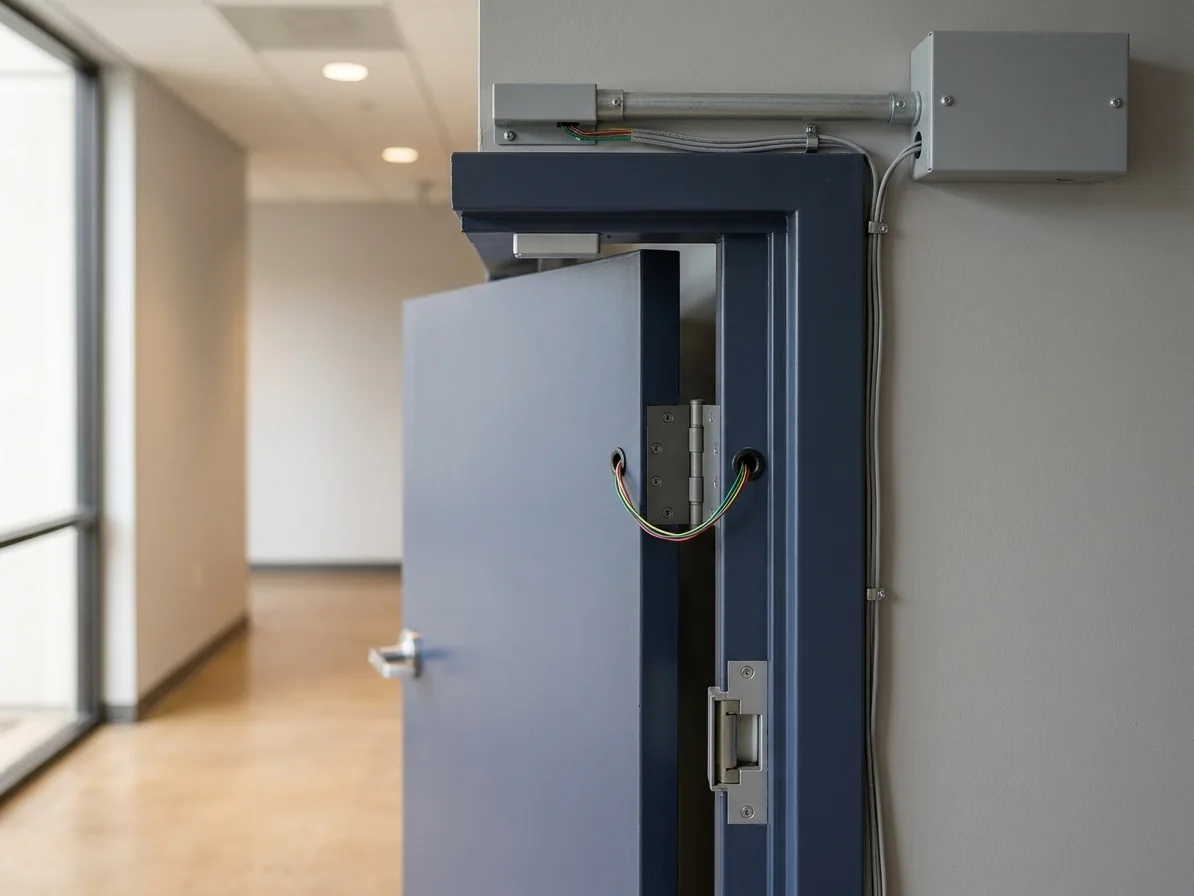
The hardware that makes a credential actually unlock the door
The readers are mounted, the panel is in the IT closet, and the software licenses are paid for.
What is not done is the door itself: the strike that has to release under load, the lever that has to unlock without buzzing, the wire that has to get from a fixed frame into a moving leaf and survive years of cycles. A lot of card access vendors terminate at the panel and stop at the frame. We do not stop there, whether the system is ours or theirs.
Commercial Lock & Door is a door contractor, commercial locksmith, and access control installer. We install and service the electrified hardware your credential system operates: electric strikes, electrified mortise and cylindrical locks, electric latch retraction exit devices, power transfer hinges and loops, request-to-exit devices, door position switches, and the power supplies behind all of it. We also design and install complete access control systems, readers and controllers included, and we are just as happy installing the door scope under a platform you already bought. Either way, we make the openings work.
We cover San Diego County: tenant floors downtown, lab and office space in Sorrento Valley, business parks off the 15 in Kearny Mesa, distribution buildings out toward Otay Mesa. Integrators bring us in for the door scope on a project. Facilities and IT teams call us when an opening has started misbehaving and nobody can say whether the problem is the head end or the hardware.
What we install at the opening
Our scope starts at the opening and works outward.
If the design calls for a credential to unlock a door, something mechanical has to move, and that something has to be specified to the actual frame, leaf, and latch in front of you rather than to a generic line on a submittal.
Common scope on these jobs:
- Electric strikes for hollow metal, aluminum storefront, and wood frames, matched to the existing latch projection and frame prep instead of whatever shipped in the box.
- Electrified mortise locks and electrified cylindrical levers, including monitored functions and latch or lever status switches.
- Electric latch retraction on rim, surface vertical rod, and concealed vertical rod exit devices, solenoid or motorized.
- Power transfer: electric hinges, concealed transfer devices in the frame, and surface door loops where a leaf will not take a concealed run.
- Request-to-exit switches built into the pushpad or lever, and ceiling motion sensors where the hardware cannot carry a switch.
- Door position switches, concealed in the frame or surface mounted, wired so the loop reports the door and not the weather.
- Power supplies, distribution boards, fire alarm relay tie-ins, and battery backup where the design calls for it.
- Magnetic locks, on the openings where the egress arrangement genuinely supports one.
Fail-safe vs fail-secure, and the egress question underneath both
Fail-secure means the door stays locked when power drops. The inside lever or pushpad still retracts the latch, so egress is mechanical and never depends on electricity.
Fail-safe means the door unlocks when power drops, which is what you want on stairwell re-entry and on a handful of interior doors, and exactly what you do not want on a suite entry during a Sunday outage. When a call starts with "the door was unlocked all weekend," fail-safe hardware sitting on a circuit that dropped is one of the first things we go looking for.
Fire-rated openings narrow the choices fast. A labeled assembly has to positively latch, so a fail-safe strike, a maglock standing in for the latch, or panic hardware left dogged all defeat the label. Electric latch retraction on a fire-rated exit device has to drop out on alarm so the latch re-projects, which means the fire alarm relay is part of the hardware scope, not an afterthought. Field modification is its own trap: drilling a labeled frame or leaf for a strike pocket or a transfer device outside the listing voids the label, and an inspector who sees fresh grinding on a labeled edge will write it up.
Magnetic locks carry the heaviest baggage because there is no latch at all. Egress depends entirely on release, which is why they get built with a sensor plus a pushbutton plus an alarm interface, and why they draw scrutiny that a fail-secure strike never does. When an opening can be solved with a latch, we solve it with a latch.
The door decides what hardware fits
Narrow stile aluminum storefront is the most common surprise.
A 1-3/4 inch leaf with a narrow stile will not take a mortise lock, so the realistic paths are a rim exit device with latch retraction, an electrified narrow stile lock, or a strike in the jamb working against a deadlatch. On a storefront deadlatch, the auxiliary plunger has to rest on the face of the strike, not fall into the keeper pocket. When it drops in, the latch can be shimmed and the door binds every time the frame moves in the heat.
Hollow metal is friendlier but still needs verification: throat depth, whether the frame is grout filled, whether there is a removable mullion carrying the strike, and whether the existing prep is a standard 4-7/8 inch face or something a previous contractor improvised. Handing, bevel, and backset all have to be confirmed at the door rather than assumed from a floor plan, and a continuous hinge needs a different transfer solution than a butt hinge with a listed electric hinge cutout.
Door closers matter more on electrified openings than people expect. The last few degrees of swing are what put the bolt into the keeper, and that comes down to latch speed and to whether the closer has the spring size for the door it is hung on. A lobby vestibule under stack pressure will stop an underpowered closer just short of latching. Backcheck is a different adjustment entirely: it cushions the door on the opening swing to protect the leaf and the wall, and turning it up does nothing for a door that will not latch. When the opening does not close all the way, the panel reports a door that is closed and unlocked, or a strike that never gets a chance to relock, and the hardware takes the blame for an adjustment problem.
Failure modes that get blamed on the system
Before the software takes the blame, the opening is worth ruling out, because the mechanical and electrical conditions at the door can be measured and adjusted directly. These are the patterns we see over and over:
- Preload. The closer or wind pushes the door against the keeper and the solenoid cannot overcome the side load. Classic symptom: it works fine until someone leans on the door.
- Voltage drop. A 12VDC device at the end of a long, thin run from a closet reads fine at rest and starves under load. The strike hums and never releases.
- Inrush. A latch retraction exit device pulled by an undersized supply browns out the circuit. The fix is a supply rated for the inrush, or motorized retraction instead of solenoid.
- Coil type. An AC strike buzzes by design. A DC strike that buzzes is usually being fed ripple from a poor supply or a shared, overloaded circuit.
- Transfer wire fatigue. Hinge and loop conductors flex at the leading edge every cycle and eventually crack. Intermittent unlock on one door and only one door is very often the loop.
- Door position switch gap. A sagging leaf or a bent frame widens the magnet gap past the switch rating, and the door reports held open while standing closed.
- Strike alignment. The keeper and the latch drift out of line as the building moves, so the latch catches on the lip instead of seating.
- Dogged or overridden hardware. A pushpad left mechanically dogged makes every credential look like it worked, because the door was never latched.
Working alongside integrators and IT
When we install the full access control system, there is no split to manage: panel, readers, credentials, and door hardware are one scope and one contractor.
When another party owns the head end, the cleanest jobs are the ones where the scope split is written down before anyone shows up. Typically the integrator or the IT team owns the panel, the readers, the credentials, and the terminations at the head end. We own the opening: hardware selection against the actual door, the prep, the transfer, the strike or lock, the REX and position switch at the door, and the mechanical adjustment that makes the whole thing repeatable. Where the wire is pulled and who lands it at the panel is a conversation, not an assumption, and it is worth having at the walkthrough.
In occupied buildings, cutover is its own piece of planning. An opening that is torn apart is a security problem the moment the crew leaves, so the work gets sequenced to put each door back mechanically secure and operable before the end of the shift, even if the electrified function is not live yet. Where an opening cannot be closed out that way, we call it out before the work starts so the building can plan coverage instead of finding out at the end of the night. Tenant floors, labs with clean areas, and medical suites usually need work scheduled outside operating hours, and building access rules tend to decide the schedule more than the hardware does.
When we finish, you should be able to hand the next person a list of what is on each opening: door number, hardware model and function, fail-safe or fail-secure, power source, and what the REX and position switch are actually wired to. A door schedule that reflects reality is worth more on the next service call than any amount of guessing.
Surveys, scheduling, and how a quote comes together
Quoting electrified work from a spreadsheet is how projects go sideways.
We survey the openings: frame type and material, handing and bevel, existing preps, latch and strike condition, closer function, what power exists nearby, what the system side expects to see, and whether the opening carries a fire label. Photos and door numbers from your side speed this up, and a copy of the integrator's device list helps more than a floor plan does.
The quote comes back per opening so you can phase it. Some buildings do the main entries and the server room first and pick up interior doors on the next budget cycle. Some hardware is stock and some is not, especially electrified mortise locks in a specific finish, function, and keyway, so lead time gets called out where it applies rather than discovered later.
If your property manager runs a vendor portal, or the building requires vendor paperwork, badging, or an escort after hours, send that at quote time so it does not stall the schedule. Once an account is open, ongoing work can run on purchase orders and standard terms, which is usually simpler for everyone than a new approval for every service call.
Commercial work is quoted per job, never off a price list. These are the factors that make a quote larger or smaller:
- Number of openings, and whether they repeat with the same frame, handing, and hardware or each one is different.
- Door and frame type, since an existing standard strike prep in hollow metal is straightforward and a narrow stile aluminum leaf needing new prep is not.
- Whether power already exists at the opening or a transfer, raceway, and supply have to be added.
- Hardware grade, function, finish, and keyway, from a stock fail-secure strike up to a Grade 1 electrified mortise lock in a restricted keyway.
- Fire label status, which limits field modification and can push the work toward listed hardware or a shop-prepped frame or leaf.
- Access conditions: occupied tenant space, after hours work, escort or badging requirements, and ceiling access above a hard lid.
Where we run electrified door hardware
Strikes, latch retraction, and transfer wiring go into UTC tenant floors, Kearny Mesa business parks, Mission Valley suites, and Miramar and Otay Mesa distribution buildings.
Common in these buildings
Card-controlled suite entries, lab doors with clean areas behind them, and base building doors a tenant's card system has to operate are where this hardware turns up.