New Aluminum Storefront Entrances for San Diego Businesses
Commercial Lock & Door Co. supplies and installs new aluminum storefront entrance doors and complete framed entrances across San Diego County. Stile width, hinging, glazing, and the lock get chosen up front so the door survives its traffic and can take access control later.
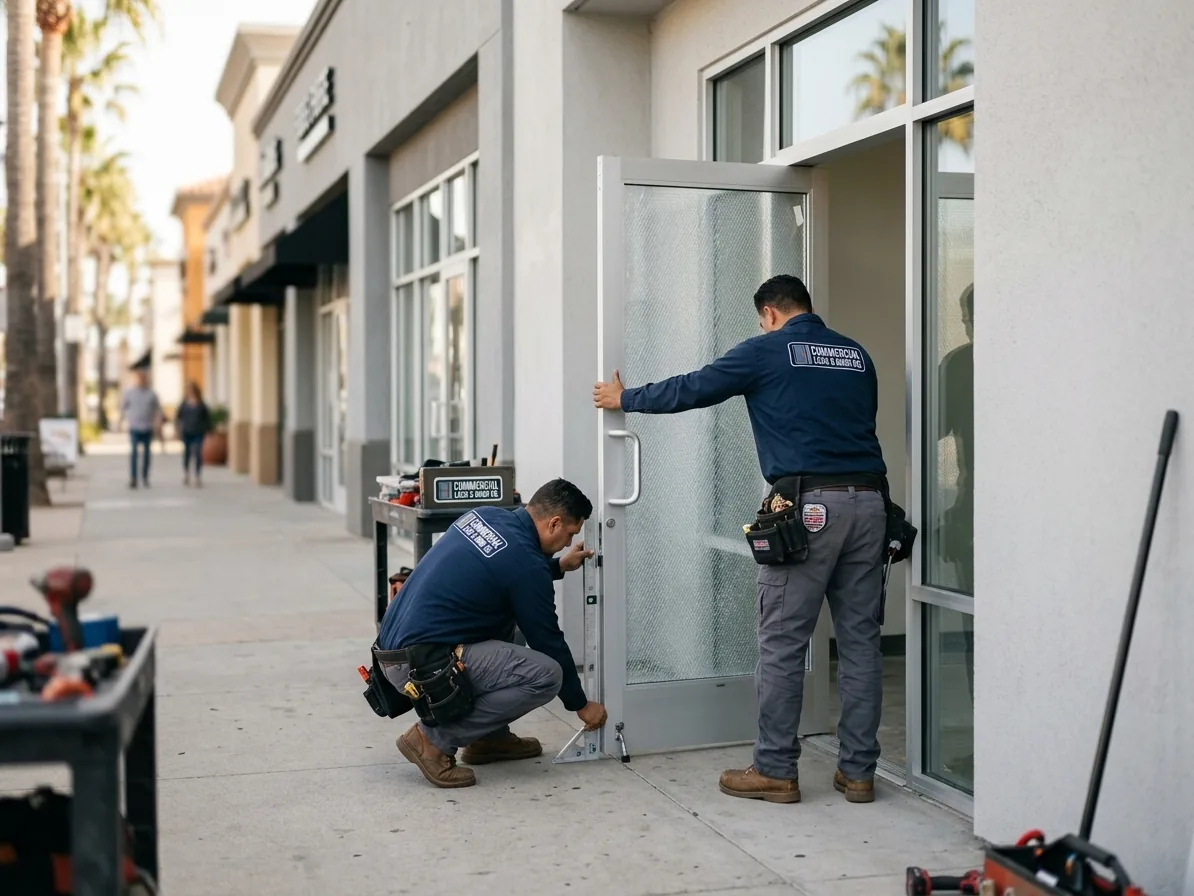
When the entrance is done, not just out of adjustment
Some entrances reach the end. The lock stile has been cut for three generations of hardware and will not hold a strike.
The bottom rail corners are soft with corrosion and the leaf will not keep an adjustment for more than a season. A truck backed into the pair and twisted the active leaf. Or a landlord handed you a bare rough opening in a new suite and the storefront contractor is long gone. At that point the question is not which part to fix. It is what to order.
We supply and install aluminum storefront entrance doors and complete framed entrances: single leaves and pairs, narrow through wide stile, door-only swaps into sound existing framing, and full tear-outs with new frame, sidelites, and transom where the old system is finished. We handle the door, the glass coordination, the hardware, and the lock as one scope, because a storefront entrance that gets ordered in pieces almost never goes together clean.
The boundary matters, so here it is. A sagging door that can be re-hung, a spent closer, a deadlatch missing its strike: that is repair work, and we would rather re-hang your door than sell you a new one. This page is for when the leaf, or the whole entrance, is actually done.
Narrow, Medium, or Wide Stile: Buy for the Traffic
The stile is the vertical frame member of the leaf, and its width is the first decision on any new storefront door. Narrow stile runs about 2 inches of metal at the edge, medium about 3-1/2, wide about 5.
More metal means a stronger corner joint, more room for hardware, and a door that shrugs off the daily abuse a thin one absorbs into its joints.
Narrow stile is the maximum-glass look: a slim frame around a big tempered lite. It photographs well and it suits an office suite or a boutique that sees modest, polite traffic. What it will not tolerate is carts, deliveries through the leaf, or a decade of customers hitting it with a shoulder, because every one of those loads lands on two thin corner joints and a lock stile with barely an inch of backset for the hardware.
Medium stile is the workhorse and the one we quote most for retail. It carries the same glass area within a slightly heavier frame, takes a wider range of locks and exit devices without special strikes, and holds adjustment years longer under real traffic. If you are unsure, this is the honest default.
Wide stile is for entrances that get worked: restaurants and bars turning over all evening, taprooms rolling kegs and CO2 through the front, retail with stroller and cart traffic all day. The extra metal supports panic hardware comfortably, survives impact, and gives the closer and hinging something substantial to pull against. It costs more up front and it is the cheapest door per year of service in a hard-use opening.
Door-Only Swap or a Complete New Entrance
There are two scopes on this page and they are priced very differently. A door-only swap hangs a new leaf in your existing framing.
A complete entrance tears out to the surrounding storefront or the slab and sets a new frame, with sidelites and transom where the elevation has them. Door-only is faster and cheaper, and it is only worth doing when the framing deserves to stay.
So before we order anything we put a tape on the frame. Diagonals get measured for square, because a new leaf hung in a racked frame inherits every problem the old leaf had. Anchors get checked at the jambs and sill, the header gets checked for the closer it will carry, and the sill gets checked for the corrosion that starts under a threshold that was never sealed. A frame that fails those checks turns a door-only swap into money spent twice.
Profile matching is the part people skip. Aluminum storefront systems interchange loosely, not exactly: glazing pocket depths, hinge and pivot preps, and hardware backsets differ between manufacturers and between decades of the same line. We measure the existing stiles and preps before ordering so the new leaf arrives fitting the frame it is going into, instead of getting field-modified into it.
Complete entrances are part of our commercial door installation trade, and they are the right call for a new suite build-out, a frame that is racked or corroded, or a center that wants its entrances brought to one standard instead of patched one tenant at a time.
- Frame diagonals agree and the reveals are even, so the opening is still square
- Jamb and sill anchors are tight and the threshold has not lifted
- Header is sound and deep enough for the closer the new door needs
- No corrosion blooming at the sill line or the bottom of the jambs
- The frame profile is current enough that a new leaf can be prepped to match it
Decide the Lock Before the Door Is Ordered
Narrow stile aluminum doors take two families of lock, and the choice is permanent in a way most buyers do not realize. An MS-style deadlock throws a long laminated bolt deep into the jamb.
The MS deadlock is mechanically the strongest thing you can put in that stile, and it is not a latch: the door closes unlocked and stays unlocked until somebody throws the bolt with a key or a thumbturn. A deadlatch latches itself every time the door swings shut, and it is the only one of the two that an electric strike can release.
That last sentence is the day-one decision. If there is any chance this entrance ever gets a badge reader, a keypad, a video intercom with buzz-in from the counter, or any part of an access control system, the door should be ordered with a deadlatch, unless the plan is a maglock or electrified exit hardware instead. Converting an MS deadlock later is not door surgery, because the common storefront deadlatch is built to drop into the same stile cutout, but everything around it changes: the jamb needs a new strike, the inside trim goes from thumbturn to paddle, the cylinder needs a different cam, and the electric strike cut in the jamb is its own later project. Ordering the right lock costs nothing extra. Retrofitting it is a whole visit.
Panic hardware is not a preference, it is an occupancy question. Assembly spaces, which is where most restaurants, bars, and taprooms land once the seat count climbs, are required to have exit devices at certain occupant loads, and the authority having jurisdiction has the final say on where that line falls for your space. The reason to settle it before ordering is that an exit device changes the stile choice, the glazing layout, and the outside trim, so it has to be in the order, not bolted on after.
Cylinders and keying ride along with the lock decision. The mortise cylinder needs the cam that matches the lock body, and if the center or the building already runs a master key system, we key the new entrance into it on day one instead of handing you an orphan key.
Continuous Hinges, Pivots, or Butt Hinges
Offset pivots are the traditional hang: a top pivot in the header, a bottom pivot carrying the full weight of the leaf and its glass.
Pivots are compact, they suit most singles and pairs, and they wear in one direction, at the bottom, where the load lives. On a moderate-traffic door a good pivot set is a decades-long answer.
A continuous gear hinge runs the full height of the leaf and spreads the load along the entire jamb instead of concentrating it at one bearing. It is the hang we recommend for high-cycle and hard-use entrances, and for openings where the jamb is slightly imperfect, because full-height engagement forgives what a single pivot point cannot. It also removes the classic storefront failure mode entirely: there is no bottom pivot to flatten and drop the leaf out of its strike.
Butt hinges show up on storefront less often, mostly where an existing frame is already prepped for them or where the door ties into a hollow metal or hybrid frame. We use them where the prep calls for them rather than forcing a conversion.
How the door closes gets decided with the hang, not after it. An overhead concealed closer hides in the header and keeps the leaf clean, but it needs header depth and it is the harder unit to service. A surface closer is visible and reachable, which matters on an entrance that will get seasonal adjustment. Center-hung leaves ride a floor closer. Whichever it is, spring size gets picked for the leaf width and how much wind the entrance actually sees, with backcheck set so a gust cannot drive the new door into its own header.
Glass, Thresholds, Opening Force, and Finish
Every lite in a storefront door is tempered safety glazing.
Tempered glass is made to order, it cannot be cut or drilled in the field, and it is the long pole in the schedule, so we coordinate the glass order with the door order and do not pull an old door out until its replacement can actually be glazed. One more thing to know before ordering: many older doors carry 1/4 inch monolithic glass, while new entrances are commonly glazed with 1 inch insulated units, which changes the extrusion, the weight the hinging carries, and how the door feels on the closer.
Accessibility gets designed in, not inspected in. As a general principle that means a low threshold with a beveled profile rather than a raised saddle, opening force the closer can actually meet, and sweep timing that does not shut the door on someone moving slowly. California generally takes accessible entrance requirements further than the federal baseline, and the authority having jurisdiction has the final say on any specific opening, so we build to the drawings where drawings exist and to the conservative reading where they do not. The hardware side of accessibility is its own subject and we handle it as part of the same order.
Finish is where a center either looks managed or looks patched. Clear, dark bronze, and black anodized cover most of San Diego's retail stock, but anodizing varies batch to batch, and a new leaf next to a twenty-year-old bronze door will read slightly different in raking sun no matter who supplies it. The honest play for a multi-tenant center is to pick the standard finish once and hold every replacement to it. On coastal properties out toward Carlsbad, we also spec with salt air in mind: sealed sills, stainless fasteners, and hardware finishes that do not pit by the second summer.
Scheduling, Lead Times, and Getting a Number in Hand
Quoting starts with photos of the existing entrance and the elevation, and it always includes a site measure before anything is ordered, because a prepped leaf and a tempered lite are both made to order and neither can be returned.
We record opening dimensions, handing, frame condition, hardware preps, and glass spec, and the quote comes back itemized per opening: leaf, frame if any, glass, hardware, and labor as separate lines rather than one number.
While the door is on order, your entrance keeps working. If the old leaf is damaged or insecure, we stabilize it as a repair in the meantime rather than leaving you to babysit it. Install day is sequenced so the opening is never left open: old leaf out, new leaf hung, glazed, hardware set, keyed, and locking before we leave. On a complete entrance with frame work, we plan how the storefront is secured for any window where the opening is apart, and that plan is agreed on before demolition, not improvised at dusk.
We are open seven days, which is how this work gets done in occupied centers: swaps scheduled early, late, or on the tenant's dark day, with tenant notice and any building access requirements handled before we mobilize. Purchase orders are welcome, and for property managers replacing entrances across a center we will phase the openings across budget periods and keep the hardware and keying records so every later call starts from a known door.
Commercial work is quoted per job, never off a price list. These are the factors that make a quote larger or smaller:
- Stile width and leaf count. A wide stile pair is more metal, more glass, and more hardware than a narrow stile single.
- Door-only swap versus a complete entrance. New framing, sidelites, and transom work change the scope entirely.
- Glazing. Lite size, 1/4 inch monolithic versus 1 inch insulated units, and how much of the elevation is glass.
- The hardware package. Deadlatch versus MS deadlock, exit devices, closer type, and continuous hinge versus pivots.
- Finish. Standard clear or dark bronze anodized versus black or a custom match held across a center.
- Access and timing. After-hours work in occupied centers, tenant notice, and keeping the opening secure between steps.
Where we run storefront door installation
Downtown storefront pairs, Poway and El Cajon strip centers, and coastal Carlsbad entrances that see salt air all get measured before a leaf is ordered.
Common in these buildings
Retail cart traffic, restaurant pairs on panic hardware, and taprooms rolling kegs through the front are where medium and wide stile doors earn their price.