Tenant Turnover Lock Change for San Diego Property Managers
A tenant turnover lock change rekeys a vacated unit so the outgoing tenant's keys stop working while the property master key keeps operating. Commercial Lock & Door Co. handles turnover rekeys for San Diego County property managers, from single suites to routed multi-property days.
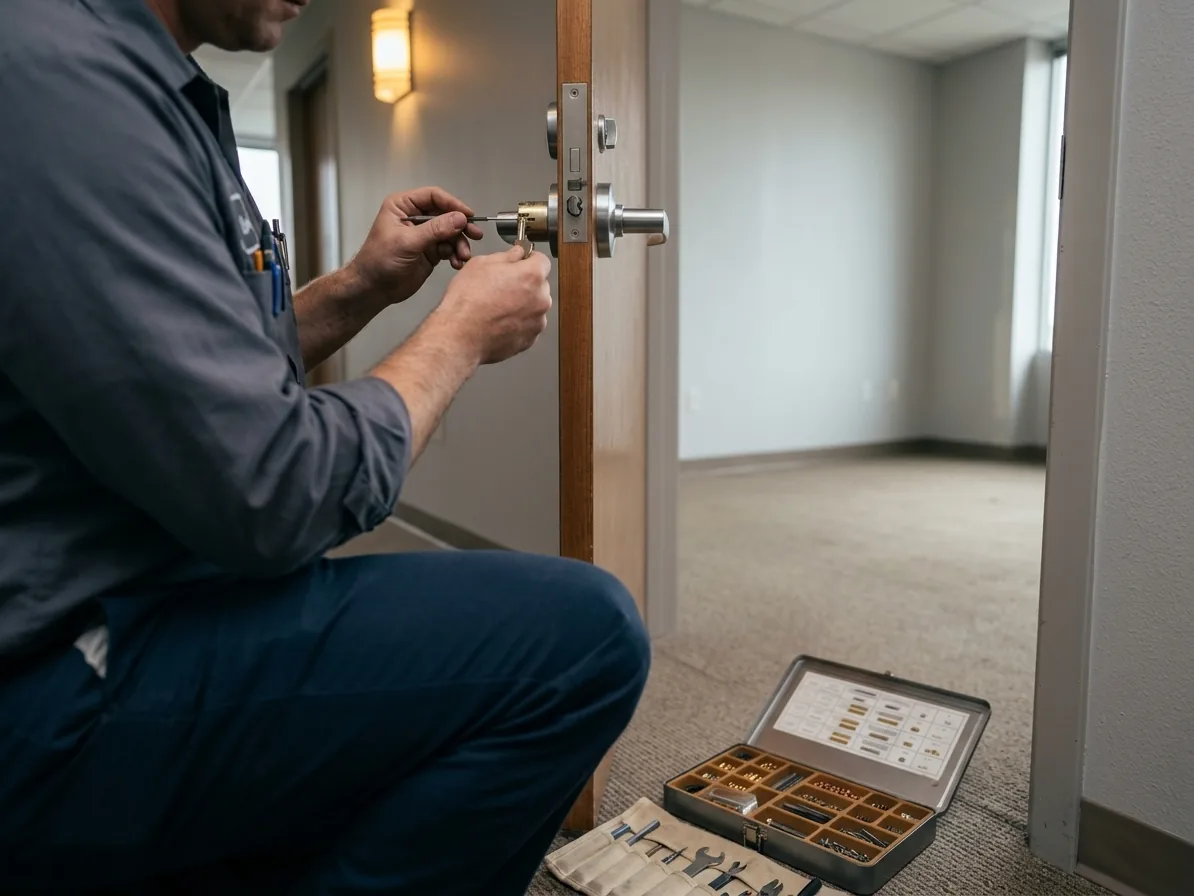
When the keys come back short at move out
A suite turns over and the keys come back short. The outgoing tenant hands you four, the file says six were issued, and at least one of those was duplicated at a hardware store by an employee nobody remembers hiring.
That is the normal condition of a turnover, not the exception. The real question is not whether to rekey. It is how to rekey the unit without breaking the master key system that lets your maintenance tech into every door on the property.
We do turnover rekeys for property managers, landlords, and owner-operators across San Diego County. Most of it is scheduled work rather than urgent work: a unit list, a date the space has to be ready to show, and a requirement that management holds a working key through the vacancy and into the new tenancy. Some of it is a single suite. Some of it is a dozen units across four addresses in one routed day.
Rekey the Cylinder or Replace the Hardware
Most turnovers are a rekey, not a replacement. Rekeying means pulling the cylinder, dumping the old pin stacks, and repinning to a new bitting so every key the outgoing tenant kept is dead.
The lock body, the lever, the strike, and the door prep all stay where they are. That is the right call whenever the hardware is sound and the keyway is one that can still be serviced.
Replacement earns its cost in specific cases. A key-in-knob set on a suite entry that sees daily traffic is a Grade 3 part doing a Grade 1 job, and repinning it only resets the clock on a lock that is already failing. Mortise cylinders with chewed cams, worn tailpieces, and blanks from a dead keyway family are cheaper to swap than to nurse. Function matters too. A storeroom function lever that locks behind everyone is wrong for a suite where the new tenant wants the door open during business hours, and an office function lever with a broken push button is wrong everywhere.
Portfolios that turn units regularly are the best case for interchangeable cores. A control key pulls the core in seconds and a pinned replacement drops in. Cores get pinned at the bench before the visit, the door is open for under a minute, and the old core goes back to stock to be repinned for the next unit.
- Cylindrical lever sets in office, entry, and storeroom functions, Grade 1 and Grade 2
- Mortise locks on older suite entries, where cylinder length, cam, and trim all have to match
- Aluminum storefront entries running a mortise cylinder into a hook bolt or a deadlatch
- Small format and large format interchangeable cores on properties already running key control
- Aftermarket deadbolts and keypad locks the outgoing tenant installed without asking anyone
Master Key Continuity Through the Turnover
The unit key has to change. The master must not.
That sounds simple until a cylinder gets repinned with whatever bitting was convenient and the new change key also happens to operate the suite two doors down. Accidental cross keying is the most common damage done to a master key system during turnover, and it usually stays hidden until a tenant mentions that their key opened the wrong door.
A master keyed system comes off a key bitting array. Change keys are progressed from the top master within maximum adjacent cut limits so cuts stay close enough that keys enter and turn cleanly. Every level of masters adds a master pin to the stack, and every master pin adds another shear line in that chamber. Two shear lines in several chambers is ordinary. Six is a lock that rakes open.
So we pull the new bitting from the system, not from the door. With bitting records in hand, we take the next unassigned change key in the block and repin to it. Where records went missing with the last management company, we decode the existing keys and cylinders, rebuild the array on paper, and hand that document back to you as something you own. If there is real reason to think the outgoing tenant walked off with a master, the honest fix is retiring the top master and rotating the property, which is planned work rather than a same-visit decision.
On properties where keys keep drifting into circulation, a restricted keyway is the actual solution. Blanks are not sold over the counter, duplication is controlled at the source, and the key count stops climbing every time a lease ends.
Batch Scheduling Across a Portfolio
One suite is a stop. Twelve suites across four properties is a route, and routing is where the cost comes out of a turnover program.
We would rather take a list and plan a day than take twelve separate calls spread over two months.
Send building requirements along with the quote request. Vendor paperwork, PO numbers, check-in and badging procedures, loading dock and elevator reservations, and tenant notice periods all get sorted before the crew shows up rather than in the lobby that morning. Occupied common doors, corridor entries, and roof or utility access can be scheduled outside business hours when the building requires it.
- Unit numbers, door count per unit, and which of those doors sit on the master
- Whether each space is vacant, in cleanout, or still holding a holdover tenant
- Existing keyway, and whether you intend to stay on it or move to something restricted
- How many keys per unit and who physically receives them
- The date the space has to be ready to show or hand over
- Building rules covering after-hours work, elevator use, or tenant notice
Per-Unit Key Records You Actually Keep
The reason turnover rekeys keep getting redone is that nobody wrote anything down.
A property with clean key records rekeys a unit once. A property without them rekeys the same unit twice, because no one can prove which keys are dead and which are still floating.
We leave a unit with a bitting record tied to the unit number and the date, keys stamped so a found key can be traced back, and a count of what was cut and where it went. Management spares stay with management and get logged the same way. When a tenant later reports a lost key, you can look at the record and tell immediately whether you lost one change key or a key that also works a common corridor door. Those are two very different conversations.
Key control is mostly policy, not hardware. Deciding up front how many keys leave the office, whether keys get signed for, and what happens at move out puts a ceiling on how far the system can drift over the next five tenancies.
What Turnover Exposes on the Door Itself
A vacant suite is the only time the door is genuinely available. That makes turnover the right moment to correct what has been getting worse across three tenancies.
We look the opening over while the cylinder is out, because the added time is small and most of what turns up is cheap to fix in that same visit.
None of what follows is upsell for its own sake. A misaligned strike is what makes a new tenant call in week two saying the brand new lock is broken. That call costs everyone more than shimming the strike correctly while the door was already open.
- Deadlatch plungers dropping into the strike cutout instead of riding the strike face, which leaves the latch open to a shim
- Strike plates filed or shimmed by a previous vendor until the latch barely engages, with the lip cut back far enough to lose throw
- Closers with dead backcheck letting the door swing into the wall, and closers mounted off template so the arm binds in the last few degrees
- Aluminum storefront doors racked at the stile corners, where the fix is corner tightening or pivot and hinge work rather than a larger strike
- Exit devices left dogged down from the last tenant's business hours, and rim strikes worn until the latch rides over them
- Fire rated openings where someone drilled for an aftermarket deadbolt, a field modification that voids the label and has to be addressed rather than covered up
- Hollow metal frames spread at the head, where door and frame no longer share a plane and no amount of new hardware helps
Commercial work is quoted per job, never off a price list. These are the factors that make a quote larger or smaller:
- Number of units, and how many doors per unit sit on the key system
- Whether existing cylinders can be repinned or the hardware has to be replaced
- Keyway family, and whether you are moving to a restricted keyway
- Depth of the master key structure and how much of it has to be rebuilt
- Keys cut, stamped, and logged per unit
- Access constraints such as occupied buildings, after-hours windows, elevator scheduling, or gated properties
Where we run tenant turnover lock change
Routed turnover days run from Poway and Carlsbad business parks to Escondido retail units, Downtown office floors, and Sorrento Valley flex suites, cores pinned before the drive.
Common in these buildings
Turnover rekeys come from portfolio managers holding a unit list, office floors that sublease, and storefront suites where the last tenant added a deadbolt without asking.