Hollow Metal Door and Frame Installation for San Diego Buildings
Hollow metal doors and frames carry the hardest-working openings in a building: exterior service doors, stairwells, and back-of-house. Commercial Lock & Door Co. supplies and installs steel doors and frames, welded or knock-down, across San Diego County.
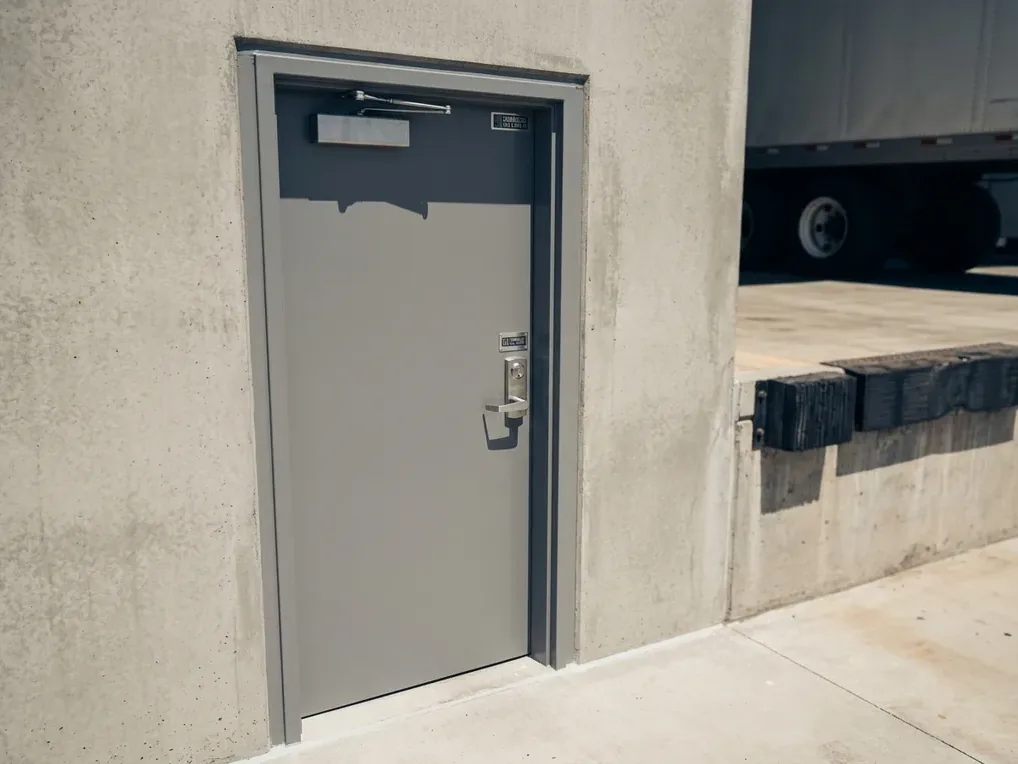
The doors that take the beating
Nobody photographs a hollow metal door. It is the gray door at the dock, the stairwell door that slams behind you, the electrical room door wearing a decade of paint.
Then the bottom of the frame rusts through, or a pallet jack folds the door around its own closer arm, and the opening nobody thought about is the one that will not lock at close.
Hollow metal is a system, the same way storefront is. Two steel face sheets over a core, hung in a formed steel frame, anchored into whatever the wall happens to be. Gauge, core, frame type, and anchoring all have to match the wall and the traffic, and most of the failed openings we see got one of those four wrong on day one. We supply and install hollow metal doors and frames across San Diego County as part of our commercial door installation work: exterior service doors, stairwell and utility doors, and back-of-house openings.
We are also not in a hurry to demolish anything. A fair share of the frame replacements we are asked to quote end up as a new door hung on the frame that was already there.
Door Gauges and Cores, and What the Numbers Mean
Steel gauge runs backward. A lower number is thicker metal, so a 14 gauge door is heavier than a 16, and a 16 is heavier than an 18.
Most commercial doors are 18 gauge, and for an office corridor or a utility room that is plenty. 16 gauge is the working standard for exterior and service doors. 14 gauge is for openings that get hit: dock area man doors, trash rooms, anywhere a cart or a pallet jack shares the path with the door.
The core is the part you cannot see and the part that decides how the door ages. Honeycomb kraft core is the standard, light and fine for most interior work. Polystyrene and polyurethane cores go in exterior doors where the temperature difference matters, a conditioned warehouse office or a door next to a walk-in. Steel-stiffened cores run vertical steel ribs welded to both skins, and they are what you buy when the door will be slammed, kicked, and shouldered for twenty years.
Warehouse traffic finds the weak door. In the tilt-up parks around Miramar and Otay Mesa we see 18 gauge doors on dock stairs with the bottom third caved in from pallet strikes, and skins split at the lock prep from being yanked against a slide bolt. Replacing that door with another 18 gauge unit buys a couple of years. A 14 gauge steel-stiffened door with the same preps costs more once and ends the cycle.
Exterior doors should be galvannealed steel, a zinc-iron coating under the primer, rather than bare cold-rolled sheet. It is the difference between a door that chalks and a door that blooms rust at every scratch. Ask what the skin is before you approve a quote. Plenty of budget doors going into coastal buildings are cold-rolled with gray primer, and the primer is doing all the work.
Welded Frames, Knock-Down Frames, and When Each Is Right
A welded frame arrives as one rigid piece, corners welded and ground smooth. A knock-down frame arrives as three pieces, two jambs and a head, and gets assembled in the opening.
The catalogs treat them as equivalent. On the wall they are not. Welded is the frame for masonry, tilt-up, and any opening that takes abuse. It goes in plumb as a single unit, gets anchored and usually grouted, and the corners never move relative to each other. The cost is logistics: it has to travel as a full rectangle, fit through the building, and go in while the wall can still be worked around it.
Knock-down earns its place in occupied buildings and tenant improvements. A slip-on drywall frame wraps a finished stud wall, snaps together at the corner tabs, and compresses to the wallboard. No wet trades, no wall surgery, minimal disruption to the suite next door. The trade is at the corners. The seams are visible, and on a door that gets worked hard, the hinge jamb can loosen and walk independent of the head.
The short version we give property managers: interior office doors in drywall, knock-down is the right call. Exterior openings, stairwells, masonry, or anything a cart will hit, welded, anchored, and grouted.
A Good Frame With a Bad Door Is a Door Swap, Not a Demo
Frames outlast doors. The door takes every slam, every kick, every pry attempt, and all of the closer forces, while the frame sits in the wall holding on.
Before anyone quotes a full opening replacement, the frame deserves ten minutes of honest inspection, because a new door hung in the existing frame is a far smaller job than cutting a frame out of a grouted masonry wall.
We check the base of both jambs for rust-through, put a bar on the frame to see whether the anchors still hold, run diagonals to check for spread and rack, and look at the hinge and strike preps for stripped screws and torn reinforcements. If the frame passes, we measure it as it actually is, not as the nominal size says it should be, order the door to match the existing preps, and hang it.
When the frame fails the inspection, we say that too. A frame rusted through at the floor line has no anchor left where the door loads it hardest. A frame spread by a forklift strike will never hold a latch in alignment. And a frame with preps cut for three generations of hardware becomes a filler-plate museum that costs more to dress up than to replace.
- Rust-through at the floor line on either jamb, especially on grout-filled frames
- Diagonals that disagree, meaning the frame is racked and the latch will never line up
- Anchors loose in the wall, so the whole frame moves when the door slams
- Hinge reinforcements torn or stripped past what a repair plate can recover
- Impact damage that bent the stop or the rabbet, so the door cannot seat
Anchoring and Grout: The Wall Decides
A hollow metal frame is only as strong as what ties it to the wall, and the tie is different for every wall type.
New masonry gets wire or strap anchors laid into the block courses as the wall goes up. Existing masonry and concrete openings get drilled expansion anchors through the frame face or soffit. Steel stud walls get stud anchors that clip to the framing. Tilt-up panels, which make up most of the industrial stock in Miramar, Kearny Mesa, and Otay Mesa, get frames set into cut openings and anchored with drilled concrete anchors.
Grout is the other half of a masonry or tilt-up frame. A frame filled solid with grout stops flexing, stops drumming when the door slams, and shrugs off cart strikes that would oil-can a hollow one. It also makes future hardware changes slower, since every strike cut and wire path has to be ground out of the fill, and it holds water against the inside of the steel if the fill ever gets wet. That is a trade worth making on purpose rather than by default.
The failure we get called for is the loose frame. Anchors were skipped or missed the framing, the frame drums and shifts, hinge screws work loose, and the door starts chewing its own strike. By the time someone calls, the complaint is usually about the lock. The lock is fine. The connection to the wall is gone, and the fix is re-anchoring the frame, not another strike adjustment.
On existing openings we would rather add anchors than pretend the old ones are working. Drilled anchors through the hinge jamb at the reinforcement points, set before the new door goes on, cost little while the opening is already apart.
Rust Starts at the Bottom
Steel openings die from the floor up. Mop water, rain blown under the door, irrigation overspray, and salt air all collect in the same place: the bottom six inches of the frame and the bottom edge of the door.
The paint bubbles at the base, then flakes, then the steel goes. Grout-filled frames are worse, because the fill wicks water and holds it against the steel from the inside, so the frame rusts outward and looks fine right up until it does not.
Distance to the water sets the pace. The detail that lasts twenty years in El Cajon starts blooming in eight near the coast. Openings toward Carlsbad and anywhere west of the 5 want galvannealed doors and frames, a sealed sill line, and a real recoat schedule rather than one coat of gray primer at install and nothing after.
Caught early, a rusted base can be a repair. We cut the rot out of the jamb base, splice in new steel, treat and prime it, and reseal the sill. Past a certain point the splice is bigger than the frame, and the honest answer is a new galvannealed frame set with the base sealed off the slab and every field-cut edge primed before it goes in.
Factory primer is not a finish. Every hollow metal door and frame ships expecting field paint, and the openings that skip it are the ones we replace early. The bottom edge of the door matters most and gets painted least, because nobody sees it. When we hang a door, the top and bottom edges get sealed before it goes on the hinges, a ten minute step that decides which decade the door fails in.
Hardware Preps, Fire Labels, and Getting the Work Scheduled
Hollow metal doors and frames come prepped from the shop, and the prep is the part to get right at order time.
The prep sheet covers a cylindrical lock prep or a mortise edge prep, hinge cutouts at standard locations, a strike prep in the frame, closer reinforcement in the head, and backer plates where an exit device mounts. Steel reinforcements are welded inside the door and frame wherever hardware lands, which is why a factory prep holds for decades and a field-drilled one is a compromise.
If you are carrying hardware over from the old door, we match the new preps to it: same backset and prep type, same hinge size and spacing, same strike location, same closer mounting. If the hardware is being upgraded at the same time, this is the cheapest moment that upgrade will ever have, since the preps and reinforcements are ordered instead of retrofitted. The same logic covers wiring: if a badge reader or electric strike is anywhere in the building's future, a junction box and a conduit sleeve in the frame now saves grinding grout out of it later. We handle the commercial door hardware ourselves, so the door, the frame, and the hardware arrive as one coordinated order instead of three vendors pointing at each other.
Stairwell, corridor, and some exterior openings carry fire labels, a small metal tag or embossed stamp on the hinge edge of the door and on the frame rabbet. A labeled opening has to be replaced as a labeled assembly, with the rating preserved and the hardware chosen to match, and the authority having jurisdiction has the final say on what an opening needs. We cover that work under fire-rated door installation. If you are not sure whether an opening is labeled, look at the hinge edge, and if there is a tag, say so before anything gets ordered.
Quoting starts with the opening: photos of the full door, the frame corners, the base of both jambs, the hinge edge where a label would be, and the wall around it. Doors and frames get ordered to measurements we take ourselves, because a door ordered to a phoned-in dimension is how openings end up shimmed with washers. Quotes are written per opening and itemized, we take purchase orders, and we schedule around the building, including keeping the opening secured or attended for the window it stands open. We are open seven days a week, so a dock door or a stairwell can be done on a Sunday when nobody is walking through it.
Commercial work is quoted per job, never off a price list. These are the factors that make a quote larger or smaller:
- Gauge and core. An 18 gauge honeycomb door and a 14 gauge steel-stiffened door are not the same purchase.
- Whether the existing frame stays. A door swap into a sound frame is a fraction of the scope of cutting a grouted frame out of masonry.
- Wall type. Drywall, block, poured concrete, and tilt-up panels each anchor differently, and grout fill adds labor.
- Hardware. Carrying good existing hardware over costs less than new, and factory preps cost less than field modifications.
- Fire labels. A labeled opening has to be replaced as a labeled assembly with hardware to match.
- Access and timing. Occupied buildings, dock traffic, after-hours windows, and keeping the opening secured while it stands open all add time.
Where we run hollow metal doors and frames
From Otay Mesa dock doors to El Cajon and Escondido service entries, the wall type and the traffic decide the gauge, the frame, and the anchoring.
Common in these buildings
Pallet jacks at the dock, mop water in self storage corridors, and students slamming stairwell doors all wear out steel openings in their own way.