Commercial Door Hardware for San Diego County Buildings
Commercial door hardware covers the locks, closers, exit devices, hinges, and thresholds that make a building's doors work as one system. Commercial Lock & Door Co. specifies, supplies, installs, and services it for buildings across San Diego County.
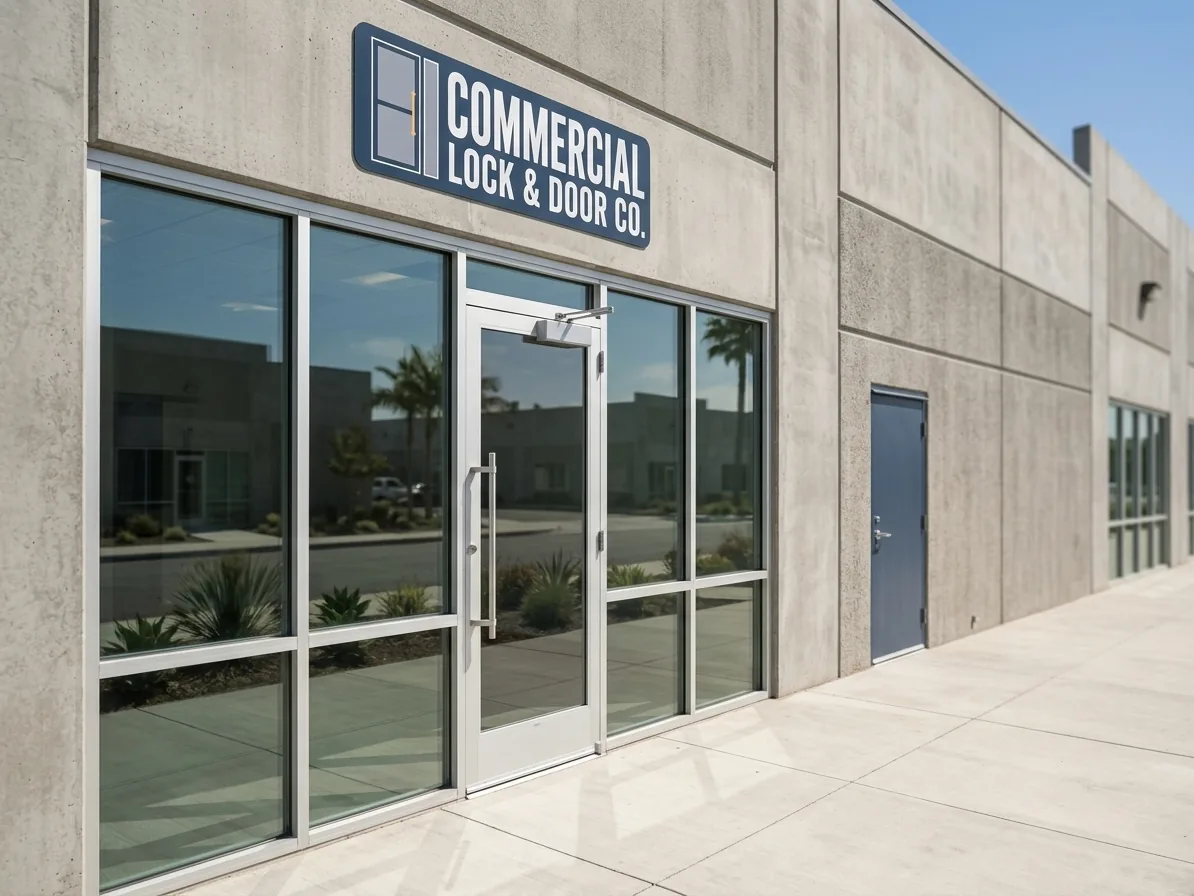
The doors nobody wants to talk about
Somewhere in the building there is a door nobody wants to talk about. The closer weeps oil onto the mat.
The lever on the suite next door is a different finish than everything else on that floor. The rear exit rattles because the vertical rods have drifted out of adjustment, and the storefront cylinder takes a key that former employees are still carrying. None of it is an emergency on its own. Together it is a hardware problem, and it usually gets solved one service call at a time instead of once, correctly.
Commercial door hardware is a system. The lock, strike, hinges, closer, exit device, threshold, and frame all have to agree with each other, with the fire label on the door, and with how people actually move through the opening. When one piece gets chosen without the others, the opening starts fighting itself. The closer overpowers the latch. The deadlatch stops depressing against a worn strike. The door drags the threshold. Then the callbacks start.
We work as a commercial door contractor across San Diego County, from Otay Mesa up through Carlsbad and inland to El Cajon and Escondido. That means specifying, supplying, installing, and servicing the hardware itself, and keeping a record of what sits on each opening so the next order matches the last one.
Grade 1 vs Grade 2, and where each earns its keep
Hardware grading comes from the ANSI/BHMA A156 standards, and each product category has its own document. Grade 1 sits at the top of the cycle and strength testing, Grade 2 below it, Grade 3 below that.
A grade is a test result, not a warranty, and it says nothing about whether the piece is correct for the opening.
The practical question is where the traffic is. A Grade 1 cylindrical lever on a warehouse man door that gets hit all shift pays for itself. The same lever on an interior conference room does not. Grade 1 earns its keep on exterior openings, stairwells, public restrooms, and any door where a closer is driving the latch home all day. Grade 2 is an honest choice for low traffic offices, storage rooms, and privacy sets inside tenant space.
Grade and fire rating are separate questions and get decided separately. What a labeled opening needs is hardware listed for use on a fire door, and that listing is what an inspector looks for. A great deal of listed hardware happens to be Grade 1, but the grade is not what makes it acceptable on a labeled opening, and writing Grade 1 into a spec does not by itself answer the label.
Finishes have their own standard, and the number matters more than the name. 626 satin chrome and 630 satin stainless read the same from across a lobby and read obviously different side by side on one frame.
- A156.1 covers butts and hinges
- A156.26 covers continuous hinges, which sit under their own standard rather than with butt hinges
- A156.2 covers bored and preassembled locks, the common cylindrical lever
- A156.3 covers exit devices, including rim, mortise, and vertical rod types
- A156.4 covers door controls, meaning closers and their arms
- A156.13 covers mortise locks and latches
- A156.18 covers materials and finishes, where the finish numbers live
Storefront, hollow metal, or wood: the opening drives the hardware
Aluminum storefront is its own world. A narrow stile leaves very little face at the lock edge, so a standard mortise lock body sized for a wide stile door has nowhere to go.
What fits is hardware built for that stile: a narrow backset mortise deadlock throwing a hookbolt, the MS style lock you see on most storefront pairs, a narrow stile rim exit device, or a paddle operated deadlatch. Those doors pivot more often than they hinge, they take concealed overhead or surface closers depending on the header, and the bottom rail height decides what will physically fit. When a storefront door starts dragging, the cause is usually a worn pivot or a racked frame, not the lock, which makes it a storefront door repair call rather than a hardware order.
Hollow metal in a hollow metal frame is the most forgiving opening in the building. It is prepped to standard patterns, takes a cylindrical lock at a 2-3/4 inch backset or a mortise lock in a standard pocket, and the frame carries a reinforced hinge jamb and a standard strike prep. Wood doors in those same frames behave similarly, with the caveat that the edge and lock prep were cut at the factory and are not always where the shop drawing said.
Then the exceptions: pairs with removable mullions, doors on surface vertical rods or concealed vertical rods, openings with electrified hardware that needs an electric hinge or a raceway to get power across the gap, and pairs with astragals that must close in sequence. Those are the openings skipped during a walkthrough that later hold up the whole job.
Specifying a set: function, handing, prep, finish
Most hardware that arrives wrong is wrong in one of four ways, and all four are catchable at the desk before anything ships.
Strikes deserve their own line. A deadlatch only works when its plunger lands on the face of the strike rather than dropping into the pocket, which is why a worn or wrong strike quietly turns a secure door into a door that opens to a shim. ANSI strikes in hollow metal, T strikes in wood, dust proof strikes at the sill for flush bolts, and lip length sized to the frame reveal are all part of the same decision as the lock.
Keying belongs in the specification too. Keyway family, conventional cylinders or interchangeable core, open or restricted keyway, and how the new openings fold into an existing master key system. Adding doors to a master system after the fact is a pinning problem, and pin stacks only tolerate so many levels before the system loses security or starts crossing keys.
- Function. Storeroom, classroom, office, entry, passage, and privacy are different lock functions. A storeroom function always relocks behind you. An office function lets a tenant leave it unlocked. Choose that on purpose, not by catalog default.
- Handing. Left hand, right hand, left hand reverse, right hand reverse. Stand outside the opening, see which way it swings and where the hinges are. Levers, mortise locks, and exit device trim all care.
- Prep. Backset, door thickness, bevel, strike type, hinge size, and cylinder length. Backset is measured from the edge of the door to the center of the crossbore, so a latch built for 2-3/8 will not reach a bore drilled at 2-3/4. On most cylindrical locks that is a latch problem and many latches adjust between the two sizes, so the fix is the correct latch rather than a bigger hole. On a mortise lock or on exit device trim the backset is fixed, and the wrong one means the right part has to be ordered.
- Finish. Match the finish number, not the color description, and confirm the lever, hinges, closer, and exit device are all available in it before the order goes out.
Matching hardware that is already in the building
Very few jobs are a clean slate. The realistic scope is a floor or a wing at a time, and the new hardware has to live next to hardware somebody else installed.
That starts with a survey, opening by opening: what is on the door, what the frame is prepped for, what the finish is, and which key opens it. From there the choice is retrofit or replace. A retrofit plate or wraparound reinforcement covers an abandoned mortise pocket or a chewed out cylindrical bore and lets a new lock sit clean. Filler plates handle old strike cutouts. Where the prep is too far gone, the answer is a new door or a reworked frame, and that is far better priced during the survey than discovered with the door off its hinges.
Closers are the piece most often replaced wrong. Regular arm, parallel arm, and top jamb mounts use different templates and deliver different power at the same spring size, so a replacement does not always land on the existing holes. Opening force on an accessible door is a code limit rather than a preference, and it comes from spring power together with the drag the door is already carrying: tight weatherstrip, worn hinges or pivots, and building pressure at an exterior opening. Backcheck, sweep, and latch speed are a different set of adjustments. Backcheck works on the opening swing, cushioning the door before it reaches the wall. Sweep and latch speed are on the closing cycle: sweep brings the door most of the way home, latch speed decides whether it drives the latch into the strike, and closing speed has to leave enough time for a slow walker to clear the opening. None of that arrives correct out of the box. It gets set at the door with a screwdriver and a pressure gauge. Delayed action is worth specifying anywhere people push carts.
Fire-rated openings and the label
If the door carries a label on the hinge edge, the rules change. A labeled opening must be self closing and self latching, which means a working closer and a latch that genuinely throws into the strike.
Fire exit hardware is not the same as panic hardware. Panic hardware can be dogged down to hold the latch retracted. Fire exit hardware cannot be dogged, and a dogged device on a labeled door is something an inspector will write up.
Field modification is where labels get destroyed. Cutting a new lock prep, adding a louver, or undercutting the door in the field can void the listing unless the work follows a listing agency's field modification procedure. A hole for a labeled viewer is permitted job site preparation, provided the viewer itself is a labeled unit. Hold opens work the same way: a labeled door may be held open only by a device listed to release on alarm, never a kick-down holder and never a wedge.
Doors on the egress path also have to release without tight grasping, pinching, or wrist twisting, and without a key, tool, or special knowledge from the inside. That is why lever trim and exit devices are the default in commercial space, and why a thumb turn deadbolt added above an existing lock is usually the wrong answer on an exit door.
How a hardware order runs, request to punch list
Walkthrough and survey first, then a door schedule listing every opening and the set that belongs on it, then a quote written line by line against that schedule so every number traces to a door.
Larger orders get cut sheets before anything is ordered, so you approve the actual product instead of a description.
Lead time is the part that surprises people. Stock finishes and common functions move quickly. Special finishes, electrified options, custom continuous hinge lengths, and anything keyed to a restricted keyway can sit at the factory. We would rather say so in the quote than on install day.
Installation gets scheduled around the building. Tenant space during business hours, lobby and exterior openings early or after close. Before the first door comes apart we go through the openings that cannot sit open, what securing each one looks like while the hardware is off, and which ones are better held for an evening or a weekend, so nothing on that list is a surprise mid shift. At the end, a walkthrough: every opening checked for latching, closers adjusted at the door, and keys cut and turned over against a signed key record so the building knows what it holds.
Commercial work is quoted per job, never off a price list. These are the factors that make a quote larger or smaller:
- Number of openings, and how many of them share an identical hardware set
- Door and frame type: aluminum storefront, hollow metal, wood, or a pair with a mullion or vertical rods
- Whether existing prep accepts the new hardware or needs a retrofit plate, filler, wraparound, or new frame work
- Grade and finish selected, and whether that finish is stocked or a factory special order
- Fire label and egress requirements at the opening, which limit what can be modified in the field
- Keying scope: new keyway family, restricted keys, or folding the doors into an existing master key system
Where we run commercial door hardware
The same opening by opening survey covers Carlsbad business park suites, El Cajon and Escondido hollow metal man doors, and Downtown San Diego storefront entries.
Common in these buildings
Property managers inheriting mismatched keyways, business park suites facing a lease renewal walkthrough, and warehouse man doors hit all shift are where this hardware usually lands.