Fire-Rated Door Assemblies Supplied and Installed Across San Diego
A fire-rated opening is a labeled set: door, frame, hardware, and glazing tested together. Commercial Lock & Door Co. supplies and installs complete labeled assemblies, 20 minute through 3 hour, for stairwells, corridors, and separation walls across San Diego County.
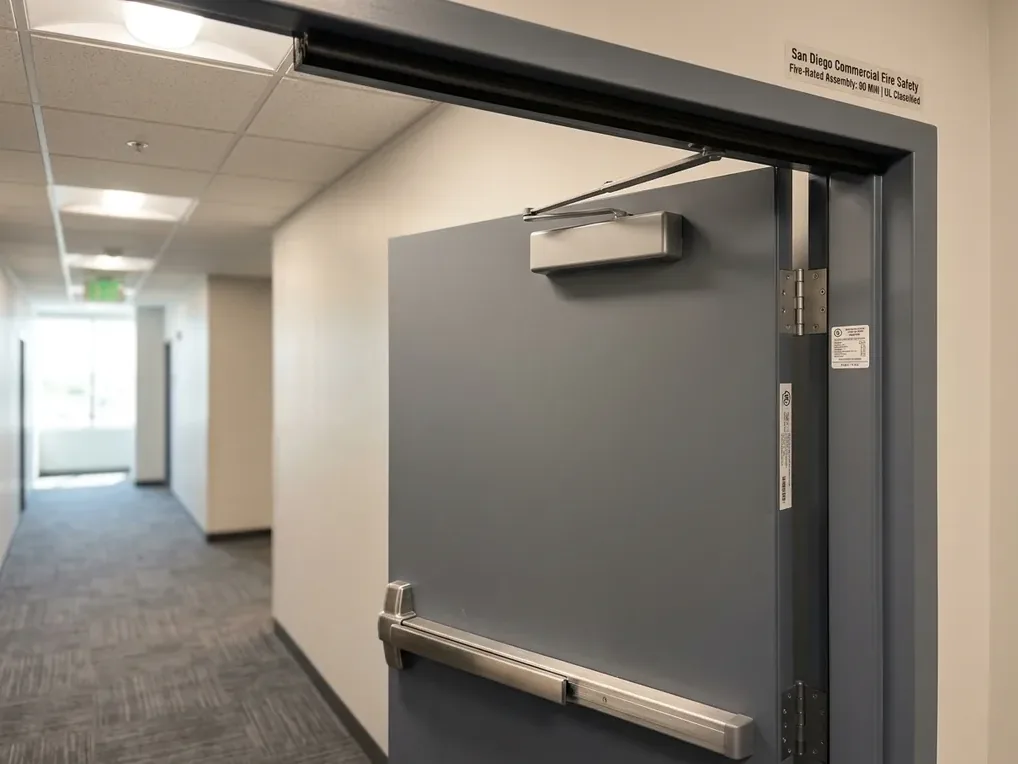
The label is on the assembly, not the door
A fire door usually announces itself on paper before it fails in person.
The inspection report comes back with openings listed by number: labels painted over, a stair door that no longer latches, a wedge under the corridor door by the ice machine, a lite somebody cut into a rated slab years ago. Or a tenant improvement adds a wall, the plans call the new opening rated, and the door schedule needs an assembly nobody has ordered yet.
This page is about the assembly itself: supplying and installing the labeled door, frame, and glazing as a set. If your labeled door is healthy and only the closer, exit device, or latching needs attention, that is our fire-rated door hardware work and a smaller visit. The line between the two is simple. Hardware problems get repaired on the door you have. A missing label, a field-modified slab, or a frame that never carried a listing means the opening itself has to change.
We would rather repair than replace, and on rated openings we hold to that wherever the label allows it. A door that will not latch usually needs hardware, not a new slab. But the label is the boundary. Once a door has been cut, planed, or drilled outside its listing, no repair puts the rating back, and the honest answer is a new labeled assembly sized to the opening.
A Label Covers the Assembly, Not Just the Door
A fire-rated opening is tested and listed as a set. The door carries a label, usually a metal tag or embossment on the hinge edge.
The frame carries its own label, typically in the rabbet where the door closes against it. The hinges, latching hardware, closer, and any glazing are each listed for use on a rated opening. Take any one piece out of that set and the opening no longer matches what was tested.
Ratings run 20, 45, 60, and 90 minutes on most commercial work, with 3 hour doors on the heaviest walls. The door rating follows the wall it sits in. As a general principle, a 2 hour wall calls for a 90 minute door, and a 1 hour corridor wall commonly takes a 20 minute door with smoke and draft control. The plans and the authority having jurisdiction have the final say on any specific opening, so we read the door schedule rather than guess.
The label is why a rated opening cannot be assembled from parts that each merely look right. A heavy hollow metal door in a heavy frame with sturdy hardware is not a fire door unless every piece was listed and the assembly went in the way the listing describes. It is also why the tag matters more than the steel: when an inspector walks the building, the label is what they read.
Where Rated Openings Show Up in a Building
The stair is the one everybody knows. Exit stair enclosures are rated construction, and every door into them is a rated opening, usually at the top of the scale for that building.
Exit passageways that carry people from the bottom of a stair to the street get the same treatment. Corridors in buildings where people sleep carry rated doors with smoke and draft control: hotels, apartments over retail, care settings. Separations between different uses in one building do the same job. The wall between a restaurant and the parking structure, between lodging floors and the ground floor lease spaces, between an office build-out and the warehouse behind it.
Then there are the rooms nobody visits. Electrical rooms, mechanical rooms, elevator machine rooms, trash rooms, and storage rooms holding enough of the wrong material to need separation. In Sorrento Valley and UTC lab buildings that shows up as rated doors on chemical storage and control areas. In Miramar and Otay Mesa tilt-ups it is usually the electrical room and the office demising wall. Downtown it is stair towers and the corridors of everything built over a podium.
None of this is a code opinion on your building. The door schedule on your plans says which openings are rated and to what. Where the plans are long gone, the labels on the existing doors and frames are the record of what was there, and when neither exists, the question goes to the authority having jurisdiction, not to a door vendor.
Positive Latching, and Why a Maglock Cannot Hold a Fire Door
A fire door has to do two things entirely on its own: close, and latch. The closer handles the first.
The second is positive latching, a latch bolt engaging a strike so the door is mechanically held in its frame. In a fire the slab warps and pressure builds on the fire side, and the latch is what keeps the door in the opening while that happens. A door that closes but does not latch fails at exactly the moment it exists for.
This is why magnetic locks alone cannot secure a fire door. A maglock holds the door with an electromagnet, not a latch, and it is required to release when power drops or the alarm trips. The moment it releases, a door with no latch is held by nothing. A maglock can ride on a rated opening for access control only on top of hardware that still latches by itself.
Access control on rated openings runs through listed hardware that preserves the latch: a labeled fail-secure electric strike, electrified lever trim, or electric latch retraction in a rated exit device. Pairs bring their own rules, coordinators so the leaves close in the right order and latching for both leaves. What never belongs on a rated opening is hardware that defeats self-latching or was never listed for it: barrel bolts, chains, and the aftermarket deadbolts that accumulate over a building's life.
Field Modification Voids the Label
The listing covers the door and frame as they left the shop. NFPA 80 permits only a short list of field work, small holes for fasteners and surface hardware and not much beyond, and everything outside that list voids the label.
This is the part of fire door work that surprises people most, because the modifications that kill a label are exactly the ones any competent carpenter would happily perform on an ordinary door.
So the label rules out the usual field improvisations. No cutting a vision lite into a slab. No planing an edge to clear new flooring. No trimming a door down to fit a smaller opening. No mortising a pocket for hardware the door was never prepped for. No louver cut into an electrical room door because the room runs hot. Each of those turns a rated assembly into an unrated door wearing a decorative tag.
The practical consequence is that rated doors get machined before they arrive. We order doors and frames from lines like Steelcraft and Ceco Door, prepped at the shop under label service for the exact hardware locations, lite kits, and sizes the opening needs, so nothing has to be improvised at the building. Measuring correctly the first time is most of this trade.
- Vision lites: field-cut lites void the label, shop-installed listed lite kits do not
- Undercuts: a rated door cannot be trimmed in the field beyond the small allowance in its listing
- Hardware preps: new mortises and large through-holes are shop work, done before the label goes on
- Louvers: never field-cut into a rated door, and rarely permitted on one at all
- Old holes: hardware that comes off leaves holes that get filled the way the standard describes, not with whatever is on the truck
Self-Closing, Hold-Opens, Gasketing, and Clearances
Every fire door is self-closing and self-latching, which makes the closer part of the rating and also the component that absorbs the most daily abuse.
A rated opening with a dead closer is an open opening. We size and adjust door closers to the leaf and the traffic, using listed units on rated openings, which most commercial-grade closers are.
The wedge is the most common fire door violation in any building, and it exists because people genuinely need the door open. The legal version of a wedge is a hold-open that releases on alarm: the alarm trips, the holder lets go, the closer shuts the door, the latch catches. Kick-down holders and friction hold-open arms have no place on a rated opening, because nothing releases them.
Clearance is where good doors quietly drift out of tolerance. The standard holds rated openings to tight gaps, on the order of an eighth of an inch at the head and jambs and a limited undercut at the floor, with the listing controlling the exact numbers. New flooring is the classic way to lose the bottom clearance, and a settling frame is the classic way to lose the top. Gasketing and smoke seals matter on openings that carry smoke and draft control, and they are listed components, not a roll of weatherstrip. Gasket also cannot be stacked up to disguise a door that no longer fits its frame.
Painted Labels, Annual Inspections, and Getting a Number in Hand
NFPA 80 calls for fire door assemblies to be inspected annually with the deficiencies documented, and building owners carry that obligation whether or not anyone has been doing it.
When an inspection finally happens, the findings are consistent: labels painted over during the last three repaints, labels missing entirely, doors that do not latch, wedges, dead closers, and gaps past tolerance. We are usually called after that list exists, pricing corrections from a report is routine work, and when we are in a building on a hardware walk we flag rated openings with obvious problems before they become findings.
Some of those findings are recoverable. Paint lifts off a metal tag with patience, and a sound, unmodified door with a missing label can sometimes be evaluated and relabeled in the field. A door that has been worked over outside its listing cannot, and the authority having jurisdiction decides what they will accept either way.
Replacement starts with the frame question, because the frame sets the scope. A labeled frame in good condition can often stay and take a new labeled door. A frame with no label, spread jambs, or rust at the floor comes out, and pulling a frame from a grouted masonry wall is a different day than pulling one from a stud wall. We handle both here as part of the labeled assembly, using the same methods as our hollow metal door and frame installs, and the wall gets patched to match, not left for another trade.
Quoting starts with photos: both labels or the spots where they should be, the full opening, the hardware, and rough dimensions. Rated assemblies are ordered to the opening, so a site visit to verify sizes, wall construction, and frame condition comes before anything goes to the shop. Quotes are written per opening and itemized, we take purchase orders, and multi-door corrections can be phased across budget periods. We are open seven days, corridor and stairwell work in occupied buildings gets scheduled around your tenants rather than through them, and the opening is left secured every time we step away from it.
Commercial work is quoted per job, never off a price list. These are the factors that make a quote larger or smaller:
- The rating itself. A 20 minute corridor door and a 90 minute stairwell door are different doors, frames, and glazing.
- Whether the existing frame carries a label and can stay, or comes out of the wall with the door.
- Wall construction. Pulling a frame from grouted masonry is a different day than steel stud and drywall.
- Hardware. Existing hardware is often not listed for the rating and gets replaced along with the door.
- Vision lites. Rated glazing and listed lite kits add cost quickly as the rating climbs.
- Access and timing. Occupied corridors, hotel floors, and lab suites push the work to nights and weekends.
Where we run fire-rated door installation
From Downtown stair towers to Sorrento Valley chemical storage rooms and Poway and Carlsbad business park electrical rooms, each labeled assembly is measured and ordered to its opening.
Common in these buildings
Hotel corridors, inspection-flagged stairwell doors, and lab chemical storage rooms are where a missing label or modified slab most often calls for a whole labeled assembly.