Commercial Door Lock Repair in San Diego County
Commercial door lock repair diagnoses why a lockset, cylinder, or latch stopped working and services the hardware in place instead of defaulting to replacement. Commercial Lock & Door Co. repairs commercial lock and door hardware across San Diego County.
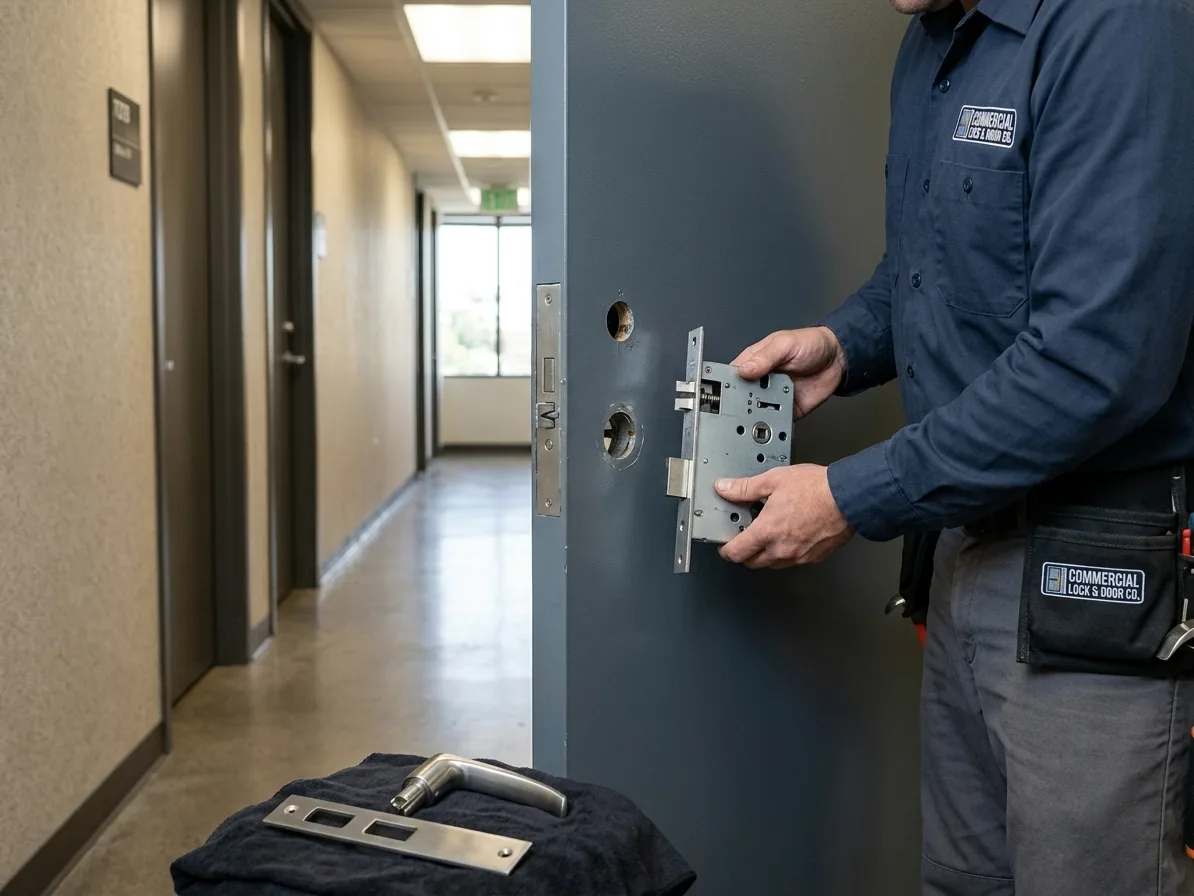
The lock faults that sit on a punch list for weeks
A lever that has to be lifted before the latch will pull back. A key that turns but no longer throws the bolt.
A back door that latches fine at seven in the morning and drags by three in the afternoon. Faults like these sit on a punch list for weeks, because nobody is certain whether the fix is a small part or a whole new opening, and nobody wants to authorize the wrong one.
Plenty of commercial locks get replaced when they only needed service. Commercial hardware is built to come apart. A mortise case opens on a bench. A cylinder can be repinned. A Grade 1 cylindrical lock will often take a new retractor spring, a new latch, or a fresh set of through bolts and go back to work for years. What kills commercial hardware early is usually not the hardware at all. It is an opening that has shifted, a closer that stopped controlling the last few inches of swing, or a strike that was never readjusted after the frame took its first hit from a pallet jack.
We service commercial and multi-tenant property across San Diego County, from the storefront corridors downtown to the office parks off the 15 and the distribution buildings out toward Otay Mesa. The first visit is a diagnosis at the opening: what failed, what caused it, and what it will take to make it hold. From there you get a written quote and a schedule you can put in front of a tenant.
What Actually Fails Inside a Commercial Lockset
Cylindrical locks, mortise locks, and exit devices fail in different but predictable ways.
Identifying which one is on the door narrows the repair before a tech touches a screwdriver, and it tells you whether you are looking at a part, a case rebuild, or a new opening.
Most of these faults announce themselves weeks before the door actually stops working. Staff stop reporting them because the door still closes.
- Cylindrical (bored) locks: return springs take a set and the lever starts to droop, which is the earliest warning you get. After that the retractor wears, the spindle rounds off in the hub, or the through bolts loosen and the rose begins to spin on the door face.
- Deadlatch plungers: the small auxiliary plunger next to the latch bolt has to land on the strike lip, not drop into the strike opening. When a door sags or a strike shifts, the plunger falls into the cutout and the anti-shim function is gone. The door still latches, so nobody calls it in.
- Mortise locks: the case is serviceable. Broken hubs, worn cams, tired latch springs, and a loose auxiliary latch are all replaceable inside the case. On many cases the function can be changed as well, which is how a classroom lock becomes a storeroom lock without cutting a new door prep.
- Cylinders: a key that has to be jiggled usually means a worn key, a burr in the plug, or springs that have gone soft after years of duplication. Mortise cylinders add two more failure points, the cam and the set screw behind it. A cylinder that spins freely in its housing is a set screw problem, not a lock problem.
- Exit devices: rim devices fail at the latch and at the dogging mechanism. Surface vertical rods fail at rod adjustment and at the top latch, which quietly stops engaging long before anyone notices, because the bottom rod alone still holds the door shut.
- Lever trim: set screws back out, spindles wear round, and outside trim starts turning freely without retracting anything behind it.
When the Lock Is Fine and the Door Is the Problem
Many lock repair calls turn out to be alignment calls. The lockset is healthy and the opening moved.
Replacing the lock in that situation buys a few months at most, because the new latch meets the same misaligned strike and wears the same way.
The wear marks tell the story. A bright line on the strike lip below the opening means the latch is arriving low. Scoring on the stop means the door is closing hard. A polished spot on the deadlatch plunger means it has been dropping into the cutout instead of riding the lip.
- Door sag: hinge screws pull out of a hollow metal frame, or the top hinge wears on a heavy door, and the latch lands below the strike. Repair is at the hinge and the strike, not at the lock.
- Frame spread: masonry frames that were never fully grouted spread over time until the latch no longer reaches. Shimming the strike box is a repair. Filing the strike cutout wider until the latch grabs is not.
- Closer behavior: a closer with no working backcheck lets the door slam the stop and walk the frame out of position. A closer with sweep and latch speed set too slow lets the door coast into the strike with too little energy to latch. Both get reported as a broken lock.
- Aluminum storefront: a worn bottom pivot or a racked lock stile drops the hook bolt below the keeper. Storefront also moves with the sun. A door that latches at seven and binds at three is thermal, and the fix lives at the pivot, the stile, and the keeper, which is storefront door repair rather than lock work.
- Building pressure: vestibules and doors on the return side of an unbalanced HVAC system get pushed or pulled just enough to keep a latch from seating. Worth confirming before any hardware gets swapped.
- Thresholds and sweeps: a raised threshold or a compressed sweep can hold a door a fraction short of closed, which is all the clearance a latch needs to miss.
Repair, Replace, or Upgrade
The decision comes down to four things: whether the parts are still available, whether the grade of hardware matches the traffic the door actually sees, whether the repair preserves your key system, and whether the opening is worth standardizing across the rest of your portfolio.
Keyway continuity matters more than most people expect. If a door is on a master key system, a replacement cylinder has to come from the same keyway family and be pinned to the existing bitting, or that opening is orphaned and your master no longer works there. On a restricted keyway, that continuity is the whole reason you paid for key control in the first place.
There are openings where a full lock change is the honest answer. A Grade 2 lever set on a tenant entry that cycles hundreds of times a day will keep failing no matter how well it is rebuilt. Obsolete trim with no parts support is a replacement. A case that has been drilled, bent, or fought with is a replacement. We say so rather than selling a rebuild that will bring us back in a quarter.
- Grade to traffic: Grade 1 for main entries, tenant suite doors, and anything on a closer that cycles all day. Grade 2 is fine for interior offices and low-cycle openings.
- Keyway family: matching the existing keyway and bitting so the master key system stays intact.
- Parts support: current cases and trims are rebuildable, discontinued lines often are not.
- Standardization: when several buildings run mismatched hardware, repair visits are a good time to start converging on one platform and one keyway.
Fire-Rated Openings and Exit Hardware Have Their Own Rules
A labeled door and a labeled frame carry a rating that field modification can void. That is not a technicality that shows up later in paperwork, it is the thing an inspector looks for.
Repairs on labeled openings are done with hardware that suits the label and without new cuts or holes that the label does not permit.
Exit hardware carries its own constraints. Fire exit hardware has no mechanical dogging, so if a rated opening's device is being held retracted with a hex key, that is a condition to correct rather than preserve. Where a rated door genuinely needs to stay unlatched during business hours, electric latch retraction is the correct path.
- Positive latching is the requirement. A fire door that closes but does not latch has failed, even when it looks and feels normal.
- Field modification voids the label. New cylinder holes, new lock preps, and new through-holes on a labeled door are not casual field decisions.
- Kick-down holders do not belong on a fire door. If a rated door is being propped, there is an operational reason behind it, and it usually points at a closer set too strong or an opening force problem worth measuring.
- Vertical rod devices on rated pairs need both latches engaging. A top latch that has drifted out of adjustment is the most common quiet failure we find on rated pairs.
- Repairs that change clearance around a labeled door are worth documenting for your inspection file while the tech is still on site.
How a Repair Visit Runs on Occupied Property
Occupied buildings set the constraints, so the work gets planned around them.
Retail and restaurant openings get handled before or after service hours where the schedule allows. Office suites get coordinated with the tenant contact so nobody arrives to find their door open and a tech in the way. On a medical or lab floor, we plan the sequence so an opening is never left unsecured while a case is out.
Punch lists get batched. If you have eleven openings across four buildings, walking all of them in one trip produces one quote and one scheduled block instead of eleven separate work orders. That is usually the cheapest version of the work and the least disruptive.
Vendor paperwork should not be what holds up a work order. Tell us which compliance portal you use and what documents your property requires when you request the quote, and we will route them to whoever handles it on our side. Accounts can run on POs with terms so recurring service does not need a new approval every time a lever fails.
- Openings are left secure and operable at the end of every visit, even when a part has to come back on a second trip.
- Each door gets documented by door number: hardware found, cause, work performed, and any condition we recommend watching.
- Tenant coordination and escort requirements are planned in before the visit, not negotiated at the door.
- Recurring accounts get the same techs, so the person walking your building already knows your hardware and your keyway.
Commercial work is quoted per job, never off a price list. These are the factors that make a quote larger or smaller:
- Number of openings and whether they sit in one building or spread across a portfolio
- Whether the fault is the lockset alone or the door, frame, hinges, and closer around it
- Hardware grade and function: a Grade 1 mortise case is a different rebuild than a Grade 2 cylindrical lever
- Parts availability, including discontinued trim and restricted keyway cylinders that must be ordered
- Fire-rated openings and ADA-governed openings, which limit what can be modified in the field
- Access timing: business hours versus after hours, tenant coordination, and escort or badge requirements
Where we run commercial door lock repair
Drooping levers and latches that miss the strike get diagnosed at the door, from Kearny Mesa suites to Otay Mesa warehouse man doors and Chula Vista storefronts.
Common in these buildings
Tenant suite doors on closers, HOA common area entries, and storefront deadlatches dropping into a shifted strike produce the punch lists we get asked to batch.