Commercial Door and Lock Service for San Diego Churches
Commercial Lock & Door Co. keys and repairs church campus doors across San Diego County: restricted key control for volunteer keyholders, master keying by wing, exit devices on sanctuary and fellowship hall doors, and closers, quoted opening by opening.
A campus run by volunteers and keyed over decades
A church campus is one of the harder buildings in San Diego County to keep keyed correctly.
The campus is open seven days a week, most of the people carrying keys are volunteers rather than employees, the buildings were added a few decades apart, and the person who knew where every key went stepped off the board years ago. That is not disorganization. It is what happens when a building is run by a rotating group of people who are all doing this on top of something else.
We work on the doors and the hardware on them. Exit devices on the sanctuary and fellowship hall, closers that no longer pull the door shut, mortise and cylindrical locks on the office wing, cylinders and keying across the whole campus. We are a door contractor first, so if the frame is out of square or the strike has been chiseled three times, we address the opening rather than selling you another lock that will not latch either.
The usual starting point is a walkthrough. We tag each exterior opening, note what is on it now, ask which groups use which doors on which days, and give you a written quote broken out opening by opening so a board or a facilities committee can approve it in phases. Call us or send a quote request and we will schedule around your services.
What actually goes wrong in these buildings
The same handful of problems shows up on church campuses countywide, usually a key count nobody can produce or a rim device dogged down since Sunday.
Keys go to a volunteer for one season and stay in a kitchen drawer for ten years. The fix is a restricted keyway. Blanks for a patented or restricted key are not sold over the counter, so a copy only gets cut against a name on your authorization list. Pair that with a written key record (which cylinder, which key stamp, who signed for it) and the next missing key becomes a small decision instead of a campus emergency.
Preschool on weekday mornings, a recovery group on Tuesday night, a food pantry on Saturday, sometimes a second congregation in the sanctuary. Do not hand those groups brass. Put keypad locks on the two or three doors they actually use and give each group its own code, then delete the code when the season ends. Keys stay with staff and trustees, on a master hierarchy that gives each wing its own subordinate master.
Member records, checks, and kids are three different risks and none of them belong on the key every usher carries. We put the office wing and the counting room on a separate keyway or a restricted subordinate master with a very short keyholder list, in Grade 1 mortise or heavy duty cylindrical hardware. Classroom security function on the ministry rooms lets an adult lock the lever from inside without leaving the room.
A hex key on a rim device takes two seconds and nobody remembers to undo it. Switch to cylinder dogging so only a keyholder can hold the latch back, and the same key gets used to secure it at close. If a pair of doors is chained, padlocked, or held with a slide bolt during services, that gets corrected first. A removable mullion with a rim device on each leaf gives you a wide opening and still latches.
Most of these openings can be repaired rather than replaced. A closer that leaks gets replaced with the correct size and arm on a proper template, with backcheck set so wind at the entry does not tear the arm loose. A chewed up latch edge takes a wrap around reinforcer. A worn lock often needs only a new cylinder, not a new lockset. We prioritize egress and fire doors, then work down the list as money comes in.
Residential grade hardware does not survive a door cycled hundreds of times on a Sunday, and a deadbolt drilled into a labeled fire door voids the label on the whole opening. We replace it with Grade 1 or Grade 2 hardware matched to the traffic, through bolted rather than run into wood screws, and on rated openings we use listed hardware prepped the way the listing requires so the door stays what the label says it is.
Key control that survives a changing roster
Key control at a church is not really a lock problem, it is a records problem with a hardware answer. The hardware answer is a restricted keyway plus a master key system built on paper before anything is pinned.
We lay out the hierarchy first: a top level master for the pastor and facilities lead, subordinate masters by wing, and change keys that open one room and nothing else. Pin stacks get built to that chart, not improvised at the door.
Small format interchangeable core is worth considering on a campus like this. With a control key, your office can pull a core and drop in a new one in about ten seconds, which means a lost key on Saturday night does not require anyone to come out. You keep a few spare cores on the shelf and we rekey the pulled ones at the shop.
- Restricted or patented cylinders so duplicates require authorization
- A written key chart and a signed key record for every issued key
- Rekey by zone when a key goes missing, not the entire campus
- Interchangeable cores where you want to make changes yourself
- Counting room and office wing kept off the general master
- One keyway family across the campus so future work stays simple
Keying a campus that outside groups use all week
Most congregations in the county share space, either formally with a tenant or informally with outside groups. The doors need to reflect that.
We separate the campus into zones that match how the buildings are actually used: sanctuary and narthex, education and children's wing, kitchen and fellowship hall, offices and finance. Each zone gets its own subordinate master, so a preschool director can be given the education wing without also being given the offices.
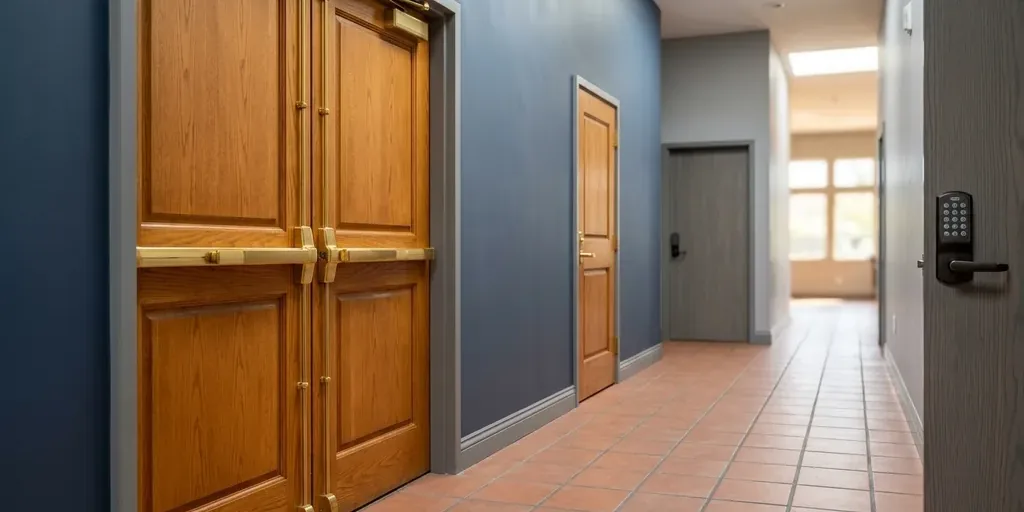
For outside groups, codes beat keys. Keypad locks on the specific doors those groups enter, each group with its own code, and codes removed on a schedule instead of chased down. Battery hardware belongs on interior and moderate traffic openings. On a heavily used exterior door, especially an aluminum storefront entry, we would rather look at an electric strike or electrified hardware tied to whatever entry method you already use, because cycle count and weather punish a battery lock out there. And when the campus outgrows codes, we design and install complete access control systems ourselves: fob or mobile credentials for staff, and door schedules that unlock the fellowship hall for Tuesday night and relock it after.
Exit devices, closers, and doors that see a crowd
A sanctuary is an assembly space, and the hardware on assembly doors has one job that outranks security: people leave with one motion, no key, no thinking. That means panic hardware in good adjustment.
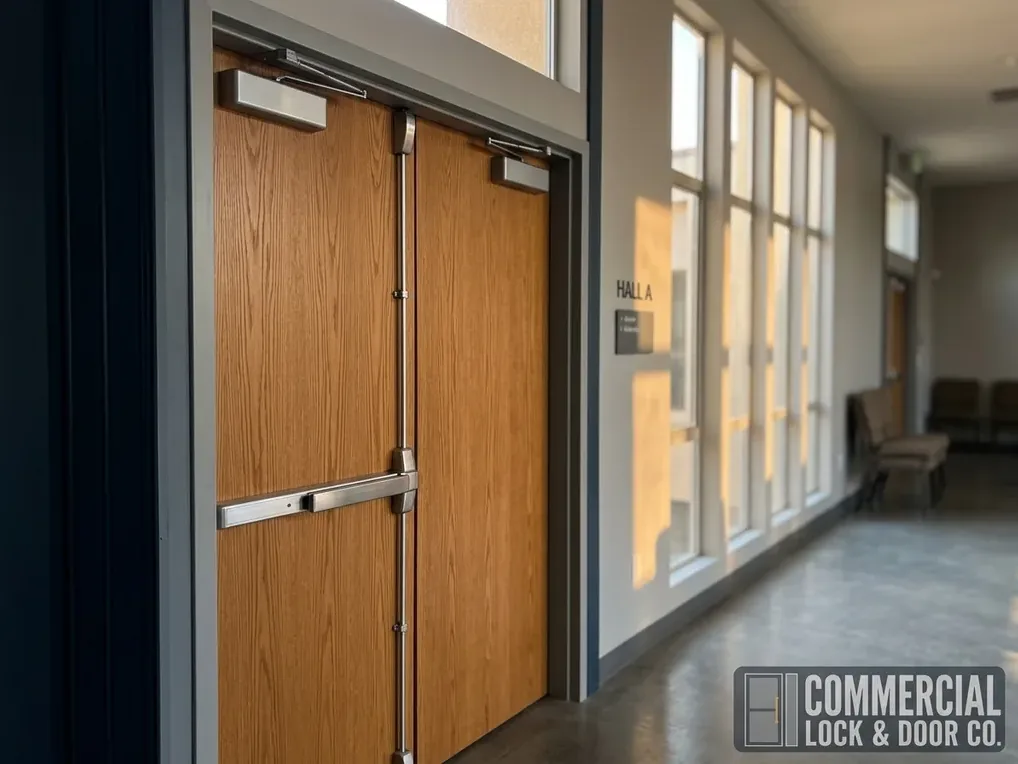
On a pair of hollow metal doors, rim devices with a removable mullion are usually the cleanest and cheapest arrangement to maintain. Surface vertical rods are common on older campuses and they drift out of adjustment, so the top latch stops catching and the door only looks secured. We adjust or convert them depending on what the opening will take.
Closers are the other constant. A church entrance takes wind, gets held open with a wedge, and gets pushed by people carrying casseroles and toddlers. We size and template the closer for the door width and the wind exposure, set backcheck so the arm is not the thing stopping the door, and set sweep and latch speed so the door actually latches rather than resting against the strike. On the accessible entrance, closer adjustment is what keeps opening force reasonable, and a low energy operator is the answer when adjustment alone will not get there.
- Rim, mortise, and vertical rod exit devices serviced or replaced
- Removable mullions for wide openings that still latch
- Cylinder dogging so exit doors get secured at close
- Closer replacement, correct arm and drop plate, backcheck set
- Delayed action closers on doors used by elderly members
- Deadlatch adjustment on aluminum storefront office entries
Quoting it the way a church buys it
We quote opening by opening. That format exists because church money moves through a committee and a meeting, and a line item quote lets you approve the three doors that matter this quarter and defer the rest without re-pricing everything.
We will tell you plainly which items are safety and which are convenience, and we will not pad the list with hardware you do not need.
Scheduling is straightforward. We schedule around your service calendar, typically on weekdays, and anything that touches a door you need for a weekend service gets staged so the opening is secure at the end of each day. We reference your PO on the invoice and can provide a W-9 for your bookkeeper. If you would rather set up an ongoing account, one contact number and one keyway family for the campus makes every future call shorter and cheaper.
- Doors serving an assembly space must open in the direction of egress and unlatch with one motion, without a key, tool, or special knowledge. Chains, padlocks, surface slide bolts, and added thumb turns on an exit door are the most common problem we find on a church campus.
- A labeled fire door has to self close and positively latch. Field drilling for a new lock, cutting the bottom for new flooring, or adding hardware that is not listed for the opening compromises the label. Hold open is done with a listed closer or holder tied to the fire alarm, never a wedge or a hook.
- Mechanical dogging that holds an exit device latch retracted is not appropriate on fire rated openings, since those doors must relatch every cycle. On non rated exit doors, dogging during occupancy is fine as long as it is undone at close, which is why cylinder dogging is worth the small upcharge.
- Operable hardware should not require tight grasping, pinching, or wrist twisting, so levers, push paddles, and touchbars are the right answer over knobs and thumb latches. Opening force, hardware mounting height, and maneuvering space at the accessible entrance all factor in, and closer adjustment or a low energy operator is usually what gets an old entry there.
General principles only. Your authority having jurisdiction has the final say on any specific opening.
What we are usually called out for
An office wing master chart, codes for the Tuesday night group, and the closer on the narthex doors account for most of the church work we do.
Master Key Systems
Commercial keying design for San Diego buildings
DetailsAccess Control Systems
The whole system, credential to latch
DetailsPanic Bars and Exit Devices
Commercial exit hardware, San Diego County
DetailsKeypad Locks and Keyless Entry
Standalone keypad and fob locks. No server, no subscription.
DetailsFire Rated Door Hardware
Labeled openings, serviced without voiding the label
DetailsDoor Closers
Surface, concealed, and floor closers
Details