Commercial Rekey Services in San Diego County
A commercial rekey resets the pinning inside existing lock cylinders so old keys stop turning and a new key takes over, with the locksets left on the doors. Commercial Lock & Door Co. rekeys buildings from single suites to industrial parks across San Diego County.
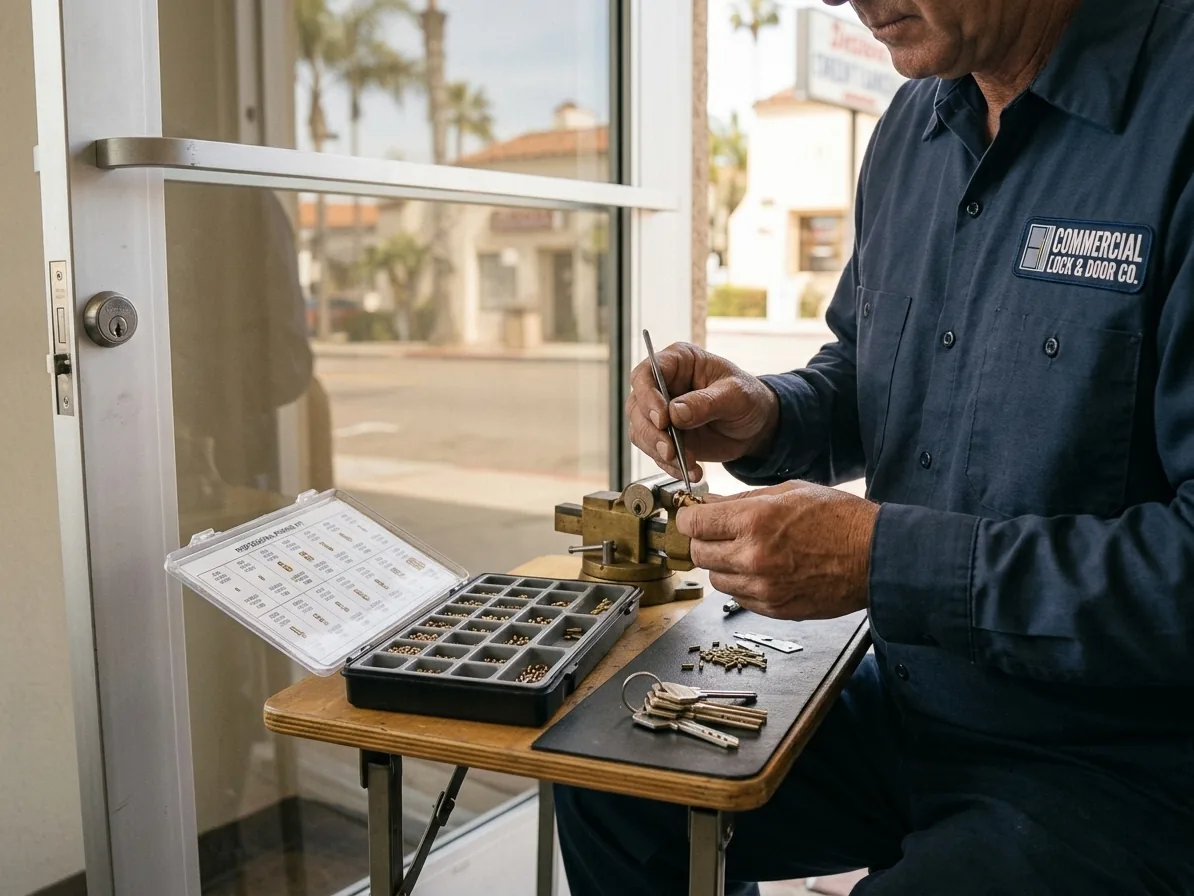
When the doors are fine but the key list is not
A key is missing and nobody can say how many copies exist. A suite turns over and the ring that comes back is two keys short of what the lease lists.
A former manager left with a master and the building has been running on trust ever since. In each of these cases the doors are fine and the hardware is fine. What changed is the list of people who can open the place.
Rekeying resets the pinning inside the cylinders you already own. Old keys stop turning, a new key takes over, and the locksets stay on the doors. No hardware order, no lead time, no closers to re-adjust, no new door prep. For most commercial buildings that is the shortest path from a key control problem back to a controlled building.
We rekey commercial cylinders across San Diego County, from single-suite offices to multi-building industrial parks. Every job is quoted after we know what is actually on the doors, how many keys have to work when we leave, and how you want the keys organized.
What rekeying actually changes
Inside a pin tumbler cylinder each chamber holds a stack. In a plain cylinder that stack is a bottom pin sized to the cut depth on the key, and a top pin under spring pressure.
Turn the correct key and every stack splits exactly at the shear line, so the plug rotates. Rekeying means pulling the plug, swapping the bottom pins to a new bitting, and reassembling. The keyway does not change. The finish, the lever, the strike, the frame prep, all of it stays where it is.
The new bitting is chosen, not random. Cuts have to respect the maximum adjacent cut specification for that keyway, because a deep cut next to a shallow one leaves a ridge the key cannot ride over. Most commercial cylinders are six pin, which gives far more usable bittings than a five pin residential cylinder and leaves room to grow a master key system later. If a group of doors should share one key, they are keyed alike. If each opening gets its own, they are keyed different. That decision is made before a single plug comes out.
The cylinder types on a commercial building
Rekeying is straightforward work, but only when the right cylinder is identified before the truck is loaded. A commercial property almost never runs one type.
- Mortise cylinders. Threaded body, screwed into a mortise lock body or an Adams Rite deadlatch, driven by a cam. Length and cam pattern both matter, because the wrong pairing leaves the cylinder standing proud of the collar or the cam short of the hub.
- Rim cylinders. Flat back plate with a tailpiece, used on rim exit devices and rim night latches. The tailpiece is cut to the device.
- Key in lever and key in knob cylinders. Pulled from the lockset once the lever comes off its catch.
- Small format interchangeable cores. A figure eight core that a control key removes in seconds. Buildings on SFIC can be rekeyed by swapping pre-pinned cores with almost no time spent at the door.
- Large format interchangeable cores. Same idea in a manufacturer specific format, common on Schlage and Corbin Russwin trim.
- Storefront cylinders. Aluminum storefront doors usually carry a mortise cylinder feeding an Adams Rite deadlatch or MS deadlock. Collar height and backset drive what fits.
- Padlocks, cam locks, and cabinet locks. Gates, electrical rooms, roof hatches, and server cabinets are part of the key system even when nobody has them on a list.
When rekey is enough, and when it is not
Rekeying answers exactly one question: who has a working key. It does not repair a lock that is failing mechanically, and it does not upgrade a cylinder that was never hard to defeat.
When the hardware is sound and the key list is the problem, rekey is the right call. Staff turnover, a tenant move out, a lost ring, a contractor who kept a key past closeout, a building where three past vendors each cut keys on their own bitting.
Replacement or repair is the honest answer in these cases:
- The plug is worn. Keys that turn only when you wiggle them, or a plug that moves slightly on the wrong key, means the cylinder is past its service life. Fresh pins in a worn plug buy a few months.
- The keyway is the real issue. Rekeying a KW1 or a Schlage C cylinder hands you a new key that any hardware store can copy. If key control is the goal, the answer is a restricted keyway, not a repin.
- The lock function is wrong. A passage set on a stockroom, or a storeroom function on a door the staff needs unlocked at opening, is a function problem. Pinning does not touch it.
- The lockset is failing. Loose levers, a latch that no longer deadlatches against the strike, a soft spring cage. Grade 2 hardware on a busy exterior opening reaches this point quickly, and Grade 1 is what belongs there.
- The opening is fire rated and the hardware is wrong for the label. Field modification of a labeled door or frame voids the label, so changes on those openings are planned, not improvised.
- The building has drifted into mismatched keyways. Rekeying each one in place preserves the mess. Standardizing on one family gives you a system you can actually administer.
Keyways, restricted keys, and real key control
A keyway is the profile milled into the plug and the matching shape of the blank. Schlage C, Kwikset KW1, Yale Y1, Sargent LA, Corbin Russwin, Best A2.
Open keyways are stocked everywhere, which is convenient right up until convenience is the problem. A key stamped Do Not Duplicate is a request, not a control. The blank is still hanging on the rack down the street.
A restricted keyway is a control. The blanks are held under patent and distributed under agreement, so copies come from an authorized source against a signature on file rather than from a self-service machine. Cylinders on those platforms usually add a sidebar or a second locking element, which raises the bar on picking and decoding as well as on duplication.
Whether you repin into your existing open keyway or move to a restricted one is a judgment about consequences. A break room and an interior office can live on an open key. Perimeter doors, the IT room, cash handling areas, sample and pharmacy storage, and anything holding controlled inventory usually justify the restricted key and the record keeping that comes with it.
A rekey is the moment to fix the key chart
If the plugs are coming out anyway, pinning to a plan costs little more than pinning door by door.
That makes a rekey the natural time to put a master key chart under the building instead of a drawer of unlabeled keys and a memory of who has what.
A master key system adds master wafers to the pin stacks so a stack can split at more than one height. That gives you a change key that opens one door and a master that opens the group. Levels build from there: change key, sub master by floor or department, building master, and where a portfolio needs it, a great grand master across sites.
Two things go wrong when a chart is improvised at the door. Cross keying, where one opening is made to accept keys from unrelated groups, multiplies the split points in each stack and creates ghost keys that open doors nobody intended. And a system pinned with no room to expand leaves nowhere to go when a suite is subdivided or a department is added. A chart drawn before pinning starts avoids both, and it leaves you a document to hand the next facilities manager.
How a commercial rekey visit runs
Before we quote, we want a door count, a photo of a typical lockset, a photo of one key including any stamping, and a plain answer on how many keys need to work when we leave.
From that we know the cylinder types, the keyway, and whether this is bench work or door by door work.
On site the sequence is pull, pin, test, tag. Every cylinder gets tested with the new key and with an old key before we move on, because the failure people find a week later is the one door that quietly still takes the old key. Keys are cut, stamped, and handed over against a count, so your log starts accurate on day one.
Disruption is usually smaller than facilities managers expect. The pieces worth scheduling around operating hours are the storefront doors and exit device cylinders, and occupied suites get after hours slots as a matter of course, not as a favor. If your building requires vendor paperwork or a purchase order in place before a tech is on site, send those requirements with the request and we will work to them.
Commercial work is quoted per job, never off a price list. These are the factors that make a quote larger or smaller:
- Number of cylinders, not number of doors. Gates, cabinets, electrical rooms, and roof hatches all carry keys.
- Cylinder type. Interchangeable cores pin on the bench, while mortise and exit device cylinders take more time at the opening.
- Whether the building is keyed alike, keyed different, or pinned to a master chart with multiple levels.
- Keyway. Open keyways use stock blanks; restricted keyways involve controlled blanks and a key record.
- Key count. Cutting and stamping fifty keys is a different job from cutting six.
- Scheduling and access. After hours work, tenant notice, escorts, and multiple buildings on separate visits all add time.
Where we run commercial rekey
Suite turnovers, lost rings, and inherited key systems get repinned across these parts of San Diego County, from Poway business park suites to Downtown office towers.
Common in these buildings
Tenant move-outs on managed portfolios, suite changes in business parks, and stockroom keys that walked off a retail floor are the usual reasons these buildings get repinned.