Video Intercoms and Telephone Entry for San Diego Buildings
Video intercoms and telephone entry let someone see and hear a visitor before the door releases. Commercial Lock & Door Co. installs and services entry stations, lobby directory boards, and the release hardware behind them across San Diego County.
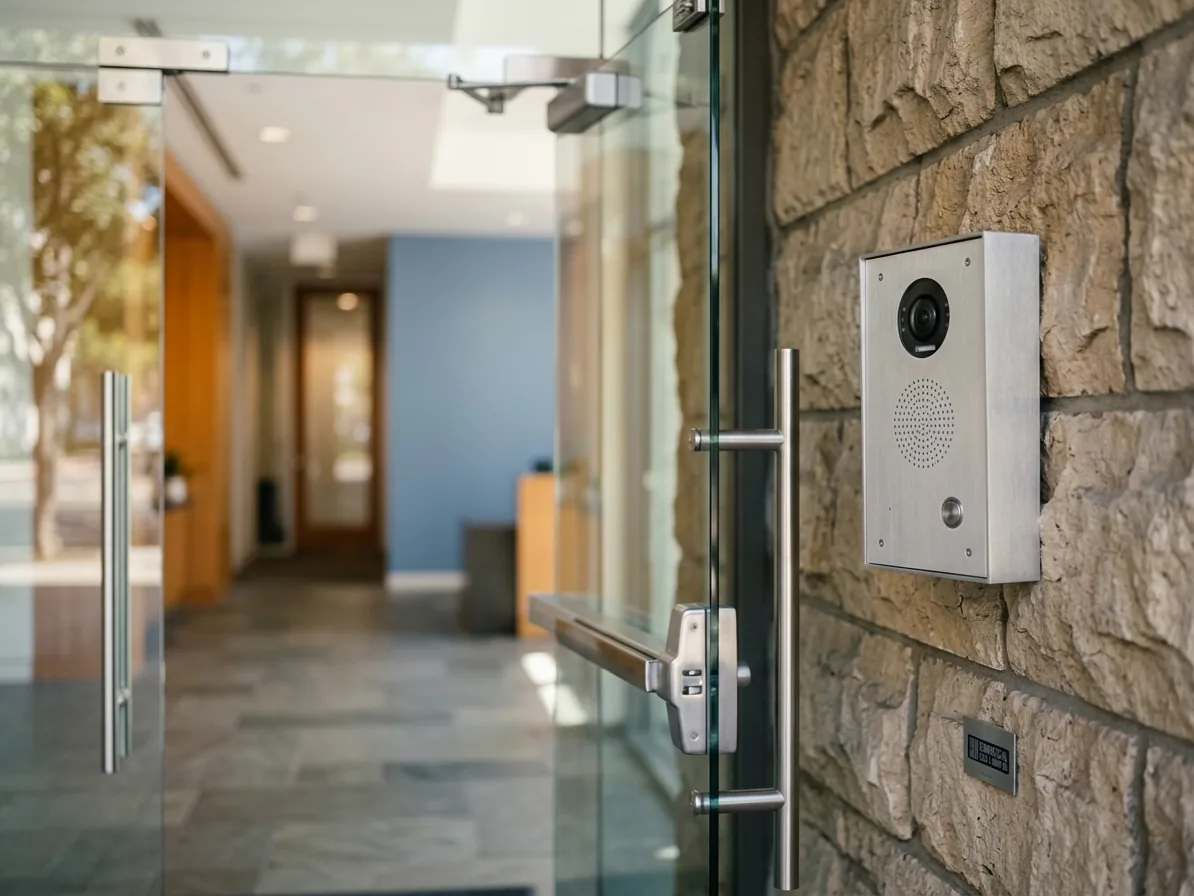
When nobody is at the desk to answer the door
There is a locked door, a visitor on the wrong side of it, and the question every buzz-in system exists to answer: who sees that person, and from where. Buildings with a staffed front desk answer it easily.
Everyone else, the medical office whose front staff are checking in patients, the self-storage office run by one person who is out on the property half the day, the Kearny Mesa suite that cut the receptionist position two leases ago, has a button that rings into an empty room.
A video intercom or telephone entry system is three parts that have to agree. A station at the door the visitor can find and press. An answering point, which can be a master station on a desk, handsets in suites, an app on a phone, or a lobby board that dials the tenant directly. And the release, the hardware on the door that actually lets it open when someone decides it should. Most of the systems we get called to fix got two of those three right.
We design, install, and service the whole chain: station, wiring, power, release hardware, and the programming and directory behind it, across San Diego County, seven days a week. We also service what is already on the wall, dead boards, stations that ring but do not release, directories still listing tenants who left years ago. And if an integrator owns your entry platform, we are glad to work the door hardware side and land on the contact it hands us.
Who Answers the Door When Nobody Sits at the Desk
Buzz-in worked fine when every building had a receptionist. Most do not anymore.
The button at the door still gets pressed, by patients, couriers, vendors, applicants, and the question of who hears it has usually never been decided on purpose. It rings a counter nobody sits behind, so staff prop the door, and the locked entry becomes decoration.
Video changes the decision, not just the convenience. An audio buzzer tells you somebody is there. A video station tells you whether it is the elevator tech you were expecting, a process server, or a stranger testing doors, and the release decision gets made on that information instead of a guess. For a waiting room that stays locked between patients, that is the difference between a door policy staff actually follow and one they quietly defeat by Thursday.
The answering point is the design decision that matters most. A fixed master station at the desk always rings in the same place and works no matter whose phone is charged. Handsets in individual suites put the decision with the tenant. An app puts the door in a pocket, which is exactly right for a manager covering three properties and exactly wrong if nobody agrees whose pocket it is. Most buildings end up with two answering points, a fixed one and a mobile one, and we will tell you which combination fits how your building is actually staffed.
One boundary worth stating. A video intercom is not a camera system. The camera in the station exists to answer the door, and some platforms keep a snapshot or short clip of each call in the call log. That is a record of who rang, not surveillance of the property, and we do not sell or install CCTV. If you need that, it is a different trade, and the intercom will do its own job alongside it.
The Door Release Is Half the Job
Every intercom, however new the app looks, ends at the same thing: a relay contact that closes for a few seconds. What that contact is wired to decides whether the door actually opens.
On most latching doors the contact lands on an electric strike that frees the latch while the visitor pulls. On a door or frame that cannot take a strike, an all-glass entry or a leaf that should not be cut, it lands on a magnetic lock, which brings its own set of egress hardware along with it.
Buzz-in controls entry, never exit. People inside leave on the lever, the paddle, or the exit device, mechanically, regardless of what the intercom is doing. That is why most exterior doors get a fail-secure release: power fails, the door stays locked to the street, the key still works, and nobody inside is trapped. A magnetic lock is the exception, since it holds the door in both directions, so it carries release requirements on the egress side, and the authority having jurisdiction has the final say on how those are configured.
The install we get called to fix most often is a station wired straight to a release with no thought about the door itself. The strike buzzes but was never matched to the latch it holds, so visitors learn the pull-at-the-exact-moment trick. Or a maglock went up on the header with no request-to-exit device, and a fire marshal's walkthrough is the first anyone hears about it. We do door hardware for a living, so the release side of these jobs is not an afterthought.
Telephone Entry Boards and the Lobby Directory
In a multi-tenant lobby the answering point cannot be one desk, so the station becomes a directory.
A visitor scrolls the display or enters a code, the board dials the tenant, the tenant talks to them and presses a digit on their own phone, and the board fires the release. DoorKing boards have run this way in Downtown mid-rises and older Mission Valley office parks for decades, and the pattern holds up because it puts the decision with the tenant being visited.
The quiet problem with these boards is the phone line. Most older units dial out over analog copper, the carriers are retiring that service a block at a time, and a board with no line looks dead from the lobby even though the electronics are fine. The fix is usually a cellular module or a board that dials over the network.
Directory management is where these systems rot. Tenants leave and stay listed. New tenants get added by whoever remembers the programming code, until nobody does. Numbers change and the board keeps dialing a dead extension. When we hand off a board, the master programming code goes to the property manager in writing, the directory matches the rent roll on that date, and we show whoever runs the building how to make changes, because a directory only stays correct if changing it is easy.
One scope note. We install and service telephone entry for pedestrian doors and lobbies. Vehicle gates and gate operators are a different trade, and if your board also runs a gate we will coordinate around it rather than pretend it is ours.
An App on a Phone Versus a Master Station on the Desk
Current video stations are network devices. The call from the door can ring a fixed master station, a desktop, or an app on several phones at once, and the release works from any of them.
Aiphone video sets cover the range from one door and one desk up to a building-wide system, and the app-based platforms add the piece owners keep asking for: buzzing in the plumber while you are at another property.
The trade-offs deserve daylight before you commit. App answering depends on the phone having signal and the app having an owner, and when the person who set it up leaves, somebody has to move the account. Buildings forget that until the first missed delivery. A fixed master station is dumber and steadier: it rings in the same place every time, whoever is standing there can answer it, and it survives staff turnover without a password reset. The buildings that run best usually keep both, the desk station as the first answer and the phones as backup.
Deliveries are the test case. A shared door code fails the same way everywhere: it gets given to one courier, within a month it is in every route driver's notes, and it never gets changed because changing it inconveniences everyone at once. With video at the door you release remotely after seeing who is standing there, and no code exists to leak. Where a recurring vendor genuinely needs unattended access, a cleaning crew on a schedule, that belongs on a keypad as its own code that can be deleted without touching anyone else's.
Replacing a Dead or Discontinued Entry Board
Entry boards die of ordinary things: a power supply that finally quits, a surge down the phone line, a display that fades past reading, a release relay with pitted contacts.
By the time a board dies, the model is usually discontinued and the company that installed it is gone. The useful fact is that the expensive part of the original install was never the box. It was the wire, and the wire is usually still there.
A retrofit reuses those paths: the conductors from the lobby to the door release, the riser to suite handsets where one exists, the feed from the electrical room. What has to be verified is whether the old wire suits the new unit. Conductor count and gauge, the condition of the jacket where it loops at the door, and whether a riser wired for an old analog handset standard can serve the new station, or whether the new system answers on phones and the riser retires in place.
The physical opening is the other measurement that matters. A flush board cut into lobby masonry or tile almost never matches the next manufacturer's cutout, so the choice is a retrofit trim plate that covers the old opening cleanly or a wall patch. We measure the cutout before anything is ordered. And if the old display still lights at all, we pull the tenant directory off the board before it comes off the wall, because rebuilding a directory from the rent roll takes an afternoon that did not need spending.
- Display segments fading or dead, so visitors cannot read the directory
- Keypad buttons that need several presses before they register
- A release relay that works on some calls and not others as the contacts pit
- Hum or crackle on the voice call that was not there last year
- A board that resets itself on hot afternoons, which is a failing power supply talking
Street Stations, Salt Air, and the Wire Path Question
A station at sidewalk height gets treated like street furniture.
On a street-facing door the station should be a vandal-resistant model: stainless faceplate, security screws, a flush or recessed mount that gives nothing to pry against, and mounting height and lighting chosen so the camera catches a face instead of the top of a hood. A plastic-faced station at street level is a service call waiting for a Friday night.
Salt air is the slower version of the same problem. From the beach communities up the coast toward Carlsbad, unsealed stations corrode from the terminals inward: green screws, a keypad that goes sticky, a speaker that fades. Coastal stations get gasketed enclosures, sealed wire entries, and stainless fasteners, and they still deserve a look whenever we are on site for anything else.
The honest part of the quote is the wire path. A station, a release, and an answering point that already have conductors between them is a short job. No path means one has to be made: surface raceway along a wall someone will look at for years, conduit across a ceiling, coring, or a wireless link between buildings described with its real limits instead of as magic. The difference between an afternoon and a multi-day job on intercom work is almost never the hardware. It is the path, which is why we walk the route before we put a number on anything.
The last question is whether this stays standalone. An intercom-only job is a complete system, and plenty of buildings never need more. But if badge readers are in the building's future, the release hardware, power supplies, and paths we run should be placed so an access control system can take them over later instead of tearing them out. Tell us where the building is headed and we will build the intercom as a first phase rather than an orphan.
Commercial work is quoted per job, never off a price list. These are the factors that make a quote larger or smaller:
- Station type. An audio doorbox, a video station, and a full directory board are different amounts of hardware and programming.
- Whether a wire path already connects the station, the release, and the answering point, or raceway and conduit have to be run.
- The release hardware. Reusing a working strike is a small line. Adding a strike, or a magnetic lock with its egress devices, is not.
- Number of answering points, from one master station to suite handsets plus apps on several phones.
- Directory size on telephone entry boards, and whether the tenant list can be pulled from the old unit or has to be rebuilt from the rent roll.
- Mounting conditions. Flush cuts in masonry, vandal-resistant stations at street level, and gasketed coastal enclosures add scope.
Where we run video intercom and entry systems
Downtown mid-rise directory boards, salt-air Carlsbad stations, and El Cajon, Poway, and Escondido suites answering from a phone all get the wire path walked before the quote.
Common in these buildings
Directory boards that stopped dialing tenants, waiting room doors released from the desk, and one-person storage offices answering the door by phone are where these calls come from.