Magnetic Lock Installation and Service for San Diego Commercial Doors
A magnetic lock holds the door with an electromagnet instead of a latch, which makes it the right device for glass doors and mullion-free pairs and the wrong one for plenty of others. Commercial Lock & Door Co. installs, repairs, and removes maglocks on commercial doors across San Diego County.
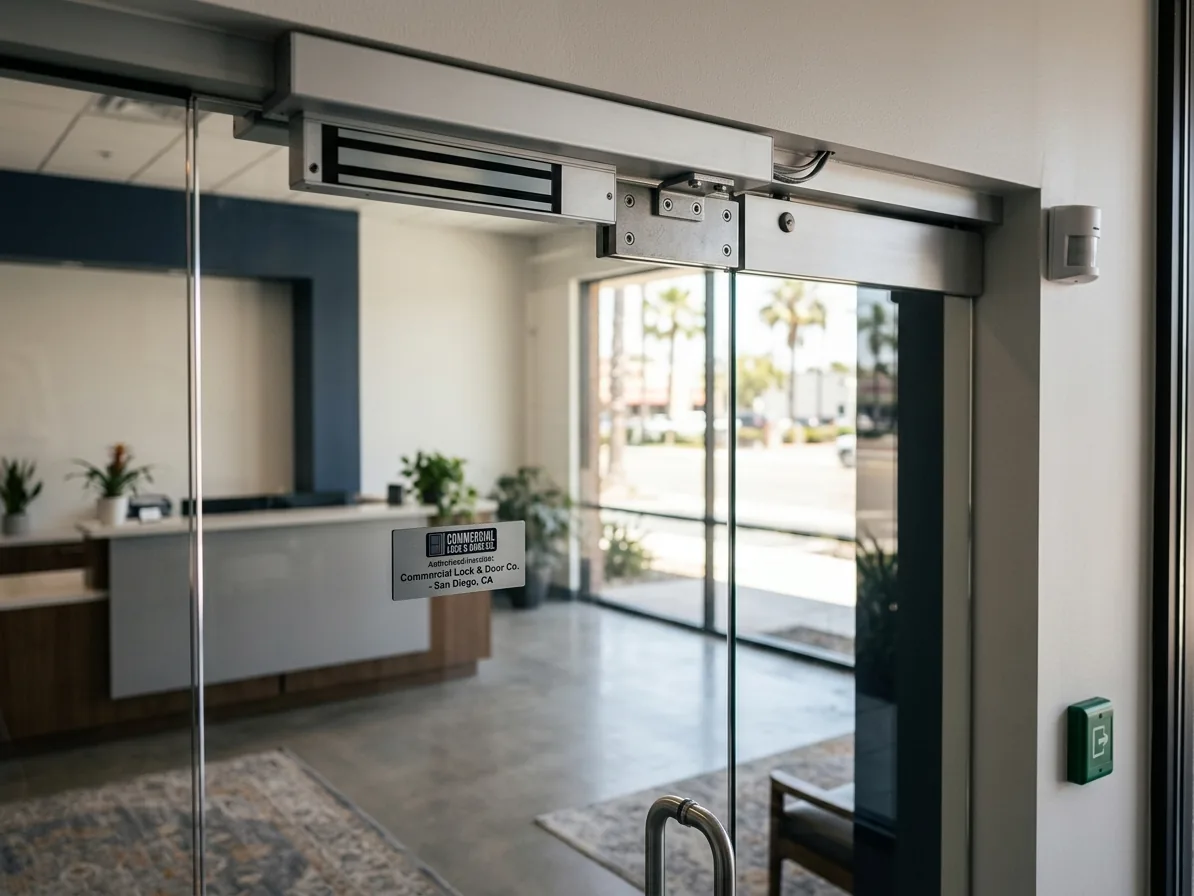
When the door has nothing to latch
The lobby door is a slab of tempered glass and somebody wants it on the badge system.
Or the maglock you already have pops open with a hard tug, or slams the armature all day, or has been quietly unlocked since the last fire alarm and nobody noticed until a walkthrough. Or you inherited a magnet over a door with no exit button on the inside wall and no paperwork on who put it there. All of those calls end at the same device, and the device is simpler than almost anything else we install.
A magnetic lock is an electromagnet in a housing on the frame and a flat steel armature plate on the door. Energize the coil and the two bond. That bond is the lock. Nothing latches, nothing moves, and with the power cut, the door is simply a door. That one fact explains everything good and bad about maglocks: they secure openings no other hardware can touch, and they are inherently fail-safe, which is why a package of release hardware legally rides along with every one of them.
We install, service, and remove maglocks across San Diego County, either as part of an access control system we design and build or as the door hardware side of a platform your integrator owns. We will also tell you when a maglock is the wrong device for the opening, because a healthy share of the maglock calls we take are for doors that should have gotten something else.
How a Maglock Works: An Electromagnet, a Steel Plate, and Nothing Else
The magnet mounts to the frame, almost always at the header on the stop side. The armature bolts to the door and meets the magnet face when the door closes.
Direct current through the coil creates the bond, and the bond holds until the current stops. There is no keeper to wear, no bolt to bind, and no mechanical linkage to fail, which is why a properly installed maglock is one of the most reliable devices in the trade.
Holding force is the spec that matters. Interior traffic-control magnets run around 600 pounds, and perimeter and exterior doors get units in the 1,200 pound class, sometimes doubled across a pair. Those ratings assume the armature meets the magnet dead flat across its full face. A magnet making contact on one corner because the door sags, or through a film of paint overspray, holds a fraction of the number on the box, which is why a weak maglock is almost never a weak magnet.
The second thing to understand before buying one: a maglock only locks while it is powered. There is no fail-secure version and no way to wire one into existence. Lose power and the opening is unlocked until power returns. That is exactly what makes the device permissible on an egress door in the first place, and it is also why a maglocked perimeter door needs an answer for how the building stays locked the night the power stays off.
Mounting is where the variety lives. An outswing door takes the standard face mount. An inswing door needs a Z bracket to bring the armature out to the magnet. All-glass doors get a shoe that clamps the top rail so the tempered leaf is never drilled, and pairs take a double magnet in one continuous housing across the header.
Where a Maglock Is the Right Answer
All-glass herculite doors are the textbook case. The leaf is tempered glass with patch fittings, it cannot be drilled or cut in the field, and there is no stile for a lock body and no jamb latch to release.
Class A lobbies in UTC and Downtown are full of these doors, and when one has to join the badge system, a maglock at the header with a glass-door shoe on the top rail is usually the only device that can secure it without replacing the door.
Double doors with no center mullion are the second case. Both leaves are active, there is no jamb in the middle for a strike to live in, and cutting vertical rod hardware into both leaves is a bigger intervention than some doors will take gracefully. A double magnet across the header holds both leaves with nothing added to the doors but armature bolts, and releases them together.
The rest of the list is openings where latch hardware simply has no place to live. Top rails already crowded by a closer. Frames with nothing behind the face to hold a strike body. The glass wall systems going into tenant improvements around Kearny Mesa and Sorrento Valley, which were never designed to carry door hardware at all. On those openings a maglock is not a compromise. It is the correct tool, chosen because nothing else fits.
- All-glass herculite entries with patch fittings and no stile to cut
- Pairs with both leaves active and no center mullion
- Interior glass wall systems and glass office fronts with no door prep
- Openings where the frame cannot accept a strike body or keeper
Where a Maglock Is the Wrong Answer
Fire-rated doors are the hard stop. A fire door has to latch positively so it stays shut against pressure, and a maglock does not latch anything.
A maglock also releases the moment power drops, and with no latch behind it, nothing is left holding the door shut against fire pressure. A magnet standing in for latching hardware on a rated corridor or stairwell door is a condition an inspection eventually finds. Rated doors that need electronic control get a labeled fail-secure electric strike or electrified latching hardware instead.
The wrong answer we see most often is a maglock on an ordinary suite or office door that already has a working lockset and a perfectly usable jamb. On that door, a strike or an electrified lever gives you fail-secure locking, free mechanical egress through the inside lever, and none of the sensor and exit button package a maglock drags along. Less hardware on the wall, less wiring, fewer things for an inspector to look at, and the door stays locked during an outage. Somebody specified the magnet because it was familiar, not because the opening asked for it.
That is why removal is a real category of maglock work for us. We take magnets off fire doors, off doors that never got release hardware on the egress side, and off openings where the panel that ran them left with a previous tenant. The right hardware goes on in the same visit, and because the header keeps the bolt holes and the paint shadow, the scope usually includes filler plates and touch-up so the frame does not advertise what used to be there.
The Egress Release Package That Rides With Every Maglock
There is no inside lever that mechanically retracts a maglock, so the model codes treat a maglocked egress door as its own category with its own required releases.
In general terms the package looks like this: a sensor on the egress side that unlocks the door as a person approaches, a marked push-to-exit button near the door that cuts magnet power directly and keeps it cut for a timed interval, commonly around 30 seconds, plus release on fire alarm activation and on any loss of power. Occupancy type changes the details of what your building needs.
The button is where installs go quietly wrong. It is supposed to interrupt magnet power itself, wired in hardware, so that getting out never depends on the access control panel being awake. We regularly open enclosures and find the button landed as an input to the panel instead, which means a hung controller takes the exit release down with it. That is a rewiring visit, not a shrug.
On doors that carry an exit device, a request-to-exit switch in the device rail can do more than join the release logic. The codes recognize a second path where a release switch built into listed door hardware cuts magnet power directly the moment the bar is pushed, and with unlock on any loss of power that arrangement stands on its own in the occupancies that allow it, no sensor and no wall button required. Which path a given opening qualifies for is the authority having jurisdiction's call. Where the sensor and button package applies, we wire the releases so each one works alone, because that is the entire point of having more than one.
Delayed egress deserves its own sentence so nobody confuses it with a standard maglock. That is hardware that sounds an alarm and holds the door for a short delay after someone pushes, built for retail loss prevention and care settings where walk-away is the risk. It is a separately regulated category with its own signage, alarm, and fire alarm release requirements, it goes in only where the code path for it exists, and it is never something to improvise out of a magnet and a timer.
Power, Battery Backup, and a Lock That Never Stops Drawing
An electric strike draws power for the second somebody badges in. A maglock draws its full holding current every moment the door is secured, which in most buildings means all day and all night.
Constant draw changes the power side. The supply has to carry the steady draw of every magnet on it with headroom, on a filtered and regulated DC output, and the voltage selection on each magnet has to match what actually arrives at the end of the wire run, not what leaves the board.
Battery backup means something different on a device that never rests. Batteries that would carry a strike system for a day carry a bank of maglocks for hours, and when they run down, the doors unlock. Backup on a maglock system is runtime math, not a checkbox on a quote. We size it to the real draw, and on perimeter openings we talk through what secures the building at close if the outage outlasts the batteries, because the magnet will not.
The fire alarm tie-in deserves respect at the power supply, because most supplies offer a latching function: after the alarm drops the locks, the supply holds everything unlocked until a person pushes a reset on the board. That is deliberate, so doors cannot relock behind responders, and it matters that somebody on your staff knows where that reset lives.
One more note for coastal buildings out toward Carlsbad and the harbor. Magnet and armature faces are plated steel, and salt air pits them. A pitted face bonds weak no matter how well aligned it is, so servicing coastal maglocks includes dressing and protecting the contact faces before the holding force quietly falls to half.
The Maglock Failures We Get Called For
The door pops open with a hard tug. This is the classic, and it is almost never the magnet.
The rated bond needs flat, clean, full-face contact. A sagging door presents the armature at an angle. Overspray, tape residue, or years of grime on the faces acts as a shim. And an armature bolted down rigid cannot seat at all: the plate is designed to float slightly on a rubber washer so it can find the magnet face flat, and an installer who cranked it tight to stop a rattle cut the holding force to a fraction. We realign, clean, and restore the float before anyone talks about replacement.
The door slams, or bounces off the magnet and sits unlocked. A maglock has no latch to capture a door that arrives almost closed, so the closer has to deliver the leaf onto the armature at a controlled speed and hold it against the face until the bond takes. That is a closer adjustment conversation, latch speed and spring power tuned to the magnet, and it gets skipped on most installs because the magnet vendor and the door hardware were never in the same room. A door that bounces is a door that is unlocked while the software says otherwise.
The door sticks shut for a beat after the reader beeps. A little residual magnetism after release is normal physics, and better magnets carry a circuit to kill it. A door that hangs on longer than a beat is usually a relay dropping slow or a supply held high by something else on the circuit, and both are findable with a meter at the header.
And the door that has been unlocked since the fire alarm. It presents exactly wrong: badges beep, the panel shows the door secure, the software logs look healthy, and the leaf has been swinging free for a month because the latched power supply is what actually cut the current. After any alarm event, someone should put a hand on every maglocked door in the building and pull.
Commercial work is quoted per job, never off a price list. These are the factors that make a quote larger or smaller:
- Holding force class and leaf count. A 1,200 pound double magnet across a pair is a different job than a single interior unit.
- Header construction. Aluminum storefront, hollow metal, drywall with no backing, and frameless glass each mount differently.
- The release package. The egress sensor, marked exit button, and fire alarm tie-in often cost more than the magnet itself.
- Power. Supply sizing for constant draw, battery runtime, and how far the wire path has to run above the ceiling.
- Whether we are landing on an existing access control head end or building the reader and controller side as well.
- Removal jobs. Taking the magnet down is fast; the replacement hardware and patching the header are the real scope.
Where we run magnetic locks
Herculite lobby doors in UTC and Downtown towers, glass office fronts in Kearny Mesa and Sorrento Valley, and salt-pitted armatures near Carlsbad keep us in these districts.
Common in these buildings
Badged glass lobby doors in office parks, limited access doors in dispensaries, and lab suites behind glass wall fronts are where the maglock calls come from.