Panic Bars and Exit Devices in San Diego County
Panic bars and exit devices let anyone leave a commercial building in one motion while keeping the door secured from outside. Commercial Lock & Door Co. repairs, adjusts, and replaces rim, mortise, and vertical rod exit hardware across San Diego County.
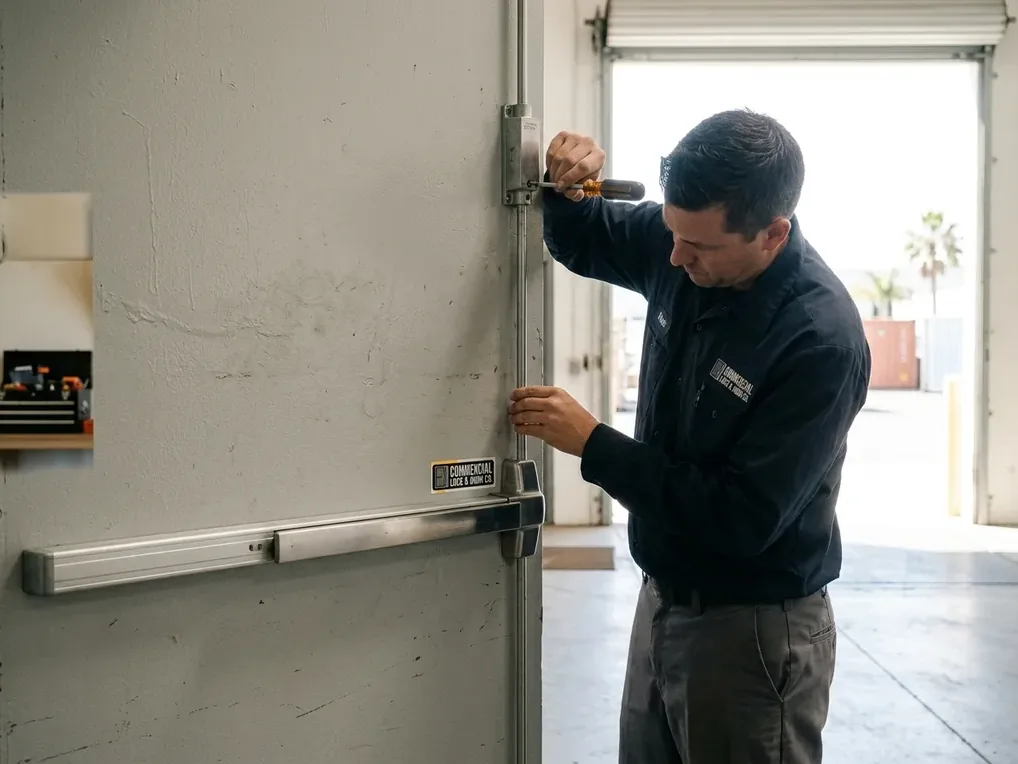
A panic bar that will not latch is a door that will not lock
A panic bar that does not latch is a door that does not lock. Many exit device calls start there.
Someone on the closing shift finds the back door pushing open with a shoulder, or a rear exit that has to be slammed before it catches. The device itself is often fine. The rods are out of adjustment, the floor strike is packed with debris, or the door has dropped on its hinges and the top latch no longer lines up with its strike.
We repair, adjust, and replace exit hardware on commercial buildings across San Diego County: rim, mortise, surface vertical rod, concealed vertical rod, exit only, alarmed, and electrified. Every opening is quoted after we look at the door.
Other calls are code driven rather than mechanical. A fire marshal walks the building and writes up a bar dogged down on a labeled fire door, a slide bolt added above a panic device, or outside trim that takes two motions to get through. Those come with a correction date attached, and the correction has to be the right one the first time.
Four Device Types and Where Each One Gives Trouble
Exit devices are not interchangeable, and the type hanging on your door decides most of the scope. What is installed is usually a function of the door, the frame, and whether the opening is a single leaf or a pair.
Rod devices have the most that can drift out of adjustment, and the device itself is rarely the cause. A door that has settled on worn hinges pulls the top latch out of line with the strike. A bottom rod takes a hit from a hand truck and bends just enough to drag. A floor strike in a kitchen or a tasting room fills with grit until the bottom latch stops seating. On pairs, the inactive leaf drifts out of alignment or the coordinator stops sequencing the leaves, so they close in the wrong order and neither one latches.
- Rim devices mount on the face of the door and latch into a surface strike on the frame stop, or into a removable mullion on a pair. Simplest to service, easiest to retrofit. Trouble shows up as a worn auxiliary deadlatch plunger, a loose or shifted strike, or a chassis working loose in elongated screw holes.
- Mortise exit devices carry the lock body in a pocket in the door edge and latch into a mortise strike. Common on heavy hollow metal and where a specific trim function is needed. Trouble runs to a worn latch and auxiliary latch, a sloppy trim spindle or hub, and a strike lip that stops lining up after the door settles.
- Surface vertical rod devices run exposed rods to a top latch at the frame and a bottom latch at a floor strike. Everything about them lives in the path of carts, mops, and pallet jacks.
- Concealed vertical rod devices hide the rods inside the door for a cleaner look, which also means the door usually comes off the hinges or the top rail comes apart before anything can be adjusted. Same failures as surface rods, plus broken or unhooked rod connections you cannot see until the door is open.
Dogging, Latching, and the Closer That Feeds the Device
Dogging holds the latch retracted so the door works as a push-pull during business hours. Hex key dogging is standard.
Cylinder dogging replaces the hex key assembly with a mortise cylinder, typically a 1-1/4 inch cylinder set in the end case or chassis, so the bar is dogged and undogged with a key on your existing system instead of a hex wrench that lives in a drawer until it disappears. A worn dogging assembly that will not hold, or a stripped hex socket, is a common reason a bar ends up dogged permanently and a door that should lock at close never does.
Fire exit hardware has no mechanical dogging at all. A labeled fire door has to positively latch every time it closes, so a device listed for a fire door assembly is built without the feature. A dogged bar on a labeled door means either the wrong device is installed or someone modified it, and both get written up.
Latching problems often trace back to the door closer rather than the bar. Sweep set too slow and the door drifts into the frame without the energy to throw the latch. Latch speed set too slow in the last few degrees does the same thing. Backcheck out of adjustment lets the door slam into the wall, and that abuse works its way back into the rods, the mounting screws, and the frame. We adjust closer valves and spring size as part of exit device work because the two pieces fail together. On rim devices we also check the auxiliary deadlatch plunger, which has to rest on the flat of the strike rather than drop into the cutout. When it falls into the pocket, the latch can be shimmed open from outside while the door reads as locked.
Egress Rules That Change the Scope of the Job
Panic hardware exists so anyone can get out in one motion in the direction of travel without knowing anything about the door. That principle is what an inspector is testing when they push a bar.
Certain occupancies, assembly and educational among them, require panic hardware once occupant load crosses the threshold in the California Building Code, and your authority having jurisdiction makes the call on your specific opening.
The write ups we get called on are consistent.
- Add-on hardware. A slide bolt, hasp, or keyed deadbolt above a panic bar creates a second releasing motion and has to come off.
- Dogged or propped fire doors. A labeled door held unlatched fails inspection, and it fails in a fire.
- Painted-over or missing labels. A fire door with no legible label is treated as unlabeled, and hardware repairs alone do not restore the rating.
- Field modification. Cutting a new device prep, drilling a labeled door, or welding on a labeled frame can void the label under NFPA 80. Some modifications are allowed; many require the manufacturer or a listing agency.
- Wrong trim function. Outside trim is a security question, but anything on the egress side that requires a grasp, a twist, and a separate unlatch does not meet the one motion requirement.
Alarmed and Electrified Exit Devices
A rear exit that staff use as a shortcut is a security and shrink problem, not an egress problem. The door still has to open.
An alarmed exit device answers that problem with a local horn in the end cap or a surface mounted exit control lock, armed and silenced with a key cylinder so a manager can pass through without calling anyone. Battery powered kits work, and they only work as long as someone changes the battery, so on doors that matter we prefer a device fed from a power supply.
Delayed egress is a different animal. It is a listed function with conditions attached: release on fire alarm, release on loss of power, signage, an approved occupancy, and a delay period the code and your AHJ allow. It is not something to bolt onto a door because people keep propping it.
On the electrified side, the usual requests are latch retraction so a bar can be released from a reader or a front desk, a request to exit switch in the touchbar so an inside push does not trip an alarm, and a door position switch so someone knows when a door is standing open. Latch retraction pulls a heavy inrush and then holds at a much lower current. Undersize the power supply or the conductors in the transfer and you get a device that chatters, retracts intermittently, or cooks a solenoid. We size the supply, use a door loop or an electric hinge rated for the conductor count, and pull wire before the hardware goes on. Where an electric strike is paired with a rim device, the strike has to be listed for use with that device, and on a labeled opening it has to be fail secure so the door stays positively latched.
Repair First, Replace When the Prep Says So
Most exit devices are worth repairing. Rods can be replaced and readjusted, touchpads and end caps are stocked items, dogging assemblies come apart, latches and strikes are separate pieces, and trim can be changed without touching the chassis.
A device that feels loose on the door is often an elongated hole in hollow metal, which calls for through bolts and a reinforcement rather than a new bar.
Replacement earns its place when a light duty Grade 2 device is sitting on a door that sees Grade 1 traffic, when parts for the series are no longer available, or when the chassis is worn far enough that the latch no longer projects fully. The first question on any replacement is what the door is already prepped for. A same prep swap is the cleanest path. Crossing device families usually means new holes, and on a labeled door that is where the fire rating conversation begins. Two retrofits come up often: a less bottom rod conversion, which removes the bottom rod and floor strike from a pair so there is nothing at the floor to bend or foul, and narrow stile devices on aluminum storefront leaves, which have to be sized for that stile. The wrong device on a storefront door is a hole pattern you cannot take back.
Scheduling Exit Device Work Around Your Operation
An exit door out of service is an egress path out of service, so this work gets planned rather than improvised.
A rim device on a single leaf is the least disruptive kind of visit, because the work happens at the face of the door with the leaf on its hinges. A concealed vertical rod pair may need the leaf off the hinges for part of the visit, which is a good reason to put it outside operating hours or into a slow window.
We cover San Diego County: downtown and the East Village, the Sorrento Valley and UTC office corridors, Kearny Mesa and Miramar, the industrial parks off the 905 and 805 near Otay Mesa, the South Bay, and out through El Cajon, Escondido, and the North County coast. Salt air is a real factor near the water. Rods, fasteners, end caps, and dogging assemblies corrode faster there than the same hardware inland, and that shows up as binding rods, seized dogging, and fasteners that will not come out clean.
Quoting is per opening. We look at the door, the frame, the device, and the label, then send a written quote that separates hardware and labor by opening so you can approve one door or twelve. We work on purchase orders, and vendor onboarding packets and document requests are handled through the office rather than by the tech on site. If you manage more than one building, an account means the next call is a phone number and a PO instead of a new vendor packet.
Commercial work is quoted per job, never off a price list. These are the factors that make a quote larger or smaller:
- Device type. A rim device on a single door is the smallest job. A concealed vertical rod pair that has to come off the hinges is the largest.
- Repair versus replacement, and whether a new device matches the existing door prep or requires new holes and reinforcement.
- Fire rating. A labeled opening limits what can be modified in the field and can turn a hardware fix into a door or frame replacement.
- Grade, function, and finish. ANSI/BHMA Grade 1 hardware, cylinder dogging, specific trim functions, and non-standard finishes all move the hardware line.
- Electrification. Latch retraction, request to exit, and door position switches add a power supply, a transfer device, and wire pulling.
- Opening count and timing. Several doors on one trip cost less per opening than several separate trips, and after hours or occupied tenant work adds time.
Where we run panic bars and exit devices
Otay Mesa warehouse pairs with bent bottom rods, Mission Valley retail rear exits, and Poway school corridors get the same rod, strike, and label check.
Common in these buildings
Restaurant back doors with grit-packed floor strikes, HOA common area exits with a correction notice, and school corridor pairs are where most of these calls start.