Locksmith and Door Hardware for Medical and Dental Offices in San Diego
Commercial Lock & Door Co. services door hardware and keying for medical and dental offices across San Diego County: controlled substance room doors, restricted key control, suite entries, closers, and privacy hardware, scheduled around patient hours.
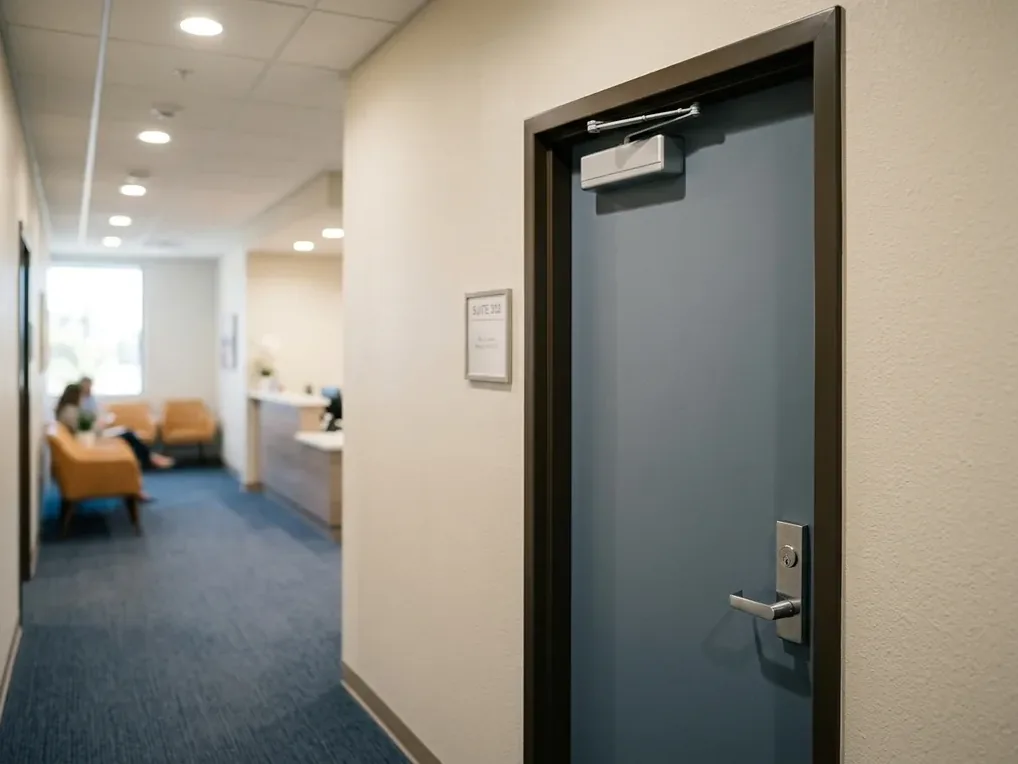
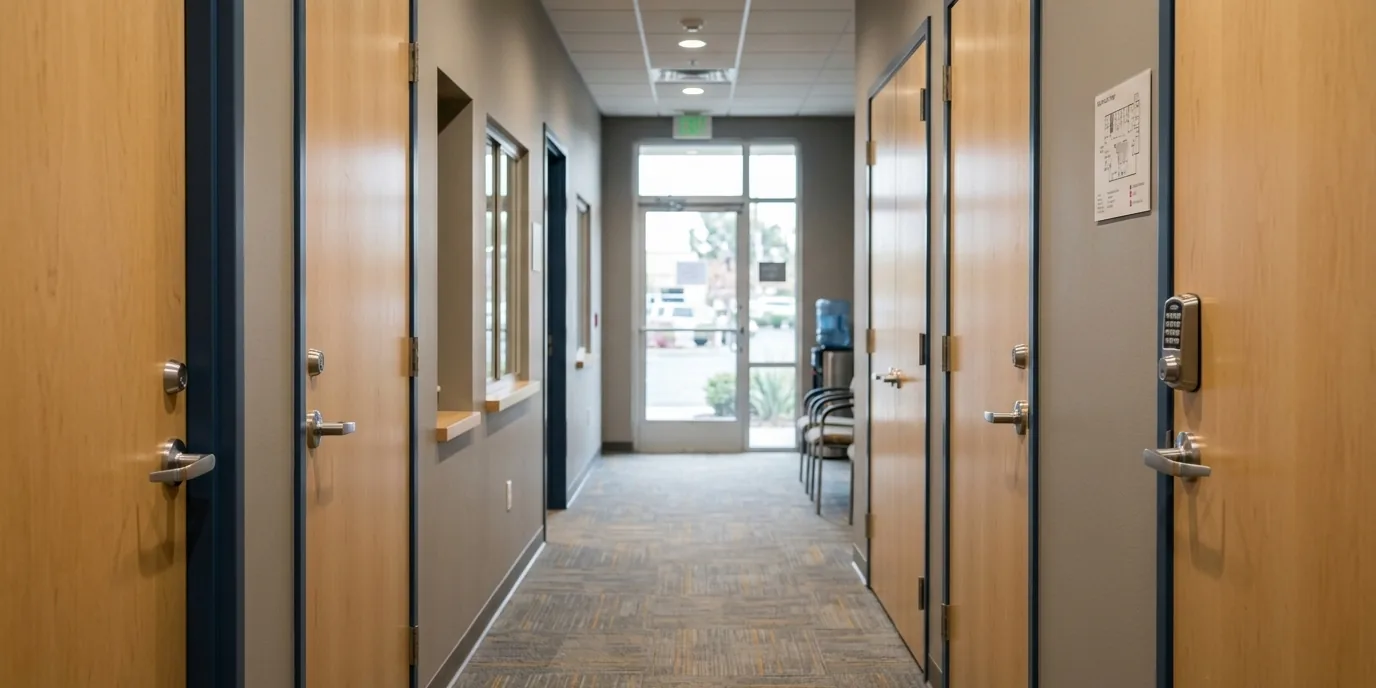
One medical suite, three security zones
A medical or dental suite is really three buildings stacked into one lease.
There is a public side where patients check in and wait. There is a clinical side where staff move all day with their hands full. And there is a short list of rooms that are supposed to stay closed to almost everyone: the controlled substance storage, the records room, the business office, the server closet. Most of what goes wrong with doors in a practice happens right where those three zones meet.
We handle both sides of that problem: the door hardware and the access control that drives it. If you want badge readers, keypads, or a video intercom on the medication room and the staff corridor, we design and install the complete system, readers, controllers, and credentials included. If your building already runs on an integrator's platform, we are just as happy to install the strikes, locks, and closers under it. Either way, a reader is only as useful as the strike, the closer, the frame, and the latch behind it. The calls we get from practices in San Diego usually trace back to one of three things: a door that stopped latching, a lock that was never rated for the traffic it gets, or a key that left the building with someone who no longer works there.
We quote in writing, schedule around patient hours, and coordinate with building management before we show up.
What actually goes wrong in these buildings
Six problems show up in practice after practice, from a supply closet turned controlled substance room to a storefront entry that will not lock at close.
Federal storage rules are written in terms of a securely locked, substantially constructed cabinet or room, not a brand of lock. That standard is about the whole opening. A Grade 1 mortise lock with a deadbolt function on a hollow core door in a knocked-together frame is theater. We look at the leaf first, then the frame, then the lock: solid core or rated leaf, a full-lip ANSI strike anchored into the stud with long screws, hinges with non-removable pins or security studs, and a cylinder on a restricted keyway so a copy cannot be cut at a hardware counter. One key, issued to a named person, logged.
That is normal in a medical office building and it does not have to leave your sensitive rooms exposed. We build a keying schedule under the building's master where the suite entry accepts the building key, and put the controlled substance room, records, and the business office on a separate restricted change key that the building master does not operate. Property management keeps its access to the entry and the mechanical spaces. The bitting record stays under key control, not in a drawer at the front desk.
The fix is a vendor tier in the keying, not a policy memo. The janitorial key operates the suite entry and the housekeeping closet and nothing else. When the cleaning contract changes hands, you swap that one level instead of rekeying the practice. On suites running small format interchangeable cores, the swap takes minutes per door with a control key and no disassembly. Where you want a record of who came in, a keypad lock with individual user codes on the entry does that job, with a mechanical override the owner holds.
A door that does not latch is an unlocked door regardless of what is on the wall next to it. Usually the deadlatch plunger is dropping into the strike pocket instead of riding the strike face, or the closer is out of adjustment and the door is coasting shut without enough force to seat the latch. We re-template the closer where the arm was mounted wrong, set sweep, latch speed, and backcheck for the actual traffic, correct strike alignment, and get off parallel arm hold-open on any door that has to stay closed. On badged corridors we set the electric strike fail-secure so a power loss leaves it locked while the lever still releases from the egress side, and a door position switch tells you when the door is standing open.
Privacy is not the same problem as security, and the hardware is different. Exam, consult, and restroom doors want a privacy set with an outside emergency release so staff can get in when a patient does not answer, plus a lever that works with a closed fist. Builder-grade privacy sets shed their spindles under clinical traffic and start failing to hold the button. We move those to a heavier duty set with a coin turn or emergency key release, keep the release tool where the front desk can reach it, and add an occupancy indicator on the doors where staff keep knocking.
Narrow stile aluminum is its own trade. The door drops on worn pivots or a failing continuous hinge, the hook bolt on the MS deadlock stops finding its keeper, and staff start yanking the door up to lock it at night. We reset the pivots or hang a continuous hinge, align the deadlock and keeper, replace the deadlatch and paddle where the door is used all day, and set the threshold and sweep. Where occupancy calls for panic hardware, we look at a rim device on a removable mullion before touching concealed vertical rods, because the rim device is far easier to keep in service.
Key control that outlasts your staff roster
Practices turn over front desk staff, hygienists, medical assistants, and per diem help. If every one of those people carries the same key, every departure is either a rekey or a risk you decide to live with.
A master key system fixes that by putting rooms into levels: one key for clinical staff, one for the business office, one for the doctor or owner, one for vendors, and a master that operates the suite.
Restricted keyways matter more here than in most commercial spaces. A restricted key blank is not sold over the counter, so a departing employee cannot make a spare on the way out. If you want to be able to change a room quickly and often, small format interchangeable cores let you pull and replace the core with a control key instead of taking the lock apart.
- A written keying schedule you keep on file, with the bitting list held under key control
- Restricted keyways for the controlled substance room, records, and the business office
- A vendor level that opens the entry and the janitor closet and nothing more
- Interchangeable cores where staffing changes often
- Rekey triggers written down: termination, lost key, contractor change, suite reconfiguration
The doors that fail first in a practice
Clinical traffic is not office traffic. A corridor door in a busy dental office cycles more in a week than a private office door does in a quarter, and it gets pushed open with an elbow, a hip, or a cart.
Grade 2 cylindrical hardware that was fine in a tenant improvement package starts to loosen, the rose spins, and the latch stops projecting fully. On the openings that carry real cycles we move to Grade 1, usually a mortise lock where the door prep allows, because the mortise case takes side load that a cylindrical lock will not.
Closers are the other repeat offender. A closer that was hung on the wrong arm or never adjusted for the door weight is why doors slam at the waiting room and drift at the lab. Templating, spring size, and backcheck are adjustments, not replacements, and most closers we look at can be brought back into range.
Working inside a medical office building
Suites in the medical office buildings around Hillcrest, Kearny Mesa, La Jolla, and the I-15 corridor come with a landlord, a building engineer, and rules about vendor access. We are used to that.
Tell us what your building requires on file before a vendor works in the suite and we will handle the paperwork ahead of the work date rather than at the elevator.
We also work around your schedule instead of the other way around. Hardware that has to come off a corridor door or a suite entry gets done before the first patient, after the last one, or on a weekend, with the opening secured in the meantime. Nothing gets left in a state where a door will not lock at close.
How a quote and an account work
Every job starts with a walk of the openings and a written quote by line item, because commercial door work is priced by what the opening actually needs.
What drives the number is the door and frame condition, the hardware grade and finish, whether the opening is fire rated, whether a keyway is restricted, and how many openings share a keying schedule.
Most practices we work with end up on an account: one point of contact, purchase orders where your bookkeeping needs them, vendor onboarding paperwork handled once, and a keying record we keep so the next call does not start from scratch.
- Doors in the path of egress must open from the inside with one motion, without a key, a tool, or special knowledge. That rules out a double cylinder deadbolt on an exit door and it rules out any interior lock that could hold a patient in. Where a room is locked electrically, the release scheme has to keep free egress intact and unlock as required on alarm or power loss.
- Labeled fire doors, which usually means the corridor and stair doors in a medical office building, must be self-closing and positive-latching. Field drilling a leaf or frame for a new lock prep or an electric strike can void the label unless the work follows the manufacturer's listing. Hold-open devices and wedges are not permitted on a rated door unless the hold-open is tied to the fire alarm, and exit devices on rated openings are not to be dogged down.
- Accessibility principles govern most of what a patient touches. Hardware should be operable with a closed fist and without tight grasping, pinching, or wrist twisting, which favors levers, push and pull hardware, and panic bars over knobs and thumb latches. Mounting height, opening force, closing speed, and clear maneuvering space at the pull side all matter, and a restroom privacy latch has to meet the same operability standard as the entry.
- Controlled substance storage is described in federal rules as a securely locked, substantially constructed cabinet or room. That is a whole-opening requirement, so the frame, hinges, strike, and leaf carry as much weight as the lock. Securing that room can never conflict with egress from the space it sits in.
General principles only. Your authority having jurisdiction has the final say on any specific opening.
What we are usually called out for
Most practice calls are one of these: a restricted keyway for the medication room, a keying schedule that survives turnover, or a closer that seats the latch.
High Security Locks
Key control for San Diego commercial buildings
DetailsMaster Key Systems
Commercial keying design for San Diego buildings
DetailsAccess Control Systems
The whole system, credential to latch
DetailsCommercial Rekey
Repin the cylinders you already own
DetailsDoor Closers
Surface, concealed, and floor closers
DetailsADA Door Hardware
Commercial accessibility hardware, San Diego County
Details