Fire Rated Door Hardware in San Diego County
Fire rated door hardware keeps labeled openings self-closing and positively latching. Commercial Lock & Door Co. services closers, fire exit devices, hinges, and gasketing on stair, corridor, and suite doors across San Diego County, quoted per opening from your inspection report.
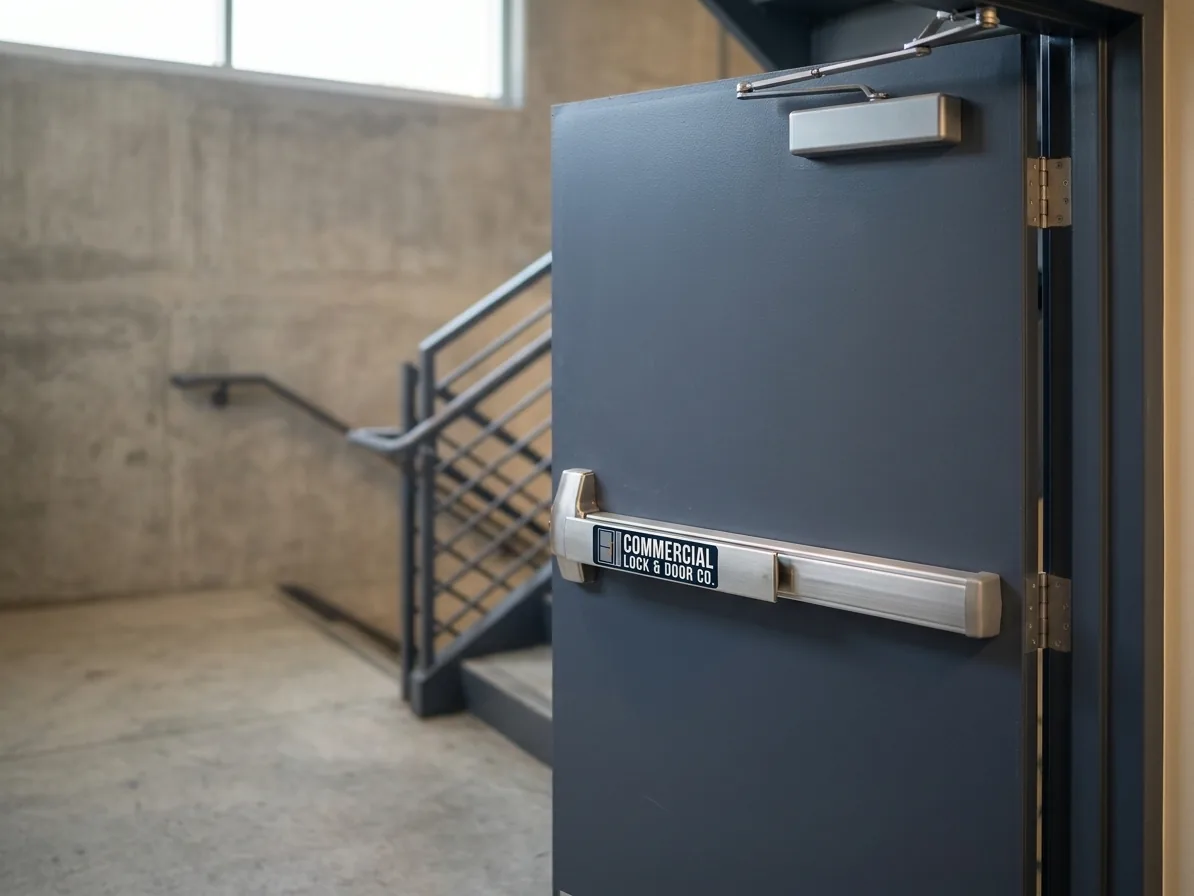
When the fire door inspection report lands on your desk
Somebody handed you a fire door inspection report. It lists openings by number, each with a line next to it: will not latch, does not close from full open, holes in the leaf, label painted over, gasketing missing, screws loose.
The report tells you what is wrong. It does not tell you what it takes to fix, and it does not separate the doors that need twenty minutes of adjustment from the one that a contractor drilled last spring and quietly took out of compliance.
Commercial Lock & Door works on labeled openings across San Diego County: stair doors, corridor and cross-corridor pairs, tenant suite entries in office buildings, rated openings into back of house and warehouse space. A fire door assembly is a listed system. The leaf, the frame, the hinges, the closer, the latching hardware, the strike, and the gasketing all have to stay inside what the listing allows. Hardware that performs fine on an unrated door can fail a rated opening without anyone noticing until an inspection or an incident.
Send us the report, or ask for a walk-through and we will build the opening schedule ourselves. Either way you get a written scope, priced per opening, that you can turn into a PO.
What the label actually covers
The label is a small metal or mylar plate on the hinge edge of the leaf, with a matching label on the frame.
The label names the listing agency and the rating in minutes, and on stair enclosure doors it may carry a temperature rise rating as well. The rating comes from the wall the opening sits in, not from preference or budget. A 90 minute opening in a fire wall does not become a 45 minute opening because the replacement door was easier to source.
The listing covers the assembly, not just the door. That is the part that trips people up. Every component in the opening has to be listed for fire door use, and mixing in one unlisted part changes the standing of the whole assembly.
- Ratings you will see in commercial buildings: 20 minute, 45 minute, 60 minute, 90 minute, and 180 minute at fire wall openings.
- Temperature rise ratings of 250, 450, or 650 degrees apply to stair enclosure doors and limit how hot the unexposed face gets. Swapping in a plain rated leaf can lose that rating without anyone realizing it.
- The label has to stay legible. A label buried under repaint is a deficiency, and a leaf with no legible label gets treated as unrated until it is field labeled or replaced.
- The frame carries its own label. A rated leaf hung in an unlabeled frame is not a rated assembly.
- Hinges, lockset, exit device, strike, closer, gasketing, and any vision light kit all have to be listed for the rating.
Why field drilling voids the label
The listing covers the assembly as it was built and tested. Cut into it on the job site and you are outside that test.
NFPA 80 permits a narrow set of field operations, and it does not permit the ones people usually want to do. This is where most of the expensive findings on an inspection report come from, and almost always the work was done by someone with no idea a label was in play.
- Function holes and through bolt holes up to one inch in diameter are generally permitted. A new lock bore that changes the prep, or a mortise pocket cut in the field, is not.
- A vision light cannot be added to a door that was not built and listed with one.
- Undercut has a limit. Trimming the bottom of a leaf so new flooring clears is one of the most common ways a rated door quietly stops being rated.
- Clearances are tight, roughly an eighth of an inch at the head and jambs and at the meeting edges of a pair. Doors that have been shaved to stop them binding usually fail here.
- Filling old holes with body filler or wood putty, or covering them with a plate, is not a repair. Steel doors take listed fill methods only.
- Welding a new strike box into a labeled frame in the field is the same problem in a different material.
Self-closing and positive latching
Two requirements sit under everything else. The door has to close by itself from any open position, and the latch bolt has to throw fully into the strike without a push, a pull, or a shoulder.
A door that swings shut and rests against the stop is a failed opening, even though it looks closed from down the hall.
Most latching failures are a closing force problem, not a lock problem. Gasketing, drop seals, carpet, and stack pressure in a pressurized stair tower all add resistance that was not there the day the closer was set.
- Closer spring size has to match the door width, weight, and the pressure it closes against. An undersized closer is the usual reason a leaf stops an inch short of the strike.
- Latch speed governs the last few degrees of swing. Too slow and the latch never seats. Too fast and the frame takes the abuse.
- Backcheck protects the closer and the frame when someone throws the door open into a wall. It is not a substitute for an overhead stop.
- A deadbolt does not satisfy positive latching. Latching means a spring-loaded latch bolt that engages the strike every single time the door closes.
- Hold-open arms, kick-down stops, wedges, and rope do not belong on a rated opening. A door that must stand open needs a listed hold-open released by the fire alarm.
Fire exit hardware is not the same as panic hardware
Both are exit devices and both release with a push. The difference is dogging.
Panic hardware can be dogged, holding the latch mechanically retracted so the door pushes free all day. Fire exit hardware has no mechanical dogging, because a rated door has to latch every cycle. If someone can put a hex key in the device and hold the latch back, that device does not belong on a labeled opening.
- Fire exit devices carry their own label and are listed for the rating of the opening they sit in.
- Rim devices on rated openings need a listed fire strike, not a generic surface strike scavenged off another door.
- Vertical rod pairs need attention. Less bottom rod versions on rated openings require the correct auxiliary fire pin or fire bolt arrangement so the inactive leaf still holds under fire conditions. Pulling the bottom rod on a rated pair the way you would on an unrated one is a deficiency.
- Concealed vertical rods live inside the leaf. Service means pulling the device and often the rod assemblies, which is a longer job than a surface rod on the same opening.
- Electric latch retraction is permitted only where the device is listed for it, and the latches have to drop back in on alarm.
- A maglock does not latch anything. On its own it does not meet positive latching on a rated opening, whatever else it does for the door.
Hinges, pairs, and the parts nobody looks at
The components that fail inspections are rarely the ones on the purchase order. Steel ball bearing hinges, the right count for the leaf height, every screw present and biting into the frame.
Continuous hinges have to be listed for fire door use. Spring hinges can serve as the self-closing device where they are listed for it, and there is a minimum count per leaf.
Rated pairs carry more parts and more ways to fail. If the leaves close out of order, the astragal fouls and neither one latches.
- A pair with an overlapping astragal needs a coordinator so the inactive leaf closes first, plus a carry bar or open back strike depending on the device.
- Flush bolts and their strikes are part of the assembly. Automatic flush bolts have to project fully into the head and threshold strikes.
- Astragals and gasketing must be listed. Intumescent seals swell under heat and are not interchangeable with plain smoke gasketing.
- Loose and missing hinge and strike screws are a routine finding and among the fastest items to correct, but a hinge that has already sagged has usually thrown the whole opening out of alignment.
- Coastal exposure counts here. Exterior stair doors near the water corrode at hinges, closer arms, and rod ends, and a seized rod is a door that will not latch.
Annual fire door inspections and what happens to the report
Fire door assemblies are expected to be inspected and tested annually, with results documented and deficiencies corrected without delay. In practice the report gets written, forwarded, and then sits, because nobody has priced the work.
We take the report opening by opening and turn it into a scope you can act on, sorted so you can see which items are adjustment, which are hardware replacement, and which are a door or frame problem that belongs in a capital line. This page covers the hardware side of a labeled opening. When the leaf or frame itself has lost its label or cannot be reused within the listing, that becomes fire-rated door installation, and we quote it as its own line.
If there is no report yet, we can walk the building first and build the schedule: location, rating, door type, frame type, existing hardware, condition, and what it would take to bring each opening back into shape. That document is useful long after the work is done, especially across a portfolio where nobody has ever counted the labeled openings.
- If your building requires vendor onboarding before work starts, tell us up front and we will route the paperwork through the office ahead of the crew.
- Replacement leaves get measured for handing, size, prep, label requirements, and frame condition before anything is ordered, because a rated door is not a stock item you swap the next morning.
- Portfolios run on one account with billing by property and a record of what was done at each opening.
Commercial work is quoted per job, never off a price list. These are the factors that make a quote larger or smaller:
- Number of labeled openings, and whether they are single leaves or pairs. A rated pair carries a coordinator, flush bolts or vertical rods, and an astragal, so it is closer to two openings than one.
- Whether the existing prep matches the new hardware. Dropping a listed lockset into an existing mortise pocket is short work. Changing function, backset, or device type on a labeled leaf is a different conversation.
- Device type on exit hardware. Rim devices are the fastest. Surface vertical rods take longer. Concealed vertical rods mean pulling the device and the rod assemblies out of the leaf.
- Whether the leaf and frame are repairable within the listing, or the assembly has been modified past it and needs field labeling or replacement.
- Special order hardware. Fire listed hardware in a specific finish, function, and your existing keyway is rarely on a shelf, and lead time carries into the schedule.
- Access and hours. Stair doors and primary egress usually run after hours or on a weekend, and occupied suites add tenant notice, escorts, and vendor onboarding.
Where we run fire rated door hardware
Labeled stair and corridor doors turn up on inspection reports from downtown office towers, Sorrento Valley lab buildings, UTC medical suites, and Carlsbad business parks alike.
Common in these buildings
Multi-tenant office buildings, school campuses, and managed portfolios hold labeled stair and corridor doors by the dozen, often with nobody tracking which ones were drilled.