High Security Locks and Key Control in San Diego
High security locks pair pick and drill resistant cylinders with restricted or patented keyways so keys cannot be copied without authorization. Commercial Lock & Door Co. installs these cylinders and runs key control programs for commercial buildings across San Diego County.
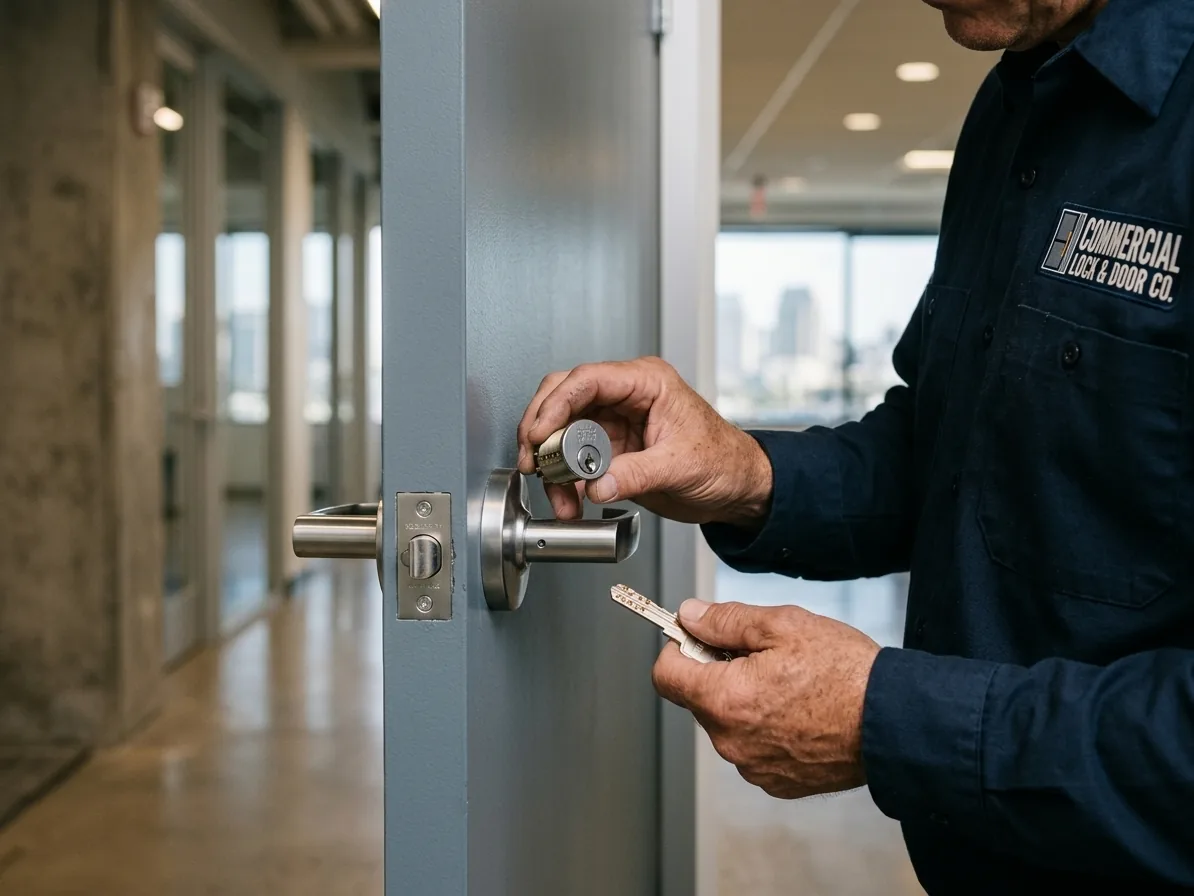
When a key you never issued opens your building
Someone has a key you did not issue. That is usually how this starts.
A former tenant's contractor still gets into the electrical room. A key stamped Do Not Duplicate comes back on a ring at turnover with a fresh brass copy hanging next to it. Nobody can say how many keys to the building exist, because the records went out with the last management company. Do Not Duplicate is a request printed on a blank. Any shop holding that blank has the machine to cut it, and the stamp gives nobody grounds to stop them.
High security hardware solves a narrower problem than the name suggests, and a more useful one. It buys drill and pick resistance at the cylinder, which matters for a handful of openings in most buildings. More importantly, it buys control over who can make a key at all. For a commercial property, that second thing is almost always the real purchase. Buildings rarely lose inventory to a picked lock. They lose it to a key that got copied at a hardware counter by someone who no longer works there.
This page covers what actually separates a high security cylinder from a Grade 1 lockset, the difference between restricted, patented, and merely proprietary keyways, and how we set up and maintain key control programs across San Diego County portfolios.
What actually makes a cylinder high security
Grade 1 under ANSI/BHMA describes the lockset, not the cylinder inside it. Grade 1 tells you the lock body survived a cycle test, an impact test, and a strength test at the latch and the lever.
The grade says nothing about the keyway. A Grade 1 mortise lock built for heavy traffic will happily accept a standard five pin cylinder that opens to a pick in short order and to a cordless drill faster than that. Cylinder security is rated on its own. ANSI/BHMA A156.30 covers high security cylinders and grades them on attack resistance and on key control. UL 437 is the listing most facilities people recognize, and it covers resistance to drilling, picking, and forced attack at the cylinder itself.
The physical hardening is not exotic. It is layered, and each layer buys time against a different tool.
The pick resistance comes from a second condition the key has to satisfy beyond lifting pins to a shear line. Depending on the manufacturer that means a sidebar that must be aligned by rotating pins, finger pins riding in angled cuts on the key blade, telescoping or interlocking pin stacks, or a magnetic element. Spool and serrated driver pins on top of that make single pin picking slow and noisy. None of this is invisible to the user. The key looks different, feels heavier, and takes a deliberate insertion.
- Hardened steel inserts or ball bearings set into the plug face and cylinder housing to skate a drill bit off the shear line
- Anti-drill pins in the front chambers
- A hardened plug retainer so the cylinder does not simply come out under torque
- Spool, serrated, and mushroom driver pins to defeat picking by tension
- A sidebar, finger pins, or rotating elements that must be positioned independently of the pin stacks
- Restricted blank distribution so the correct key cannot be casually reproduced
Restricted, patented, and proprietary are three different things
These words get used interchangeably by salespeople and they should not be.
A restricted keyway is a contractual restriction. The distributor agrees to supply blanks only to authorized shops, and the shop agrees to cut only for names on your signature card. It works until somebody breaks the agreement or the distributor changes hands.
A patented keyway adds a utility patent covering the key blade geometry or the cylinder mechanism. Unauthorized manufacture of the blank is then a legal matter rather than a policy matter, which is a meaningfully stronger position. It also has an expiration date. When the utility patent lapses, aftermarket blanks appear and you are back to contractual protection alone. Before you commit a portfolio to a system, ask which patent covers it and when that patent runs out. A system near the end of its patent term is a different purchase than one with most of its term ahead of it, even if the cylinders look identical on the shelf.
Proprietary sits in the middle and is where most confusion lives. A manufacturer keyway family can be sold in both open and restricted variants under the same family name. The name on the key does not tell you whether it can be copied. Blank availability tells you. Bring a key to a shop and see whether they can match the blank. That is the only test that means anything.
There is also a practical split between systems cut locally by an authorized shop and systems cut only at the factory against a registered account. Factory-only cutting is the tighter control. It also adds lead time every single time you need a key, which is a real operational cost in a building with weekly turnovers. Pick the one that matches how often you actually issue keys.
Key control is the part that protects you
Most commercial buildings do not have a lock problem. They have a records problem.
Nobody knows how many keys exist, who holds them, or which doors each one opens. A high security cylinder installed on top of that mess just makes the mess more expensive. The cylinder is the enforcement mechanism. The program is the thing you are buying.
A working key control program has a small number of moving parts and all of them are boring, which is why they get skipped.
The audit is the part people abandon after year one. Once a year, take the issued key log and physically confirm each key. Anything unaccounted for gets pulled at that level. A system that is never audited slowly becomes a normal building with expensive cylinders on it.
- A signed authorization list naming exactly who can order keys, updated when your staff changes
- Bitting records held on file and tied to a written keying schedule rather than to memory
- Serialized or stamped keys with an issuance log showing who received which number and when
- Purchase order or letterhead required for every cut, with no verbal orders
- A written return policy at termination and at tenant move-out, enforced against the log
- An annual audit reconciling keys in hand against keys on paper
Retrofitting without replacing your locksets
Converting a building to a high security system is usually a cylinder swap, not a hardware replacement.
The lockset bodies, exit devices, and closers you already own stay on the door. What changes is the cylinder that sits in the existing prep, which keeps cost down and keeps the doors in service.
The formats we are working with in a typical San Diego commercial portfolio are: small format interchangeable cores in BEST style housings, where a control key pulls the core without taking the lock apart and a high security core drops straight in; large format interchangeable cores on some manufacturers; standard mortise cylinders threaded into a mortise lock case, where length, cam type, and collar all have to match or the lock will not retract; rim cylinders behind rim exit devices, where the tailpiece length and the mounting plate matter; and key-in-lever cylinders on cylindrical locksets. Aluminum storefront is its own category, with Adams Rite style cylinders serving the deadlatch or the hookbolt.
Two things get checked before anything is ordered. First, cylinder projection. A cylinder that sits proud of the escutcheon gives a wrench something to grab and defeats the point. Second, fire rated openings. A labeled door and frame can only carry hardware within the listing. Field drilling a new prep to make a cylinder fit voids the label on that opening, and the label is what a fire marshal or your carrier looks for. If the cylinder does not fit the existing prep on a labeled door, the answer is a listed lockset, not a hole saw.
When a high security cylinder is the wrong purchase
Part of doing this honestly is telling you where the money should not go. A hardened cylinder protects the keyway.
That cylinder does nothing for the rest of the opening, and on many commercial doors the keyway is not the weak point. If any of the following describes your opening, fix that first. The cylinder upgrade will still be there next quarter.
The most common example in this county is a glass aluminum storefront on a retail or restaurant space. Those doors are almost never picked. They are pulled, pried at the deadlatch, or the adjacent glass goes. Spending on a patented cylinder while the deadlatch is worn and the strike is chewed out is spending in the wrong place. Get the door closing, latching, and holding first. Then control the keys.
- An aluminum storefront with a worn Adams Rite deadlatch, a spread frame, or a strike the latch barely catches
- A hollow metal frame that flexes under a pry bar because it was never grouted or properly anchored
- A closer that no longer pulls the door fully closed, so the latch never seats and the lock is decorative
- An exit device dogged down all day, leaving the rim cylinder out of the picture during business hours
- Surface vertical rods out of adjustment, so the top latch is not engaging the header strike at all
- Doors routinely propped for deliveries, where the actual fix is a procedure and a door position switch, not a better cylinder
How a rollout gets scoped and scheduled
It starts with a walk. We go opening by opening and record what is actually installed, which is regularly not what the last door schedule says.
Manufacturer, function, cylinder format, handing, frame type, closer condition, and current keying all go on the survey. That document becomes the basis of the quote and the reference you keep afterward.
Next is the keying schedule. This is the design work and it deserves an hour of your time. We map who needs to get where, build the levels around that, and deliberately leave expansion room in the pin stacks so adding a suite next year does not force a redesign. We keep cross keying to a minimum, because a heavily cross keyed system is convenient on day one and difficult the first time you have to pull a key back after a termination.
Then the cutover. Exterior and shared building doors usually go first, then tenant suites in phases by floor or by building. Keys are stamped against the issuance log ahead of time and handed out the morning each phase goes live. For occupied space, we coordinate tenant notices with your management staff and work after hours where operations require it. This works the same way whether the site is a single office building in Mission Valley, a multi-building park in Sorrento Valley or Kearny Mesa, or a distribution facility down near Otay Mesa.
Buildings we carry as an ongoing account have their keying schedule and bitting records on file here, so a turnover rekey or a key order later is a phone call against an existing schedule instead of another survey. Purchase orders and terms are standard on that kind of account. Call the shop or send over a door count and we will get a walk on the calendar.
Commercial work is quoted per job, never off a price list. These are the factors that make a quote larger or smaller:
- Opening count, and how many cylinders each opening actually carries. A pair of doors with an exit device on each leaf is two rim cylinders, not one.
- Cylinder format mix. Small format interchangeable cores swap fastest. Mortise cylinders need the right length, cam, and collar. Storefront doors need the Adams Rite style cylinder the deadlatch was built for.
- Depth of the keying schedule. A grand master with floor masters under it and expansion room left in the pin stacks takes more design work than a single level system where every door takes the same key.
- How many keys you issue at cutover, and whether they are stamped and serialized for the issuance log.
- Condition of the existing hardware. If a lockset, deadlatch, or closer needs repair before a cylinder swap makes sense, that work is scoped separately and quoted with it.
- Access windows. Occupied tenant suites, after hours work, and phased cutovers by floor or building all shape the schedule and the labor on the quote.
Where we run high security locks
We convert lab parks, office towers, and managed portfolios in these districts to restricted or patented keyways and keep the bitting records on file.
Common in these buildings
Portfolios with no bitting records, labs with controlled storage, and dispensaries that need a documented key trail are where a key control program earns its keep.