Keypad Locks and Keyless Entry for San Diego Commercial Doors
Standalone keypad and fob locks put code-based entry on individual commercial doors with no server, network, or subscription. Commercial Lock & Door Co. installs and services them on offices, stockrooms, gates, and suite entries across San Diego County.
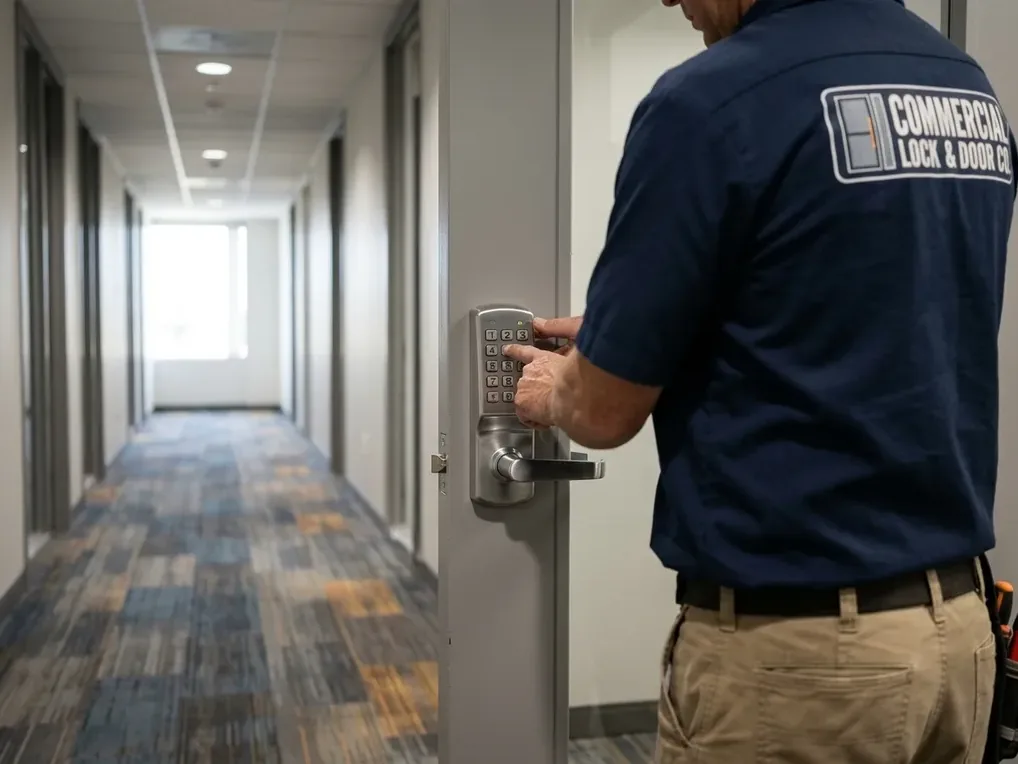
The door that has outgrown its key
Somewhere in your building there is a door that has outgrown its key. The stockroom, the IT closet, the records room, the back gate, the suite entry that a cleaning crew and two vendors and one former employee all had a copy of.
Every turnover means another rekey, another round of handing out brass, and another key you are not sure ever came back.
A standalone keypad or fob lock solves that one problem without pulling you into a security integration project. There is no panel in a closet, no network drop, no annual software subscription, no head-end to license. The credential lives in the lock. You change a code at the door in about a minute, and the person who left stops getting in.
That is the right answer for a lot of doors in San Diego County and the wrong answer for a few. Below is how to tell them apart, and what these locks are actually like to own two years in.
When Standalone Is the Right Answer
Standalone works when the opening count is low, the doors are scattered, and nobody needs to see activity in real time. Each lock is its own island.
If one fails, one door is affected, and the rest of the building never knows. It stops working at scale. Past a dozen or so openings across multiple shifts, walking the building to add and delete codes becomes a part-time job. If a credential has to die at every door the moment HR closes a file, if you need held-open or forced-door alerts, if you need lockdown from a phone, or if an auditor wants a report pulled centrally, you are describing a networked platform and we will say so. When a building gets there, we design and install full access control systems ourselves, and we still handle just the door hardware under an existing integrator's platform when that is what you already run. We are not going to sell you a battery lock and call it a system.
- Openings where running wire costs several times what the lock costs
- Leased space where the landlord will not approve conduit or core drilling
- Gates, sheds, and yard storage with no power anywhere near the jamb
- Interior doors that need control, not surveillance: supply, records, IT, mechanical
- Multi-tenant buildings where each tenant manages its own people
- A single problem door, where a full system is a large answer to a small question
The Hardware, By Name: Pushbutton, Lever, Mortise, and Exit Trim
Keyless entry is a category, not a product. What goes on your door depends on the door prep you already have, the frame, and the traffic it sees.
Mechanical pushbutton locks use a clutch mechanism and no batteries at all. One code, changed by disassembly or a change key depending on the model. They are excellent on a low-traffic closet used by a stable group and they never die at 6 a.m.
Electronic keypad cylindrical levers drop into a standard ANSI 161 prep with a 2-3/4 inch backset and are usually field reversible for handing. Grade 1 versus Grade 2 is a real decision here: a Grade 2 lever on a break room is fine, a Grade 2 lever on a warehouse door that cycles all day is a service call waiting to happen. Keypad mortise locks reuse an existing ANSI 86 pocket, get handed at install, and hold up better on heavy openings.
Keypad exit trim replaces the outside lever trim on a rim or mortise exit device. Egress from inside stays a single push, untouched. On aluminum storefront the stile width limits your options, so the honest answer is often keypad trim on a rim device rather than forcing a bulky escutcheon onto a narrow stile. Where people share codes freely, a standalone prox or MIFARE fob lock enrolled at the door with a programming card is the better behavior fix.
Code Management When Staff Turn Over
The failure of most keypad installs is not the hardware. It is that the building has one code, everyone knows it, and it has not changed since the lock went on.
Turnover then costs you the same scramble a lost key did. Issue one code per person, not one code per door. Give vendors their own code, HVAC separate from janitorial separate from the elevator company, and delete it when the contract ends. On units that support them, use temporary codes with an expiry for contractors and short-term staff. Keep a written code map somewhere that is not a whiteboard in the copy room, and set a rotation date for any code more than a handful of people know.
One detail people miss: almost every electronic keypad lock ships with a key override cylinder. If that cylinder is still the builder keyway the property was framed with, the keypad is not your weakest point. Move the override cylinders onto a restricted keyway and onto your master key system so the mechanical side is as controlled as the electronic side.
Batteries and the Failure Modes That Matter
Manufacturers rate battery life in openings, not months, so a suite door and a warehouse door on the same lock model are not on the same schedule.
Put battery replacement on your PM calendar, change the full set at once rather than one cell, and write the date inside the battery cover. Low-battery warnings on most units are a flashing LED or a chirp on unlock, which staff will ignore until the day it matters.
Two field notes. If a lock specifies alkaline, use alkaline. Lithium AA cells hold voltage flat and then drop, which compresses the warning window to almost nothing. And on a shared code, the pressed digits wear visibly on the keypad face, so rotating codes is as much about wear as about staff.
Most calls we get on keypad locks are not electronic at all. They are a sagging hinge, a latch binding on a strike that no longer lines up, or a closer slamming the door hard enough to shock the latch. The lock retracts fine and the door still will not open, so the keypad gets blamed. The same sag often drops the deadlatch plunger into the strike pocket with the bolt, so the latch stops deadlocking long before anyone notices. We check the opening before we replace the lock.
Audit Trail: What You Get, and What You Do Not
Standalone locks store events locally in a fixed buffer and overwrite the oldest entries as new ones come in.
To read the log, someone walks to the door with a handheld unit, a USB device, or a laptop running the manufacturer software. There is no central pull.
Clocks are per-lock and drift independently, so timestamps across two doors will not line up cleanly. A shared code tells you a code opened the door, not who used it. There are no live alerts, and most standalone units have no door position switch, so a propped door reports nothing.
That is enough to answer whether the storage room was opened Saturday. It is not enough for a chain-of-custody or regulated-storage requirement. If you have one, tell us early and we will scope the opening differently instead of retrofitting a shortfall.
Egress, Fire Doors, and ADA
The keypad goes on the outside. Egress from the inside has to happen in one motion with no key, tool, or special knowledge, and that rule does not bend for convenience.
A code required to leave a room is a code violation on almost every opening in a commercial building.
On a labeled fire door the label governs. Retrofitting into the existing 161 prep is usually within the door manufacturer's listing. Cutting a new hole for a large escutcheon in the field generally is not, and the label goes with it. Fire exit hardware also cannot be dogged, so keypad trim on a rated stair or corridor door means the outside stays locked and the code is the only way in. Plan for that before you install it.
ADA hardware means a lever, not a knob, operable with one hand and no tight grasping, pinching, or twisting, within the required reach range and force. A backlit keypad is worth asking for on any door people use before sunrise or in a dim corridor. On rated corridors and tenant improvement work we prep the opening so it survives inspection rather than passing it back to you as a punch item.
Commercial work is quoted per job, never off a price list. These are the factors that make a quote larger or smaller:
- Number of openings and how close together they are on one visit
- Whether the existing door prep is reused or a new prep is required
- Lock type and ANSI grade: mechanical pushbutton, cylindrical, mortise, or exit device trim
- Door and frame condition, including hinge sag, strike alignment, and closer adjustment
- Rated doors and storefront, which limit part choices and add inspection prep
- After-hours or tenant-coordinated scheduling to keep doors in service during business hours
Where we run keypad locks and keyless entry
Warehouse man doors in Miramar and Otay Mesa, Kearny Mesa stockrooms, Mission Valley office suites, and Chula Vista storefront back doors all take a standalone lock.
Common in these buildings
Standalone locks suit property managers handing tenants a suite door they control, office managers issuing vendor codes instead of keys, and medical offices securing a records room.