Office Lockout Service for San Diego Businesses
Commercial office lockout service gets businesses back into locked suites, storefronts, and back-of-house doors, using non-destructive entry first. Commercial Lock & Door Co. answers lockout calls across San Diego County, 7 days a week, 7am to 10pm.
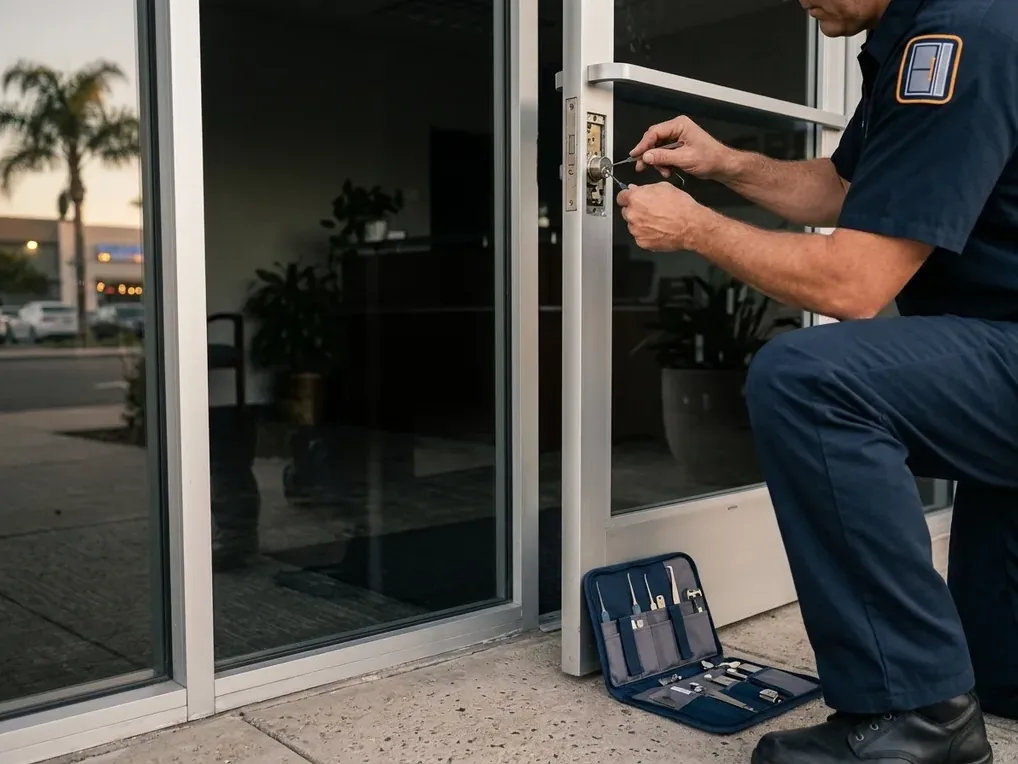
Locked out of the building before the day starts
It is 6:40 on a Monday and the front door will not open. The key turns, the cylinder rotates, and nothing retracts.
Two people are waiting in the parking lot, a delivery is due at seven, and somebody has already walked around to the back door and found the vertical rod hardware holding tight.
A commercial lockout is rarely just a lost key. More often something in the opening failed. A deadlatch stopped clearing the strike after the door dropped on worn pivots. A cylinder started spinning because a set screw backed out. A keypad lock ran its batteries down over a long weekend. Or the only key to the mechanical room left with an employee who is not coming back.
Getting in is the first half. The second half is deciding whether that lock goes back into service or gets replaced before it strands you again, and that decision is worth making with someone who works on commercial openings all day rather than whoever answers a phone first.
Non-destructive entry first, drilling last
Opening a commercial door is a decision about which part of the opening you are willing to sacrifice. Most of the time the answer is none of it.
Standard pin tumbler cylinders in the common keyway families can be picked or decoded, and a working key can often be cut on site so you are not left with an open door and no way to secure it at close.
Aluminum storefront doors are their own category. The usual setup is a deadlatch with an anti-shim plunger riding on the strike face, or an MS style hook bolt in the bottom rail throwing into the threshold. Which one you have changes the approach completely, and so does whether you are looking at a narrow, medium, or wide stile section. A hollow metal door in a welded frame with a Grade 1 mortise lock is a different problem again, because the latch sits behind a strike box you cannot reach and the work happens at the cylinder.
Drilling is the last option, and when it happens it is aimed at one point rather than the face of the lock. A drilled cylinder gets replaced and keyed to your existing key so the rest of the building does not change overnight. On high security cylinders with hardened inserts and drill plates the math is different, because the replacement is a controlled part that may have to be ordered against your key records. That is a conversation to have before the drill comes out, not after.
Why commercial doors lock you out: what actually failed
Naming the failure matters, because it decides whether you are done when the door opens or whether you are calling again in three weeks. On most commercial lockouts the key was never the problem.
These come up most often on San Diego commercial doors, and several are visible the moment the door swings.
- A deadlatch whose anti-shim plunger has fallen into the strike cutout because the slab dropped a quarter inch on worn pivots, so the latch no longer clears and the door binds.
- A closer that lost fluid or lost its backcheck, letting the door slam until the strike walked out of alignment and the latch stopped engaging.
- A mortise lock with a broken spindle or a worn hub, where the lever swings freely and the latch never moves.
- A cylinder spinning in its housing because the set screw in the mortise case backed out, which usually means the key was working right up until it wasn't.
- Surface vertical rod exit devices with a bottom rod bound in the floor strike, or a top latch riding past its strike after the door sagged.
- Panic hardware that was dogged down for months, then undogged by a cleaning crew, so a door everyone treated as open is now locked and nobody carries the key.
- An electric strike sitting fail-secure with no power, or a keypad lock with dead batteries and no mechanical override key anywhere in the building.
- A key cut from a copy of a copy, worn far enough off the original bitting that it will no longer lift the pins to shear.
Verifying you have the right to be let in
Any locksmith who opens a commercial door without asking who you are is a problem for every other building on that street.
We ask, and we ask in a way a facilities manager can satisfy in a couple of minutes rather than a couple of hours.
What we look for is photo identification plus something that ties you to the space. A lease page, a utility bill in the business name, a payroll badge, letterhead, a business license, or a signed work authorization all do the job. For a tenant suite, the tenant authorizes. For common areas, mechanical rooms, electrical closets, and roof hatches, the landlord or the managing agent authorizes, and we will call the property rather than take a tenant's word for a space they do not lease. If the person asking is a former tenant or a terminated employee, the work stops and the property gets a phone call.
If you run a portfolio, this only has to be painful once. Put an authorized caller list on file with the account and verification becomes a name and a callback, so the crew is working instead of waiting while somebody hunts for a lease PDF on their phone.
After hours, early morning, and weekend lockouts
Commercial lockouts cluster at the edges of the day.
The kitchen crew that starts prep at seven. The retail manager who opens at nine and finds the storefront cylinder turning without retracting. The property manager who gets an alarm call in the evening because a door did not latch and the contact never picks up. We take calls seven days a week, 7am to 10pm, which covers the early prep crew and the late alarm call, and we will tell you honestly on the phone when we can get there instead of quoting you a number that sounds good.
Tell us what happens when the door opens. Many commercial openings are tied to a monitored alarm with an entry delay, and somebody needs to have the code and be on the central station call list. Gate codes, loading dock routes, guard desk sign-in, and parking are worth mentioning on the first call so the work starts on arrival rather than after a second round of phone tag.
During business hours the goal is usually to keep the entrance working. On a pair of storefront doors that means securing one leaf and working the other so customers and staff keep moving. On a suite door in an occupied building it means coordinating with the tenant contact before we walk down the hall, and it means the door is either functional or properly secured before we leave the floor.
Getting in is half the job: what happens after the door opens
A lockout that ends with an open door and nothing else is a repeat call with a worse mood attached.
Once you are back in, the opening gets looked at as a whole: latch projection and how much of it actually engages the strike, strike alignment and whether the lip is bent, closer arm geometry and whether the backcheck still catches, hinge and pivot wear, and the condition of the frame at the strike prep.
Fire rated openings get their own look. The label on the hinge edge of the door only stands if the door and frame have not been field modified, so a new through-bolt hole, a filled cutout, or the wrong latch throw on a labeled opening is not a small detail. If a fire door needs work, it needs the right hardware rather than what fits, and it is better to find that out during a lockout than during an inspection.
Then the security question. If the cause was a missing key rather than a broken part, the honest recommendation is usually to rekey the affected cylinders instead of hoping the key turns up in a glovebox. Buildings that have been rekeyed a few times by different hands often end up with three keyways and no records, and that is the moment to pull the openings into one master key system with a key record you can actually run.
Anything past the opening itself comes to you as a written quote before the work happens. If your side needs a purchase order number, vendor onboarding paperwork, or invoicing on net terms, say so on the first call and it gets set up on the account rather than argued about at the end of the job.
Commercial work is quoted per job, never off a price list. These are the factors that make a quote larger or smaller:
- Time of day and day of week, since early morning, after hours, and weekend calls carry different labor than a scheduled weekday visit
- Door and hardware type: an aluminum storefront deadlatch, a Grade 1 mortise lock, and a surface vertical rod exit device are three different jobs
- Whether entry alone solves it, or the hardware failed and needs repair or replacement parts
- Restricted and high security keyways, where cylinders are controlled parts that may need to be ordered against your key records
- How many openings are involved, from a single suite door to a suite plus mechanical, electrical, and storage rooms
- Fire rated and electrified openings, which take more care and cannot be modified in the field without consequences
Where we run office lockout
Spinning cylinders in UTC tower suites, dropped storefront deadlatches in Mission Valley, and bound vertical rods on Otay Mesa man doors all get non-destructive entry first.
Common in these buildings
Suite doors locked before staff arrive, mechanical rooms only the landlord can authorize, and storefront cylinders turning without retracting are the lockouts these buildings produce.