Lock Change After Employee Termination in San Diego County
A termination lock change takes a departing employee's keys out of service by rekeying the cylinders that key operated or replacing failing hardware. Commercial Lock & Door Co. does this work discreetly for businesses across San Diego County, with new keys logged and signed for.
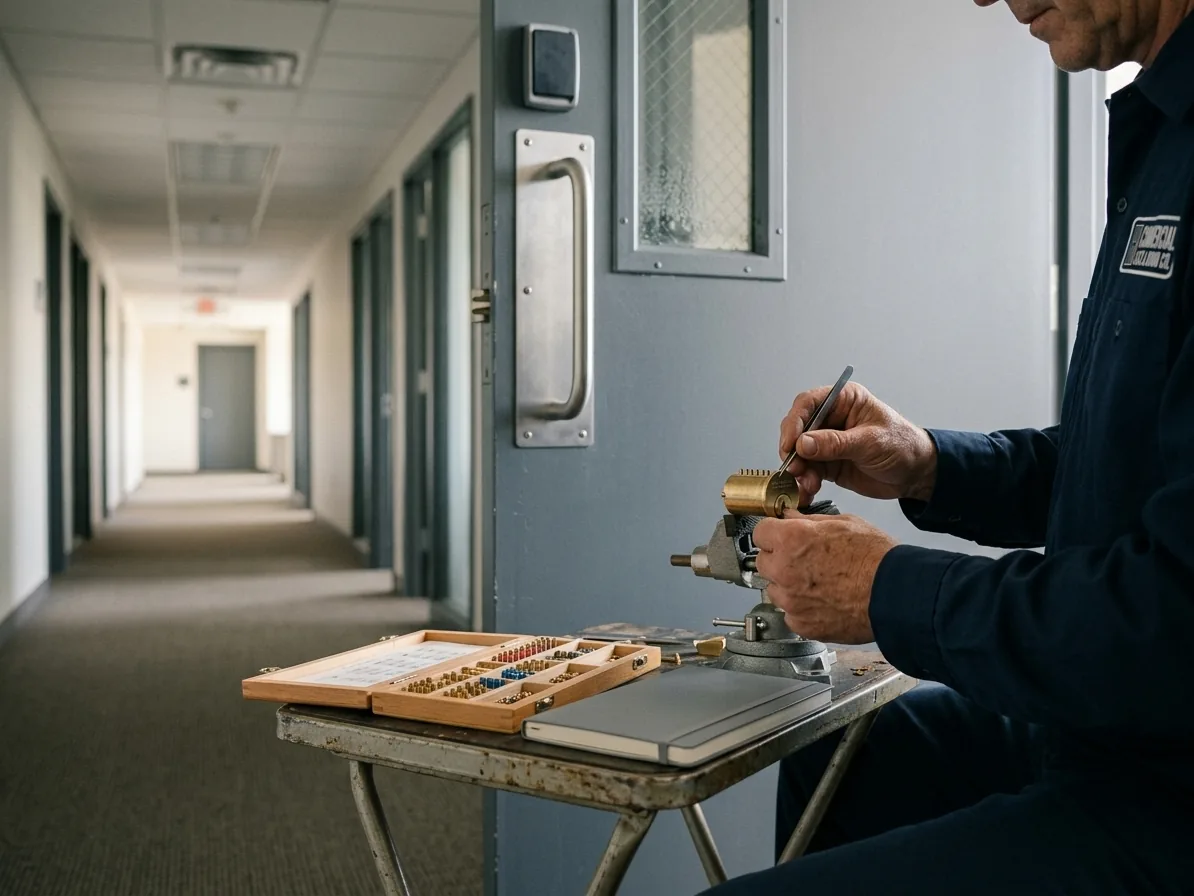
The keys you cannot account for after a termination
The termination is done and now you are doing math on keys. The exit interview covered the laptop and the badge.
Nobody can say for certain whether the brass key to the back door ever came back, or how many copies were cut off it in the years that person worked here. Until that key is dead, every opening it touched is an open question, and it is your name on the answer.
A lock change after a firing or a resignation is less about hardware than about accountability. Which doors did that key operate. Who else is carrying a copy. How do you show, in writing, that the opening is closed. Commercial Lock & Door does this work for facilities managers, property managers, office managers, and owners across San Diego County, on a schedule that fits your operation instead of announcing itself to your staff.
Some of these are one cylinder on one suite door. Some are a master key system across a portfolio. Both start the same way, with a list of what that key opens.
Rekey or Replace: What the Opening Actually Needs
A rekey changes the pin stack inside the cylinder you already own. The lock body, latch, strike, and trim all stay on the door, and the old key stops working the moment the new bottom pins go in.
For most terminations a rekey is the right call, because the hardware did nothing wrong. The key did.
A full lock change earns its keep in specific cases. The cylinder rides in a common keyway such as KW1 or SC1, with blanks sitting on a rack in every hardware store in the county. The lever has play at the spindle, or the latch no longer deadlatches against the strike, which means the door was already shimmable before anyone got walked out. Or the opening is doing Grade 1 duty on Grade 2 hardware, which shows up fast on a back door that gets shoved open with a foot forty times a shift. In those cases you are not buying a rekey, you are correcting an opening that was going to fail anyway.
Interchangeable core hardware is the fastest version of this job. Pull the core with a control key, set a new one, and the opening is finished in under a minute. If you change locks more than once or twice a year and you are not on cores yet, that is worth a conversation before the next one.
- Key-in-lever and key-in-knob cylinders on cylindrical locksets
- Threaded mortise cylinders with a cam matched to the lock function
- Rim cylinders behind rim exit devices, with the correct tailpiece length
- Mortise cylinders driving a storefront deadlatch on aluminum doors
- Small format and large format interchangeable cores
- Cam locks and padlocks on gates, cabinets, and utility rooms
Build the Key List Before Anyone Turns a Screwdriver
The expensive version of this job is the one where you rekey the front door on Tuesday and find out Thursday that the same key opened the IDF closet, the roof hatch, and the gate to the trash enclosure.
Before a cylinder comes off a door, we want to know what that key was cut to and where it sat in your system.
If you have key records, bring them. A bitting list, a code stamped on the bow, or even one original key tells us the keyway family and the depths, and from there the system can be read rather than guessed at. If the records are gone, which is common when the person who kept them is the person who left, we decode from the cylinders on site and rebuild the list as we go.
Master keying is where this gets serious. A change key operates one door and a master operates a group. If the terminated employee held a change key, we rekey their doors and pin them back into the existing master so your master still works. If they held a master, rekeying their office accomplishes nothing, because the level above it has to move. That means new pin stacks in every cylinder that master touched and new keys for every holder under it. Better to hear that before you approve a quote for four doors.
- Electrical, IDF, and telecom closets
- Roof hatches and ladder cages
- Trash enclosures, yard gates, and dock man doors
- Cash rooms, liquor rooms, and controlled storage
- File cabinets and padlocks keyed into the building system
- Mailboxes, package rooms, and alarm panel key switches
Restricted Keyways End the Copy Problem
A rekey solves today. A restricted keyway solves the next several years.
Standard keyways are open. The blank is sold to anyone, and any counter with a duplicating machine can hand a former employee a working copy in ninety seconds. Stamping a key Do Not Duplicate does not change that. It is a request, not a control.
Restricted and patented keyway families work differently. The blank itself is controlled and does not reach the retail channel, and duplication happens only against a signed authorization from the people you name. Keys get serialized, so you issue key 14 and you know whose ring it went on. When the next person leaves, the question stops being who might have made a copy and becomes which numbered keys came back.
Those cylinders cost more per opening than conventional hardware, and they pay off hardest on the doors that would ruin a week: the exterior perimeter, the cash room, the sample or pharmacy closet, the IT room. Plenty of accounts run a restricted keyway outside and a conventional keyway inside. You do not have to convert a whole building at once.
Exit Devices, Storefronts, and Electrified Trim
Not every opening has a simple cylinder to pull. A rim exit device takes a rim cylinder through the door face, and the tailpiece has to suit the door thickness.
A mortise exit device takes a mortise cylinder into the lock case. Surface vertical rod devices latch top and bottom, and the key only controls the outside trim, so a rekey there does nothing about a bottom rod that has drifted out of adjustment and stopped catching the strike. Dogging is worth checking at the same time, since a device left dogged holds the latch retracted no matter whose key you canceled.
Fire rated openings have a hard boundary. Panic hardware on a fire door cannot be dogged, and a labeled door or frame cannot be drilled, cut, or prepped in the field without voiding the label. If a termination rekey turns into new hardware on a labeled opening, the prep has to be done in a way the label survives.
On doors with electrified hardware, revoking a credential is half the work. An electric strike, an electrified lever, or a maglock opening with a request-to-exit device still almost always carries a mechanical key override. Fail-secure hardware holds the latch when power drops. Fail-safe hardware releases, which makes the mechanical cylinder matter even more on those doors. Door position switches and REX sensors do not care who was let go. The cylinder does. We handle the mechanical side either way and coordinate the credential side with whoever administers your platform.
How to Change the Locks Without Announcing the Termination
Most of these calls carry a second requirement nobody says out loud: do it quietly. Staff notice a van and a pile of removed hardware, and in a small office they can usually name the reason by lunch.
So the work gets sequenced to stay boring. Cylinders are pinned at the bench and swapped on site, so an interior door is down for a minute or two rather than an afternoon. Perimeter and high traffic openings go before opening, after close, or on a weekend. Keys come stamped and tagged so you can run a sign-out sheet that day instead of promising yourself you will build one later.
Key handoff is the part that decides whether you are back here in six months. Issue against a list, take a signature, record the serial. It takes ten minutes, and it is the whole reason this job exists.
How Quoting, Scheduling, and Accounts Work
Quoting starts with an opening count and what is in each door.
If you can tell us the number of openings, the lock types, and whether the system is master keyed, we can usually put a written number in front of you without a site visit. Mixed hardware or missing key records are faster to walk than to describe, so in those cases a short walk of the property comes first. It also keeps a change order from showing up on the day of the work.
Quotes are itemized by opening, and they say what is rekeyed, what is replaced, and how many keys you receive. We work to POs and invoice through accounts payable rather than asking for a card at the door. Buildings that require vendor onboarding paperwork or a badge to reach a tenant floor should say so when they request the quote, so nothing stalls at the loading dock.
The best version of this is the one where the second call is easy. Once your keyway, bitting records, and door schedule are on file with us, the next termination is a phone call and a date instead of a discovery process. That is how most of our property management and multi site accounts across San Diego County run it, from downtown suites to the industrial parks off the 15 and the 805.
Commercial work is quoted per job, never off a price list. These are the factors that make a quote larger or smaller:
- Number of openings, and whether each is a rekey of the existing cylinder or a full hardware replacement
- Whether the system is master keyed and what level the missing key sat at, since a master change moves every cylinder under it
- Keyway choice, because conventional cylinders run less per door than restricted or patented keyways that control the blank
- Hardware type per door, since a key-in-lever cylinder is quick while mortise locks, exit devices, and storefront deadlatches take more time
- Key count, because a dozen keys for one manager is a different job than ninety keys across three shifts
- Scheduling window, since before-open, after-close, and weekend work is quoted differently than a standard weekday visit
Where we run employee termination lock change
Mission Valley office suites, Otay Mesa dock man doors, and Poway business park tenants get the same door list and signed key handoff after a walkout.
Common in these buildings
Across HOAs, business park suites, and bars the missing key is usually a maintenance tech's building master, an office suite key, or the liquor room key.