Door and Lock Hardware for San Diego Dispensaries
Commercial Lock & Door Co. installs and repairs door hardware for dispensaries in San Diego County: limited access doors, delivery entries, secure storage rooms, and the electric strikes and closers a security plan depends on.
When the doors stop matching the security plan you filed
A dispensary is one of the few retail buildings in San Diego County where the doors are part of the license.
Your premises diagram shows where the limited access areas start. Your security plan describes how those areas stay closed. When a closer lets a limited access door drift, a strike stops holding, or a back door gets propped for the fourth time this week, that is more than a maintenance ticket. It is a gap between what you filed and what is standing in the building.
We are a commercial door contractor, a commercial locksmith, and an access control installer. We work on the openings themselves: frames, hinges, closers, latches, and exit devices. We also design and install complete access control systems. We make the doors close, latch, hold, and report.
Most of this work gets scheduled around retail hours, coordinated with your existing security vendor and your landlord, and quoted opening by opening so it can go on a PO.
What actually goes wrong in these buildings
Most dispensary calls come down to a few repeat problems, from a propped delivery door to a storage room framed and locked like an office.
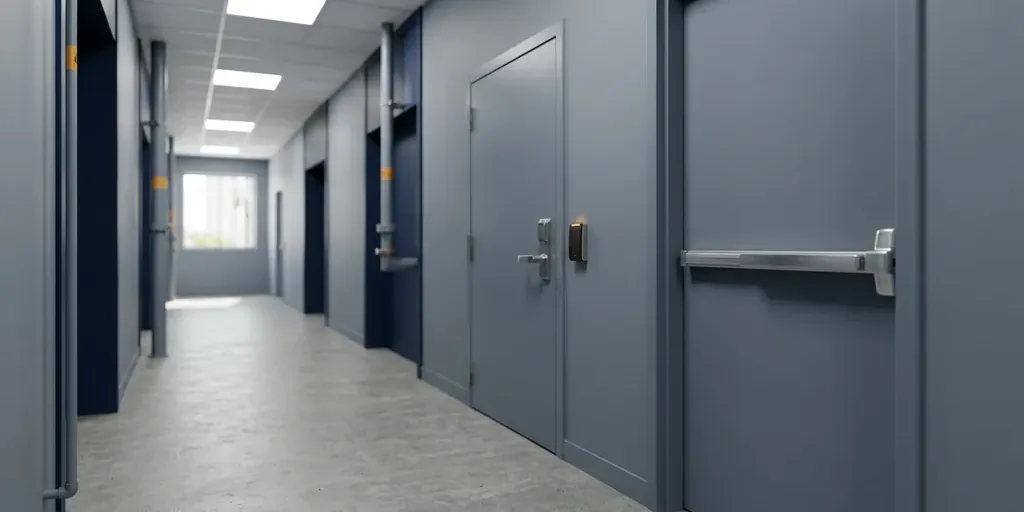
A back door that sees drivers, carts, and manifests all day should be a hollow metal door in a welded frame, hung outswing on non-removable-pin hinges or a continuous geared hinge. We put a rim exit device on it for free egress, no exterior trim or lever to attack, a latch guard over the strike, and a door position switch so your monitoring sees it standing open. A video intercom at that door, which we supply, install, and wire ourselves, ends the habit of propping it for the next knock.
Two fixes, and both are hardware. First, closer selection and adjustment: correct spring size for the door width and the pressure in the room, backcheck set so the door does not slam into a rack, latch speed set so the door actually pulls the latch home. Second, take away the ability to hold it open. Hold-open arms come off limited access openings, mechanical dogging gets locked out or converted to cylinder dogging on a restricted key, and door position switches report the ones that still get chocked.
A closet lockset in a knock-down frame on a stud wall does not match what a security plan describes. We build that opening up: hollow metal door and frame, frame anchored and grouted to the structure, continuous hinge, Grade 1 mortise lock, and where the layout calls for it a separate Grade 1 deadbolt with a full one inch throw into a reinforced strike. Astragal and flush bolts on pairs. Door position switch on the secure side. Keyed into its own group so nothing else in the building opens it.
Aluminum storefront was never built for a buzz-in door that cycles all day. The failures are predictable: the deadlatch stops deadlatching against a worn strike, the electric strike loses alignment as the door drops, the top pivot or closer arm walks out, and the leaf starts dragging the threshold. We reset the door in the frame, replace the deadlatch and strike as a matched pair, size the electric strike to the narrow stile, and set the closer so the door still latches against a lobby that is running negative.
Retail turnover and a paper key log do not mix. We set the site up on small format interchangeable cores, so a departure is a core swap at the openings in that person's zone rather than a rekey of the whole building. The keyway is restricted, so copies do not get cut at a hardware store, and the bitting records stay documented. Master keying is built by zone: sales floor, back of house, storage, and vault stay in separate groups, so one lost key never reaches the product.
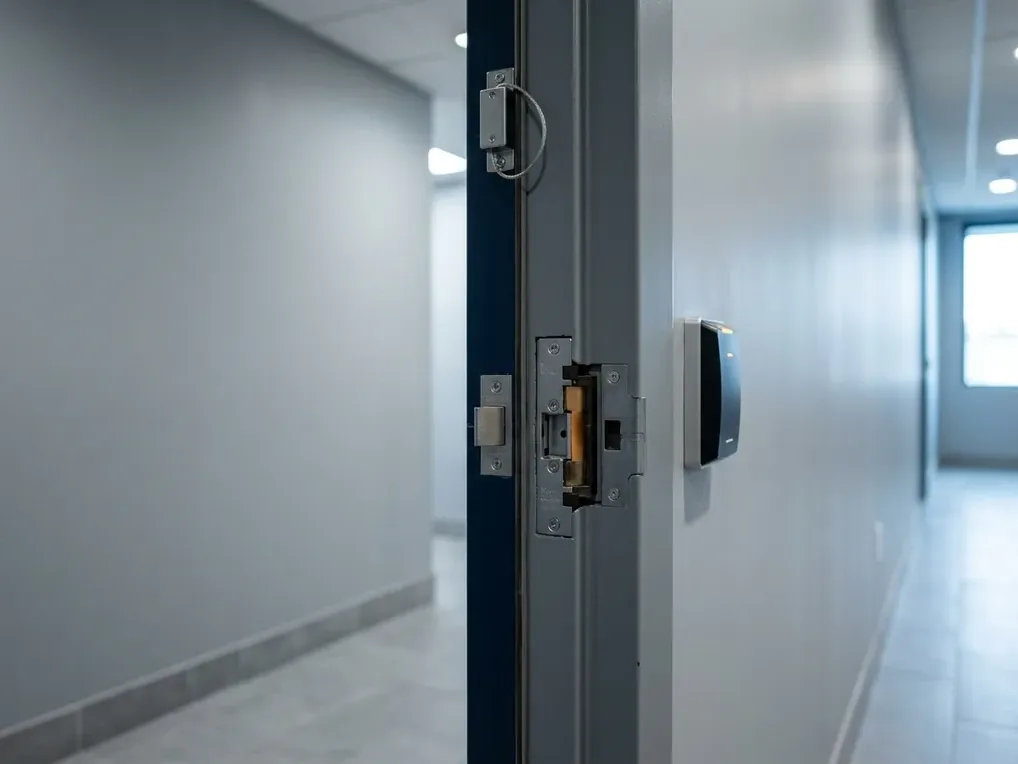
That gap is our lane. It usually comes down to fail-safe versus fail-secure chosen wrong for the opening, a request-to-exit device that never got wired, a strike that does not match the latch it is catching, or power crossing the hinge edge with no transfer hinge or door loop. We install electric strikes, electrified levers, electrified latch retraction on exit devices, power transfers, and position switches. If an integrator already owns the platform, we hand the head end and credentials back to them. If nobody does, we install and service the controllers and credentials too, so one contractor owns the whole opening.
Walk the building opening by opening
A dispensary is not one security problem. It is six or seven different openings, each with a different job, and treating them the same is how a plan gets written that the building cannot keep.
We walk the site with you and write a hardware schedule per opening.
One thing that catches operators off guard is air. Odor control usually means the building runs negative, and negative pressure fights every door in the path. Doors get heavy on the pull side and stop pulling the latch home on the push side, which reads as a broken lock when it is really a closer and gasketing problem. We size the closer to the pressure in the actual room and add sweeps and gasketing where odor containment needs them, without pushing opening force out of range on the accessible route.
- Sidewalk entry and vestibule: public accommodation, so operable hardware, opening force in range, and a closer that still latches.
- Vestibule to sales floor: the buzz-in point, usually an electric strike or electrified lever, always with free egress back out.
- Sales floor to back of house: limited access starts here. Self-closing, positive latching, position switch.
- Back of house to secure storage or vault: the heaviest opening in the building, on its own key group.
- Delivery staging door: outswing hollow metal, rim exit device, latch guard, no exterior trim.
- Rear and side emergency exits: free egress, alarmed if you want it, no chains and no added deadbolts.
Hardware your security plan can stand behind
The premises diagram and security plan you filed describe doors. Over a few years of repairs, tenant work, and vendor visits, a building drifts from the paper.
A limited access door picks up a hold-open arm so a contractor can move equipment. A strike gets replaced with whatever was on somebody's truck. A labeled door gets drilled for a wire run.
We document what is actually installed on each opening and what we changed, so the doors match the file when your compliance officer or an inspector walks the building. If something on site conflicts with what the plan describes, you hear it from us before we install, not after.
Full access control, or just the hardware under your vendor's platform
Most cannabis retail in San Diego County already has a security provider under contract, with cameras tied to license conditions. Cameras and alarm monitoring stay with that vendor; we do not work on that side.
Access control is different. We design, install, and service complete access control systems: card, fob, and mobile-credential readers, keypads, door controllers including cloud-managed platforms, and the credential setup behind them.
If your credentials already live on an integrator's platform and reopening that contract is the last thing you want to do, we work under it instead. We handle the mechanical side those systems sit on: the strike pocket, the latch, the closer, the hinge, the raceway, the power transfer, the door position switch. When a reader will not release a door, or a maglock is holding an opening that has to swing free, we sort out the hardware and hand back a clean, working door.
Scheduling, quoting, and standing accounts
Retail hours make this simple. Most dispensary work happens before doors open or after close, and vault and limited access work usually needs someone from your team present anyway.
Tell us your access rules and we schedule around them. Every job is quoted per opening, so the vestibule door prices out separately from the vault door and either one can go on a PO. If your landlord or your corporate office requires vendor onboarding paperwork before anyone works on site, send it with the quote request and we handle it up front.
Operators running more than one location usually end up on a standing account: one keyway across the group, one set of records, one number to call when a door starts dragging in Chula Vista or a closer gives out in Kearny Mesa.
- Egress comes first on every limited access door. Anyone inside has to get out in a single motion without a key, a code, or special knowledge, no matter how tightly the door is secured on the entry side.
- Magnetic locks and delayed egress arrangements carry their own release requirements and generally need sign-off from the authority having jurisdiction before they go in. Chains, padlocks, and added deadbolts on an exit door are never the answer.
- A fire door label covers the assembly, not just the leaf. Field drilling, cutting, or welding outside the listing voids it. Labeled openings need listed preparations, fire rated electric hardware where electrification is required, and self-closing, positive-latching operation. Fire exit hardware cannot be mechanically dogged.
- A dispensary sales floor is a public accommodation. Hardware has to be operable without tight grasping, pinching, or twisting of the wrist, opening force and closer timing stay within accessible limits, and doors in series in a vestibule need enough clear space between them.
General principles only. Your authority having jurisdiction has the final say on any specific opening.
What we are usually called out for
Dispensary work leans on electric strikes at the buzz-in door, hollow metal at the vault and delivery entries, and restricted keying that survives budtender turnover.
Access Control Systems
The whole system, credential to latch
DetailsElectric Strikes
Fail-safe or fail-secure, matched to frame and latch
DetailsHigh Security Locks
Key control for San Diego commercial buildings
DetailsMaster Key Systems
Commercial keying design for San Diego buildings
DetailsHollow Metal Doors & Frames
Steel doors and frames, sized to the wall and the abuse
DetailsVideo Intercoms & Entry Systems
See the visitor, then decide if the door opens
Details