Commercial Lock Change in San Diego County
A commercial lock change replaces worn locksets or swaps cylinders so old keys stop working, decided one opening at a time. Commercial Lock & Door Co. changes locks on offices, storefronts, and warehouses across San Diego County, keyed to the system a building already runs.
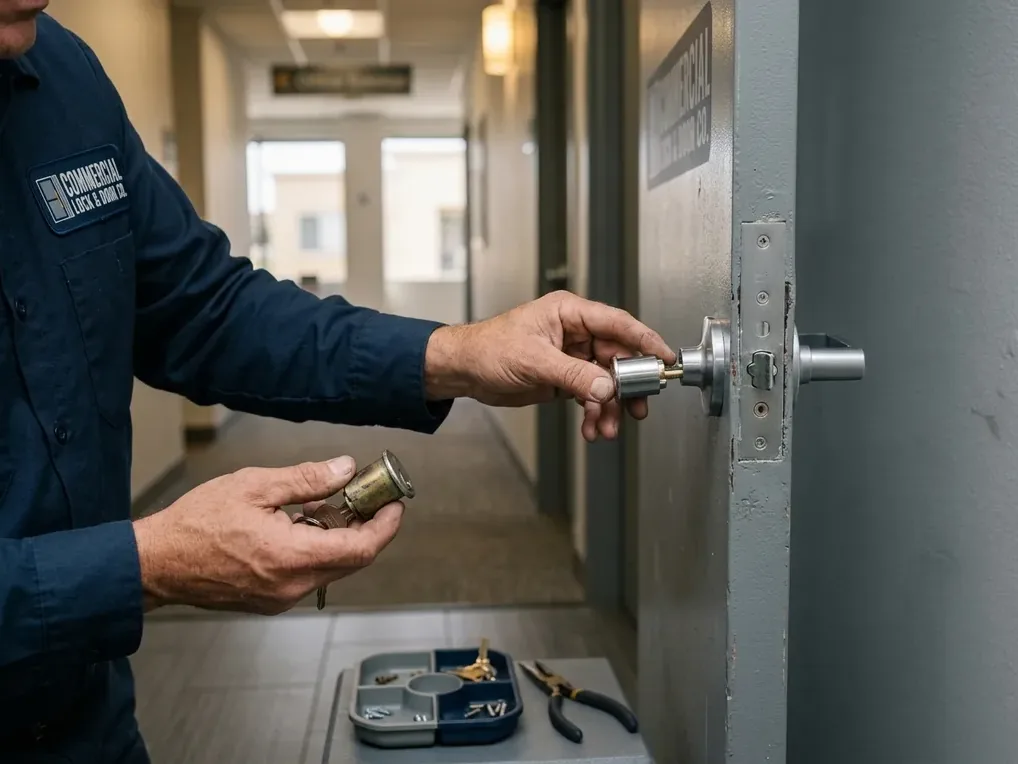
When the keys no longer match the people who hold them
Something changed, and the keys no longer match the people who should have them.
A manager left and the building key never came back. A suite turned over between tenants. A vendor was handed a mechanical room key years ago and nobody can say where it went. Or the hardware itself is worn out, and the same three openings keep showing up on the work order list every month.
A commercial lock change is really a set of decisions made one opening at a time. Some doors need nothing more than a new cylinder pinned to a new key. Some need the whole lockset replaced because the chassis is worn, the function is wrong, or the latch no longer deadlatches. Some are aluminum storefront doors that will not accept a standard lockset at all. Getting the right answer per door is what keeps the total proportionate.
Commercial Lock & Door works across San Diego County on exactly this kind of job: offices in Kearny Mesa and Sorrento Valley, retail and restaurant frontage downtown, warehouses off the 15 and out toward Otay Mesa. We quote per opening, schedule around your hours, and keep the keying records so the next change is a phone call instead of another survey.
Cylinder Swap or Full Lockset Replacement
A cylinder swap keeps the lock body and changes only the part the key touches.
On a cylindrical lever that part is the key-in-lever cylinder. On a mortise lock it is the threaded cylinder behind the cam. On a rim exit device it is the rim cylinder and its tailpiece. On aluminum storefront it is usually a mortise cylinder driving a hookbolt or a deadlatch cam. When the hardware is sound and the function is right, this is the fastest and least invasive way to take old keys out of service.
Grade matters more than most catalogs suggest. ANSI/BHMA Grade 1 cylindrical and mortise locks are built for cycle counts that Grade 2 will not survive on a main entry, a break room, or a restroom in a busy building. Grade 2 is reasonable on private offices and low-traffic interior doors. Mixing the two deliberately, door by door, is how a building-wide lock change stays sane.
Replacement is the answer when the lock itself is the problem. What we typically find on a walkthrough:
- The latch no longer deadlatches: the plunger is worn short or drops into the strike cutout, so the anti-shim feature is doing nothing
- The function is wrong for how the door is actually used, such as an office or passage function where a storeroom function belongs
- A residential grade lockset is on a door that cycles hundreds of times a day
- A knob needs to become a lever for accessible operation
- The mortise body is spent: play in the hub, a dragging deadbolt, or a spring cage that no longer returns the lever
- The strike has been filed and shimmed so many times that nothing lines up anymore
Keying to a System You Already Have
Most buildings already have a keyway family in place: Schlage C, Sargent LA, Corbin Russwin, Yale, or a Best style small format interchangeable core.
If the property runs SFIC, changing keys at a door is a control key turn and a new core, which is why portfolios with frequent turnover are worth converting. Conventional cylinders come out, get repinned or replaced, and go back in.
Master keying is where lock changes quietly go wrong. Every master wafer added to a pin stack creates another shear line, which means another key that will turn that lock whether you intended it to or not. A chart built one emergency at a time, with cross-keying stacked on cross-keying, ends up with change keys opening doors nobody assigned them. When the bitting chart is lost, we decode the keys and cylinders that are actually in the building and rebuild the chart from reality, or start a clean system and phase the old one out floor by floor.
If key control is the real goal, a restricted or patented keyway is the tool. Blanks are not sold over the counter, duplication is tied to an authorization list you control, and the cylinders carry pick and drill resistance that standard cylinders do not. Those cylinders are ordered rather than stocked in every profile, so lead time belongs in the schedule from the start.
What the Walkthrough Actually Measures
One finding comes up constantly: frame and hinge condition. If the door is sagging at the latch edge, a new lock is not the fix.
Long screws into the frame stud, a hinge shim, or a strike relocation has to happen first, or the callback is already on the calendar.
Nothing gets quoted accurately from a door count. What decides the hardware is prep, and prep is physical:
- Handing and bevel, so locksets and any electrified trim arrive correct the first time
- Door thickness, usually 1-3/4 inch in commercial construction, and backset, usually 2-3/4 inch
- Cross bore and edge bore, and whether the existing prep is standard 161
- Strike prep: ASA 1-1/4 by 4-7/8 in hollow metal, versus a T-strike or a wood frame that has been chewed out
- Stile width on aluminum storefront, which decides between a narrow stile deadlatch, a hookbolt deadlock, or leaving the existing prep alone
- Existing electrification: electric strike, electrified lever, REX device, door position switch, and how the opening is supposed to behave when power drops
- Frame and hinge condition, since a dropping door will destroy new hardware the same way it destroyed the old
Fire Rated and Egress Openings
Labeled fire doors are not blank canvases. The label on the hinge edge of the door and on the frame rabbet is what makes the assembly legal, and field modification outside the listing voids it.
Cutting a new cross bore for a different lockset, adding a deadbolt above the existing lock, or through-bolting where the listing does not allow it turns a rated opening into an unrated one. That shows up at inspection, not on the invoice.
Egress rules bind many of the same doors. A required egress door opens with one motion, no key, no tight grasping, no separate thumbturn to remember. Fire exit hardware cannot be dogged down. So when a rated opening needs a keying change, the honest path is a cylinder that fits the listed hardware already there, or listed replacement hardware that matches the existing prep. Not a hole saw.
Scheduling Around an Occupied Building
Most of these changes happen outside business hours, and the reason is practical rather than dramatic. A suite door being off its hardware for twenty minutes is fine at 7 pm and is a problem at 11 am.
Larger properties get phased: a floor a night, a building over a weekend, or common areas first with tenant suites on notice.
The coordination is usually more delicate than the mechanical work. Tenants need notice before their keys stop working. Cleaning crews and alarm response contacts need new keys before the old ones die, not after. Someone has to hold the key log and sign for what goes out. If your building requires a vendor packet, a certificate on file, badging, an escort, a freight elevator reservation, or a loading dock window, send those requirements with the request so paperwork is not what moves the date.
The change can also be staged. New cylinders go in keyed to the new system while the old keys stay live, then the property flips at one agreed moment. On multi-tenant buildings that avoids a week of confused people standing at doors.
Quoting, POs, and Standing Accounts
Commercial hardware is quoted per job because no two sets of openings match. A quote from us lists the doors, the hardware and function specified for each, the keying scheme, the finish, and the labor and access window it assumes.
If a frame needs work before new hardware will latch, that is a line on the quote rather than something discovered halfway through a Saturday night. For a building we have not surveyed, photos of the doors and the existing hardware are enough to start the quote.
Most of the properties we work with run on purchase orders and net terms. We keep door schedules and keying records by property, so the next request is short: a suite turns over, you send the suite number, and the cylinders are already specified. That is the working relationship this trade is built on, and it starts with a walkthrough and a written quote.
Commercial work is quoted per job, never off a price list. These are the factors that make a quote larger or smaller:
- Opening count, and how many doors need full hardware versus only a new cylinder
- Lock type per door: cylindrical, mortise, storefront hookbolt or deadlatch, rim cylinder in an exit device
- Grade and function specified, since Grade 1 storeroom hardware carries more cost and far more service life than a Grade 2 office lockset
- Whether the keyway is standard or restricted, and the lead time on non-stock cylinders, blanks, and finishes
- Master key system depth: number of levels, amount of cross-keying, and whether a usable bitting chart still exists
- Access conditions: after hours or weekend work, occupied tenant spaces, badging and escort requirements, and frames or hinges that need repair before new hardware will latch
Where we run commercial lock change
Kearny Mesa suite doors, Miramar and Otay Mesa warehouse man doors, and Mission Valley and Chula Vista storefront entries get the same cylinder-or-lockset call, door by door.
Common in these buildings
Turnover between tenants, a departed manager's unreturned building key, and a worn storefront deadlatch are the usual reasons a lock change gets called in.