Door Hardware and Locksmith Work for San Diego Schools and Universities
Commercial Lock & Door Co. provides door hardware and locksmith work for schools and universities in San Diego County: classroom security locks, campus master key systems, exit devices, and fire door repairs scheduled around the academic calendar.
A campus is a long run of door openings
A campus is not one building. It is a long run of openings, each with its own function, its own hardware age, and its own group of people who need to get through it.
The classroom lock, the cross-corridor pair, the gym exit device, and the front office vestibule all fail in different ways, and they all land in the same work order queue.
We work as a commercial door contractor and locksmith for schools and universities in San Diego County. That means classroom function locks and lockdown capability, master key hierarchies that stay readable as buildings get added, exit devices built for the traffic a passing period actually produces, and corridor fire doors that still close and latch the way their labels say they should.
Heavy scope belongs on a calendar rather than in an emergency call. Summer, winter break, and the weeks between terms are when it fits. We quote in writing, schedule against your academic calendar, and get the vendor paperwork your purchasing office needs on file before a truck rolls.
What actually goes wrong in these buildings
Most campus calls begin with a classroom lock keyed only from the hallway, a master chart nobody trusts, or a gym exit device worn out by spring.
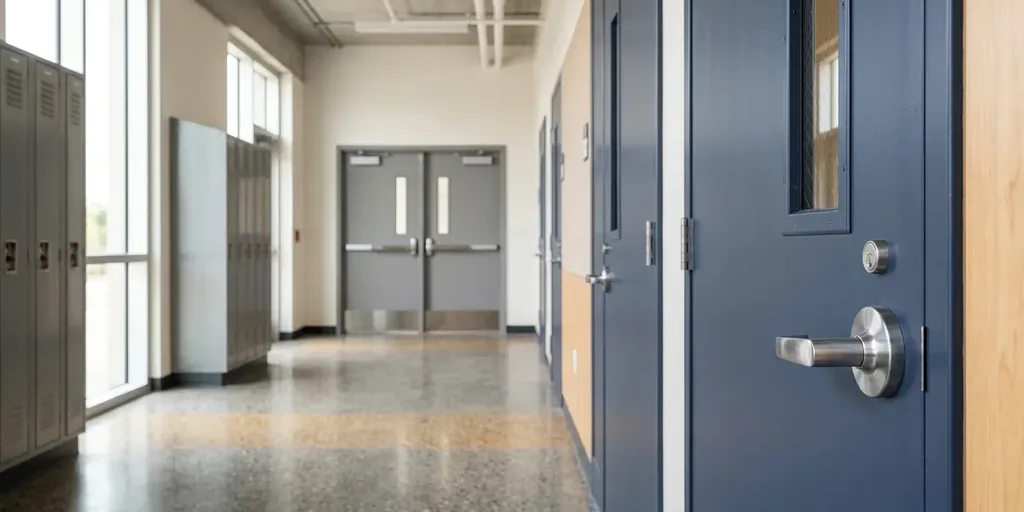
A standard classroom function lock is keyed on the corridor side only, so locking it means opening the door and stepping into the hallway at the worst possible moment. This is a hardware problem, not a training problem. Classroom security function solves it: a second cylinder on the inside face locks the outside lever while the teacher stays in the room, and the inside lever still retracts the latch every time for free egress. The function exists in Grade 1 cylindrical lines and in mortise bodies, so on many campuses it is a chassis or lock body swap that keeps the existing trim, door prep, and keyway. Barricade bars, floor wedges, and strap devices are the other thing schools reach for, and they fail on egress every time.
Campuses accumulate systems. A building goes up, it gets keyed to whatever the hardware supplier had in stock, then it gets cross-keyed into the old system so one custodian's ring still works. The result is unintended cross-opens, phantom keys that were never cut but will still turn a cylinder, and no room left in the bitting to expand. We chart what actually exists first, cylinder by cylinder, then rebuild the master key system on a proper bitting array with levels that match how the campus is run: grand master, building master, department sub-master, change key. Maximum adjacent cut specification and progression are respected so keys are cuttable and cylinders stay reliable, and expansion is designed in so the next building does not force a redesign.
How bad it gets depends on how the system was built. A well designed hierarchy contains the damage, so a lost department sub-master means rekeying that department's cylinders, not the whole campus. Small format interchangeable core hardware turns the response into a core swap at the door with a control key, done by your own maintenance staff, instead of a locksmith disassembling every lock. We can stage pre-pinned cores by building, hold the pinning records, and rotate a set at term boundaries so a key handed back late is a key that no longer works. A restricted keyway with controlled duplication handles the quieter half of the problem, which is keys multiplying at retail key machines between one term and the next.
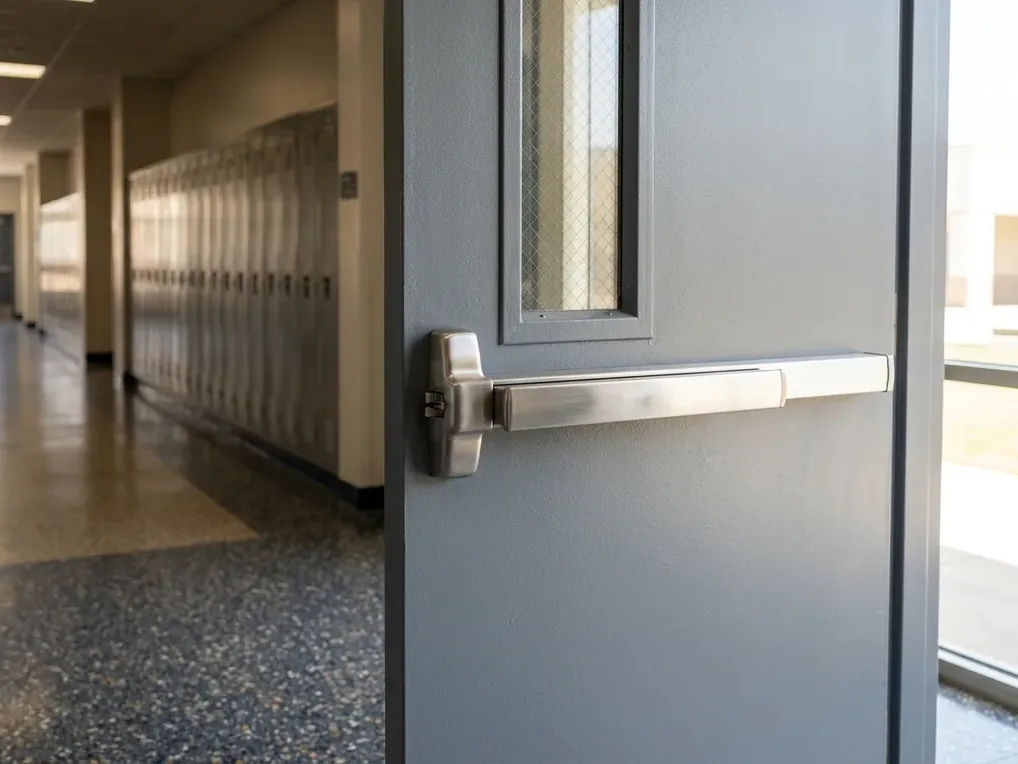
Those openings take the hardest use on campus, and the wear shows up in a predictable order. Surface vertical rod bottom latches take the abuse first, from feet, carts, and mop water. Rods drift out of adjustment, the top latch stops catching, and the door no longer secures, so somebody props it or runs a chain through the panic bars. We install Grade 1 exit devices and, where the opening allows, get rid of the bottom rod entirely with a less bottom rod kit or convert a pair to rim devices on a removable keyed mullion. Cylinder dogging replaces the hex key that lives in a drawer. On a fire rated opening there is no dogging at all, so if a rated pair has to stay unlatched during the day the compliant path is a listed electric latch retraction device that drops out on alarm.
Rated openings are listed as complete assemblies, which means the label depends on the closer, the coordinator, the hardware, the gaps, and the latching as much as on the leaf itself. Wedges under a pair that is supposed to be self-closing. A coordinator that was removed so the leaves close out of order and the inactive leaf never latches. A closer backed off until the door barely moves. A hole drilled in the field for a new cylinder or a viewer, which is outside the listing and voids the label. We walk the corridors, set closers and coordinators so both leaves close and latch in sequence, replace props with listed hold-opens released by the fire alarm, and check gaps, clearances, and positive latching. When a change would take a door outside its listing, we order the prep done to listing or replace the leaf rather than modify it on site.
Aluminum storefront on a main entrance is a system of parts that all drift. The deadlatch wears, the plunger stops riding the strike face and drops into the pocket, the door sags on its pivots or bottom rail, and the electric strike keeper falls out of alignment so it buzzes and never releases under door pressure from the wind. We adjust the opening first, then replace the deadlatch and set the strike to the correct handing. On an exterior door the strike is fail-secure, because fail-safe means a power outage unlocks the school. We also verify the request-to-exit device and door position switch so the buzz-in system is reporting a real door state instead of a guess. We design and install access control systems and video intercoms ourselves, so if the vestibule needs more than a strike repair we can quote the whole opening, and if your campus already runs on an integrator's platform we are just as glad to install and service the door hardware side under it.
Campus key systems that stay readable
A key system is a document as much as it is hardware. If the chart is wrong, every future decision built on it is wrong too, and that is how a campus ends up rekeying a whole building over one lost ring.
We chart first, design the hierarchy around departments and buildings rather than around access decisions that were made one door at a time, and hand the records back to you.
- Existing cylinders charted and documented before anything is rekeyed
- Grand master, building master, department sub-master, and change key levels set to how the campus is actually run
- Bitting array built with expansion left for the next building or wing
- Small format interchangeable cores so staff can swap a core with a control key
- Restricted keyways where duplication needs to be controlled
- Pinning records and a key issue log that stay with the campus
Hardware that survives a school year
Durability is the spec that matters on a campus.
ANSI/BHMA grading is a cycle test result, and the difference between Grade 2 and Grade 1 shows up on the openings that get used hardest: the gym, the cafeteria, the quad doors, the main corridor pairs. Grade 2 hardware can be reasonable on a low use interior office door and is a false economy on a passing period opening. We spec Grade 1 on the high traffic doors, template closers properly instead of reusing whatever holes are already in the frame, and set backcheck so a door caught by a Santa Ana wind does not tear its own top hinge out.
- Grade 1 cylindrical and mortise locksets on classroom, office, and corridor openings
- Rim and vertical rod exit devices, less bottom rod conversions, and removable mullions on pairs
- Closer templating, spring size, backcheck, and sweep timing set at the door
- Latch protectors, reinforced strikes, and hinge repair on doors that have been kicked
- Hollow metal and aluminum storefront repair, including deadlatch, pivot, and threshold work
Term boundaries, turnover, and key returns
Access changes on a schedule that no other building type has. Substitutes, coaches, student workers, resident assistants, summer program staff, and contractors all cycle through, and the keys do not always cycle back.
The practical answer is a system designed for rotation rather than a scramble every June: keys issued against a log, and a defined response when one goes missing, so the decision is already made before the call comes in.
How the work gets scheduled and billed
We work around bells, testing windows, and the academic calendar. Noisy scope goes to breaks, weekends, and after hours.
Routine service happens during the day when the opening allows it. We cover the county, from coastal campuses near the 5 to the inland districts out along the 8 and the 78, and we set clients up as accounts so the second call does not start from zero.
- Written quote with an opening by opening scope
- Work windows over summer, winter break, and weekends
- Purchase orders and vendor onboarding paperwork handled up front
- Account billing so repeat service calls do not need a new quote each time
- Check-in, badging, and escort rules followed the way your campus requires
- Egress governs everything else. From the inside, a door in the path of egress should open with one motion and without a key, tool, or special knowledge. Any lockdown method that has to be installed, removed, or released as a separate action fails that principle no matter how well it holds a door.
- Fire doors are listed as assemblies, and rated openings must be self-closing and positive latching. Field work outside the manufacturer's listing, such as drilling for a cylinder or viewer or cutting the bottom of a leaf, voids the label. Hold-open should be a listed device released by the fire alarm, never a wedge or a kickdown stop.
- Fire exit hardware does not dog. If a rated pair needs to stay unlatched during the day, the compliant route is a listed electric latch retraction device that releases and relatches on alarm.
- Operable hardware should work without tight grasping, pinching, or wrist twisting, which is why levers and push or pull hardware replace knobs on accessible routes. Closers need to be adjusted so the door is not too heavy to open and closes slowly enough for someone using a mobility device to clear the opening.
General principles only. Your authority having jurisdiction has the final say on any specific opening.
What we are usually called out for
Campus master keying, vestibule buzz-in and access control, gym and quad exit devices, and corridor fire door hardware make up most of our school work.
Master Key Systems
Commercial keying design for San Diego buildings
DetailsAccess Control Systems
The whole system, credential to latch
DetailsPanic Bars and Exit Devices
Commercial exit hardware, San Diego County
DetailsFire Rated Door Hardware
Labeled openings, serviced without voiding the label
DetailsVideo Intercoms & Entry Systems
See the visitor, then decide if the door opens
DetailsCommercial Rekey
Repin the cylinders you already own
Details